Passage Study
Seth’s Line: Calling on the Lord’s Name
Genesis 4:25–5:32
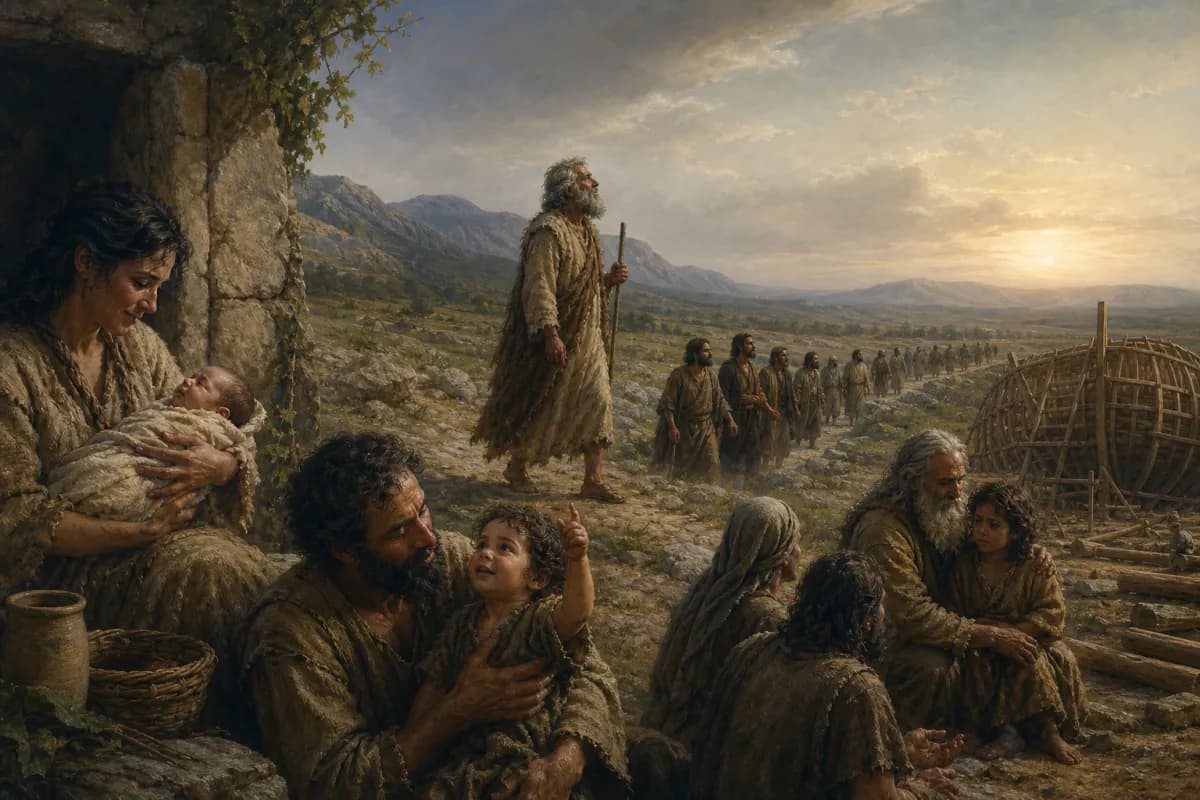
Genesis 4:25–5:32 traces the line from Seth to Noah after the violence of Cain’s family. The repeated deaths make the curse of Genesis 3 impossible to ignore, while the birth of Enosh marks the beginning of calling on the Lord’s name. God preserves a worshiping line through whom His promise moves forward toward Christ.
- In this study
- 34 verses · 5 movements
Genesis 4
4:25Adam knew his wife again. She gave birth to a son, and named him Seth, saying, “for God has given me another child instead of Abel, for Cain killed him.”
4:26A son was also born to Seth, and he named him Enosh. At that time men began to call on the LORD’s name.
Genesis 5
5:1This is the book of the generations of Adam. In the day that God created man, he made him in God’s likeness.
5:2He created them male and female, and blessed them. On the day they were created, he named them Adam.
5:3Adam lived one hundred thirty years, and became the father of a son in his own likeness, after his image, and named him Seth.
5:4The days of Adam after he became the father of Seth were eight hundred years, and he became the father of other sons and daughters.
5:5All the days that Adam lived were nine hundred thirty years, then he died.
5:6Seth lived one hundred five years, then became the father of Enosh.
5:7Seth lived after he became the father of Enosh eight hundred seven years, and became the father of other sons and daughters.
5:8All of the days of Seth were nine hundred twelve years, then he died.
5:9Enosh lived ninety years, and became the father of Kenan.
5:10Enosh lived after he became the father of Kenan eight hundred fifteen years, and became the father of other sons and daughters.
5:11All of the days of Enosh were nine hundred five years, then he died.
5:12Kenan lived seventy years, then became the father of Mahalalel.
5:13Kenan lived after he became the father of Mahalalel eight hundred forty years, and became the father of other sons and daughters
5:14and all of the days of Kenan were nine hundred ten years, then he died.
5:15Mahalalel lived sixty-five years, then became the father of Jared.
5:16Mahalalel lived after he became the father of Jared eight hundred thirty years, and became the father of other sons and daughters.
5:17All of the days of Mahalalel were eight hundred ninety-five years, then he died.
5:18Jared lived one hundred sixty-two years, then became the father of Enoch.
5:19Jared lived after he became the father of Enoch eight hundred years, and became the father of other sons and daughters.
5:20All of the days of Jared were nine hundred sixty-two years, then he died.
5:21Enoch lived sixty-five years, then became the father of Methuselah.
5:22After Methuselah’s birth, Enoch walked with God for three hundred years, and became the father of more sons and daughters.
5:23All the days of Enoch were three hundred sixty-five years.
5:24Enoch walked with God, and he was not found, for God took him.
5:25Methuselah lived one hundred eighty-seven years, then became the father of Lamech.
5:26Methuselah lived after he became the father of Lamech seven hundred eighty-two years, and became the father of other sons and daughters.
5:27All the days of Methuselah were nine hundred sixty-nine years, then he died.
5:28Lamech lived one hundred eighty-two years, then became the father of a son.
5:29He named him Noah, saying, “This one will comfort us in our work and in the toil of our hands, caused by the ground which the LORD has cursed.”
5:30Lamech lived after he became the father of Noah five hundred ninety-five years, and became the father of other sons and daughters.
5:31All the days of Lamech were seven hundred seventy-seven years, then he died.
5:32Noah was five hundred years old, then Noah became the father of Shem, Ham, and Japheth.
CONTEXTUAL OVERVIEW
Seth’s birth comes after Abel’s murder and Cain’s exile. Eve speaks of a “seed” or offspring appointed in Abel’s place, showing that God’s purpose has not been extinguished by Cain’s violence.
The genealogy is not empty filler. It deliberately repeats the fact that each patriarch dies, so the reader feels the reach of God’s warning in Eden even while life and families continue.
HISTORICAL AND LITERARY CONTEXT
Genesis uses genealogies to locate God’s promise in actual generations. This line carries the story from Adam toward Noah, where the earth’s corruption and God’s preserving mercy will again come to the foreground.
The statement that people began to call on the Lord’s name distinguishes a public posture of worship from the self-naming and violence associated with Cain’s line. The text does not claim that every descendant was faithful; it marks the preservation of worship amid a fallen world.
SECTION-BY-SECTION ANALYSIS
- Seth · Genesis 4:25Seth’s birth witnesses that God can preserve His purpose after sin has brought irreparable loss.
- Enosh · Genesis 4:26Calling on the Lord’s name marks worshipful dependence in a world tempted toward self-rule.
- Death · Genesis 5:1The repeated refrain records the enduring consequence of sin and prepares the Bible’s hope for resurrection.
CHRIST IN THIS PASSAGE
The genealogy establishes a strong canonical pattern rather than a direct prophecy. Luke includes Jesus in Adam’s family line, showing that the Savior truly enters the human history marked by sin and death. He comes not as an escape from humanity but as its faithful Redeemer.
First Corinthians calls Christ the last Adam. Where Genesis records generation after generation ending in death, Jesus rises as the beginning of a new humanity. His mission answers the genealogy’s unanswered ache: death does not have the final word for those united to Him.
REFLECTION
The repeated deaths teach sober realism without hopelessness. Families, work, and long lives are gifts, but none can remove the curse or secure the future. Calling on the Lord’s name is the right response of people who know that life must be received from God.
Jesus gives this genealogy’s hope a face. He meets families who grieve, people who fear death, and communities weary from generations of brokenness. His resurrection sends the church to proclaim a hope durable enough to outlast every grave.
Original Hebrew Word Study
Genesis 4:26
קָרָא
qara · H7121
Usually translated: to call or proclaim
Qara means to call. In Seth’s line people begin to call on the Lord’s name, marking a renewed public dependence on God in contrast to the self-exalting violence around them.
Follow the Scripture trail
Seth’s Line: Calling on the Lord’s Name in the larger story
The connection: Seth’s line carries worship and promise through a world ruled by death. Jesus fulfills that hope as the last Adam, whose resurrection begins the new humanity and whose mission brings people from every generation into life with God.
Respond to the passage
Let the genealogy teach you to number your days without surrendering to despair. Call on the Lord’s name in the ordinary work and losses of life, trusting Jesus Christ, whose resurrection gives a future no grave can cancel.
- Why does Genesis repeat “and he died” throughout this genealogy?
- What does the beginning of calling on the Lord’s name reveal about faithful life in a fallen world?
- How does Christ as the last Adam answer the genealogy’s pattern of death?
Prayer
God of every generation, teach me to receive life as Your gift and to call on Your name in faith. Thank You for Jesus, the risen last Adam. Give me hope stronger than death and make my life a witness to His coming new creation. Amen.