Passage Study
The Two Dreams: God Speaks in an Unresolved Prison
Genesis 40:1–40:23
Genesis 40:1–23 places Joseph in prison with Pharaoh’s cupbearer and baker. He refuses to claim their dreams as a private power, saying that interpretations belong to God. The dreams are fulfilled exactly, yet the cupbearer forgets Joseph. The passage teaches patient dependence on God’s wisdom and points to Jesus, whose saving mission is not delayed by human forgetfulness and who gives hope beyond a world of uncertain outcomes.
- In this study
- 23 verses · 5 movements
Genesis 40
40:1After these things, the butler of the king of Egypt and his baker offended their lord, the king of Egypt.
40:2Pharaoh was angry with his two officers, the chief cup bearer and the chief baker.
40:3He put them in custody in the house of the captain of the guard, into the prison, the place where Joseph was bound.
40:4The captain of the guard assigned them to Joseph, and he took care of them. They stayed in prison many days.
40:5They both dreamed a dream, each man his dream, in one night, each man according to the interpretation of his dream, the cup bearer and the baker of the king of Egypt, who were bound in the prison.
40:6Joseph came in to them in the morning, and saw them, and saw that they were sad.
40:7He asked Pharaoh’s officers who were with him in custody in his master’s house, saying, “Why do you look so sad today?”
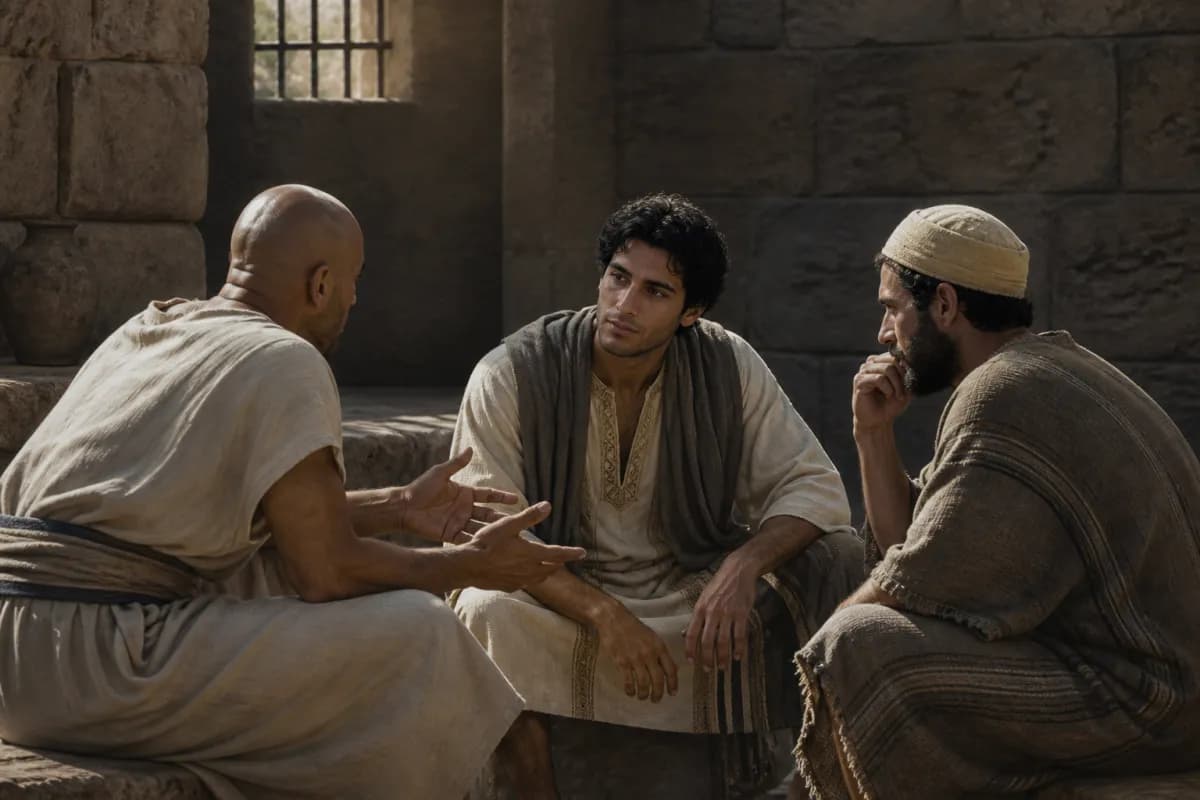
40:8They said to him, “We have dreamed a dream, and there is no one who can interpret it.” Joseph said to them, “Don’t interpretations belong to God? Please tell it to me.”
40:9The chief cup bearer told his dream to Joseph, and said to him, “In my dream, behold, a vine was in front of me,
40:10and in the vine were three branches. It was as though it budded, it blossomed, and its clusters produced ripe grapes.
40:11Pharaoh’s cup was in my hand; and I took the grapes, and pressed them into Pharaoh’s cup, and I gave the cup into Pharaoh’s hand.”
40:12Joseph said to him, “This is its interpretation: the three branches are three days.
40:13Within three more days, Pharaoh will lift up your head, and restore you to your office. You will give Pharaoh’s cup into his hand, the way you did when you were his cup bearer.
40:14But remember me when it is well with you. Please show kindness to me, and make mention of me to Pharaoh, and bring me out of this house.
40:15For indeed, I was stolen away out of the land of the Hebrews, and here also I have done nothing that they should put me into the dungeon.”
40:16When the chief baker saw that the interpretation was good, he said to Joseph, “I also was in my dream, and behold, three baskets of white bread were on my head.
40:17In the uppermost basket there were all kinds of baked food for Pharaoh, and the birds ate them out of the basket on my head.”
40:18Joseph answered, “This is its interpretation. The three baskets are three days.
40:19Within three more days, Pharaoh will lift up your head from off you, and will hang you on a tree; and the birds will eat your flesh from off you.”
40:20On the third day, which was Pharaoh’s birthday, he made a feast for all his servants, and he lifted up the head of the chief cup bearer and the head of the chief baker among his servants.
40:21He restored the chief cup bearer to his position again, and he gave the cup into Pharaoh’s hand;
40:22but he hanged the chief baker, as Joseph had interpreted to them.
40:23Yet the chief cup bearer didn’t remember Joseph, but forgot him.
CONTEXTUAL OVERVIEW
The prison holds two men from Pharaoh’s own court, each troubled by a dream after a night without explanation. Joseph notices their distress and asks why their faces are downcast. His question matters because he is also a prisoner with a personal injustice to report, yet he attends to the sorrow of others rather than treating his own pain as the only story in the room.
When they explain that no interpreter is available, Joseph directs them away from himself: interpretations belong to God. He then gives two sharply different interpretations. The cupbearer will return to Pharaoh’s service in three days; the baker will be lifted up in judgment. The accuracy of both outcomes confirms God’s knowledge, even as Joseph’s own deliverance remains delayed.
HISTORICAL AND LITERARY CONTEXT
Dreams appear throughout Genesis as one means by which God reveals His purpose, from Jacob’s vision at Bethel to Joseph’s own dreams. Genesis 40 does not present a general method for interpreting every dream. Its claim is narrower and stronger: in this prison crisis, God gives Joseph the interpretation that human experts do not have.
The cupbearer and baker hold positions of close service to Pharaoh, so their fate anticipates Joseph’s eventual appearance before the king. The “three days” culminate in Pharaoh’s birthday, when one official is restored and the other executed. The contrast is sobering: God’s revelation tells the truth even when that truth is not equally welcome to every listener.
Did you know?
An ancient Egyptian dream book sorted dreams into good and bad omens—and wrote the word “bad” in red. The surviving papyrus even pairs individual dream scenes with their proposed meanings.
Why it matters: A written dream manual helps explain the prisoners’ expectation that their dreams needed an interpreter.
SECTION-BY-SECTION ANALYSIS
- The downcast faces · Genesis 40:4Joseph’s care for fellow prisoners shows attentiveness to another person’s distress even when his own situation is unresolved.
- Interpretations belong to God · Genesis 40:8Joseph credits God rather than presenting spiritual insight as his personal possession or route to self-promotion.
- The forgotten request · Genesis 40:3The cupbearer’s failure leaves Joseph’s hope in God rather than in a human connection he cannot control.
CHRIST IN THIS PASSAGE
Joseph’s experience of being forgotten is a thematic echo of the rejection and abandonment that mark Jesus’ path, but Genesis 40 is not a direct prophecy of the cross. Its clearer connection is the trustworthiness of God’s word in a setting where human promises fail. Jesus embodies and announces God’s kingdom with complete authority, and His resurrection confirms that God’s saving promise outlasts apparent defeat.
The two outcomes also keep judgment and mercy before the reader. Jesus does not bring vague reassurance; He calls people to repentance and promises life to those who trust Him. At the cross, the innocent King bears judgment for sinners so that those joined to Him may receive the welcome and life they could never secure for themselves.
REFLECTION
It is tempting to make one helpful relationship the hinge of our hope. Joseph makes a reasonable request, but the cupbearer forgets. The disappointment is not a lesson against asking for help. It is a reminder that good help can fail, while God’s faithfulness does not depend on a person remembering us at the right moment.
Jesus sees people who feel overlooked in long, unresolved seasons. He does not ask them to deny the injustice of being forgotten. He invites them to bring it to Him, to serve faithfully where they are, and to hold their future in the hands of the risen Lord whose promise is more durable than any human connection.
Original Hebrew Word Study
Genesis 40:8
פָּתַר
patar · H6622
Usually translated: to interpret or solve
Patar means to interpret or solve. Joseph refuses to treat dream interpretation as personal brilliance and directs the cupbearer and baker to God, to whom interpretations belong.
Follow the Scripture trail
The Two Dreams: God Speaks in an Unresolved Prison in the larger story
The connection: In prison, Joseph tells the truth God gives him and is then forgotten by the person who could help. The delayed rescue prepares for God’s larger preservation of life; in Jesus, God’s saving word reaches its goal, promising forgiveness and resurrection life to people no human patron can finally save.
Respond to the passage
Bring to Jesus the person, institution, or opportunity you have made the final answer to your future. Ask for grace to seek help wisely while resting your hope in the God who remembers His people when others fail them.
- Why does Joseph begin by saying that interpretations belong to God?
- What makes the cupbearer’s forgetting so painful at the end of the chapter?
- How does the resurrection of Jesus change the way you wait when human help is delayed or fails?
Prayer
God who sees the forgotten, keep me from making human help the foundation of my hope. Thank You for Jesus, whose saving promise cannot fail. Give me patience, honesty, and love for others while I wait for what You will do. Amen.