Passage Study
Pharaoh’s Dream: God Raises Joseph to Preserve Life
Genesis 41:1–41:57
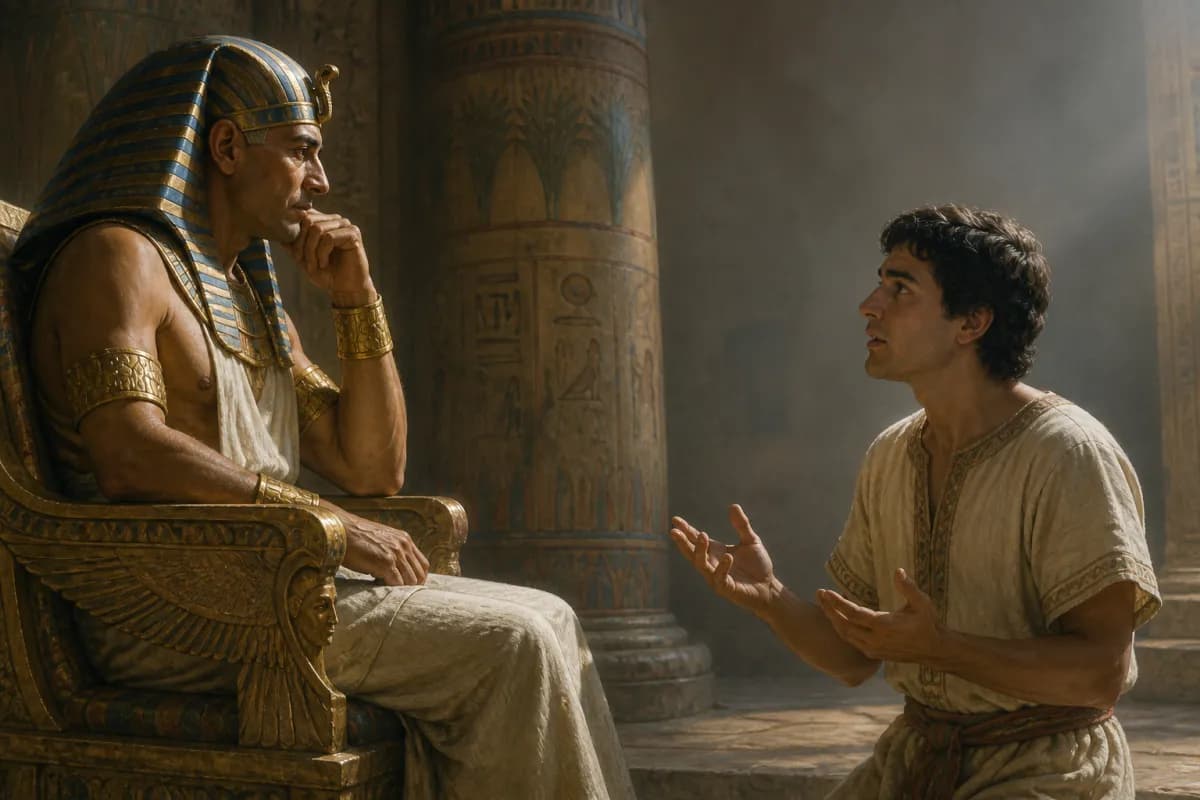
Genesis 41:1–57 moves Joseph from prison to Pharaoh’s court when no Egyptian expert can explain the king’s dreams. Joseph gives God the credit, interprets seven years of abundance followed by seven years of famine, and proposes a wise response. God raises the rejected prisoner to preserve many lives, a pattern that finds its fulfillment in Jesus, the risen King whose saving mission gives life to the world.
- In this study
- 57 verses · 5 movements
Genesis 41
41:1At the end of two full years, Pharaoh dreamed, and behold, he stood by the river.
41:2Behold, seven cattle came up out of the river. They were sleek and fat, and they fed in the marsh grass.
41:3Behold, seven other cattle came up after them out of the river, ugly and thin, and stood by the other cattle on the brink of the river.
41:4The ugly and thin cattle ate up the seven sleek and fat cattle. So Pharaoh awoke.
41:5He slept and dreamed a second time; and behold, seven heads of grain came up on one stalk, healthy and good.
41:6Behold, seven heads of grain, thin and blasted with the east wind, sprung up after them.
41:7The thin heads of grain swallowed up the seven healthy and full ears. Pharaoh awoke, and behold, it was a dream.
41:8In the morning, his spirit was troubled, and he sent and called for all of Egypt’s magicians and wise men. Pharaoh told them his dreams, but there was no one who could interpret them to Pharaoh.
41:9Then the chief cup bearer spoke to Pharaoh, saying, “I remember my faults today.
41:10Pharaoh was angry with his servants, and put me in custody in the house of the captain of the guard, with the chief baker.
41:11We dreamed a dream in one night, he and I. Each man dreamed according to the interpretation of his dream.
41:12There was with us there a young man, a Hebrew, servant to the captain of the guard, and we told him, and he interpreted to us our dreams. He interpreted to each man according to his dream.
41:13As he interpreted to us, so it was. He restored me to my office, and he hanged him.”
41:14Then Pharaoh sent and called Joseph, and they brought him hastily out of the dungeon. He shaved himself, changed his clothing, and came in to Pharaoh.
41:15Pharaoh said to Joseph, “I have dreamed a dream, and there is no one who can interpret it. I have heard it said of you, that when you hear a dream you can interpret it.”
41:16Joseph answered Pharaoh, saying, “It isn’t in me. God will give Pharaoh an answer of peace.”
41:17Pharaoh spoke to Joseph, “In my dream, behold, I stood on the brink of the river;
41:18and behold, seven fat and sleek cattle came up out of the river. They fed in the marsh grass;
41:19and behold, seven other cattle came up after them, poor and very ugly and thin, such as I never saw in all the land of Egypt for ugliness.
41:20The thin and ugly cattle ate up the first seven fat cattle;
41:21and when they had eaten them up, it couldn’t be known that they had eaten them, but they were still ugly, as at the beginning. So I awoke.
41:22I saw in my dream, and behold, seven heads of grain came up on one stalk, full and good;
41:23and behold, seven heads of grain, withered, thin, and blasted with the east wind, sprung up after them.
41:24The thin heads of grain swallowed up the seven good heads of grain. I told it to the magicians, but there was no one who could explain it to me.”
41:25Joseph said to Pharaoh, “The dream of Pharaoh is one. What God is about to do he has declared to Pharaoh.
41:26The seven good cattle are seven years; and the seven good heads of grain are seven years. The dream is one.
41:27The seven thin and ugly cattle that came up after them are seven years, and also the seven empty heads of grain blasted with the east wind; they will be seven years of famine.
41:28That is the thing which I have spoken to Pharaoh. God has shown Pharaoh what he is about to do.
41:29Behold, seven years of great plenty throughout all the land of Egypt are coming.
41:30Seven years of famine will arise after them, and all the plenty will be forgotten in the land of Egypt. The famine will consume the land,
41:31and the plenty will not be known in the land by reason of that famine which follows; for it will be very grievous.
41:32The dream was doubled to Pharaoh, because the thing is established by God, and God will shortly bring it to pass.
41:33“Now therefore let Pharaoh look for a discreet and wise man, and set him over the land of Egypt.
41:34Let Pharaoh do this, and let him appoint overseers over the land, and take up the fifth part of the land of Egypt’s produce in the seven plenteous years.
41:35Let them gather all the food of these good years that come, and store grain under the hand of Pharaoh for food in the cities, and let them keep it.
41:36The food will be to supply the land against the seven years of famine, which will be in the land of Egypt; so that the land will not perish through the famine.”
41:37The thing was good in the eyes of Pharaoh, and in the eyes of all his servants.
41:38Pharaoh said to his servants, “Can we find such a one as this, a man in whom is the Spirit of God?”
41:39Pharaoh said to Joseph, “Because God has shown you all of this, there is no one so discreet and wise as you.
41:40You shall be over my house. All my people will be ruled according to your word. Only in the throne I will be greater than you.”
41:41Pharaoh said to Joseph, “Behold, I have set you over all the land of Egypt.”
41:42Pharaoh took off his signet ring from his hand, and put it on Joseph’s hand, and arrayed him in robes of fine linen, and put a gold chain about his neck.
41:43He made him ride in the second chariot which he had. They cried before him, “Bow the knee!” He set him over all the land of Egypt.
41:44Pharaoh said to Joseph, “I am Pharaoh. Without you, no man shall lift up his hand or his foot in all the land of Egypt.”
41:45Pharaoh called Joseph’s name Zaphenath-Paneah. He gave him Asenath, the daughter of Potiphera priest of On as a wife. Joseph went out over the land of Egypt.
41:46Joseph was thirty years old when he stood before Pharaoh king of Egypt. Joseph went out from the presence of Pharaoh, and went throughout all the land of Egypt.
41:47In the seven plenteous years the earth produced abundantly.
41:48He gathered up all the food of the seven years which were in the land of Egypt, and laid up the food in the cities. He stored food in each city from the fields around that city.
41:49Joseph laid up grain as the sand of the sea, very much, until he stopped counting, for it was without number.
41:50To Joseph were born two sons before the year of famine came, whom Asenath, the daughter of Potiphera priest of On, bore to him.
41:51Joseph called the name of the firstborn Manasseh, “For”, he said, “God has made me forget all my toil, and all my father’s house.”
41:52The name of the second, he called Ephraim: “For God has made me fruitful in the land of my affliction.”
41:53The seven years of plenty, that were in the land of Egypt, came to an end.
41:54The seven years of famine began to come, just as Joseph had said. There was famine in all lands, but in all the land of Egypt there was bread.
41:55When all the land of Egypt was famished, the people cried to Pharaoh for bread, and Pharaoh said to all the Egyptians, “Go to Joseph. What he says to you, do.”
41:56The famine was over all the surface of the earth. Joseph opened all the store houses, and sold to the Egyptians. The famine was severe in the land of Egypt.
41:57All countries came into Egypt, to Joseph, to buy grain, because the famine was severe in all the earth.
CONTEXTUAL OVERVIEW
Two years after the cupbearer forgets Joseph, Pharaoh has dreams no court expert can interpret. The images are memorable and alarming: seven healthy cows are swallowed by seven gaunt cows without becoming visibly changed, and seven full ears of grain are swallowed by seven thin ears scorched by the east wind. The repetition signals that the message is fixed and urgent.
The cupbearer finally remembers Joseph and tells Pharaoh about the Hebrew prisoner who interpreted the two prison dreams accurately. Joseph is hurried from confinement, shaved, and given new clothes before standing before the king. His first sentence refuses flattery: the answer does not come from Joseph’s own ability; God will give Pharaoh a response concerning peace and well-being.
HISTORICAL AND LITERARY CONTEXT
Genesis 41 is the turning point of the Joseph narrative. The dreamer sold into slavery now interprets dreams for the most powerful ruler in the story, yet the chapter preserves the central claim that God, not Joseph’s charisma, reveals what is coming. The elevation fulfills Joseph’s earlier dreams in an unexpected form, through service to Egypt rather than immediate rule within his family.
The famine is described as affecting Egypt and surrounding lands. Genesis presents Joseph’s administration as a means of preserving life, not as a timeless blueprint for state policy. Its literary role is to bring Jacob’s family to Egypt and to show that God’s promise survives by providence during a threat no family could overcome by itself.
Did you know?
A roughly four-thousand-year-old Egyptian granary model has more people measuring and recording grain than carrying it: nine administrators and measurers to six sack carriers. Its miniature scribes write on both papyrus scrolls and wooden boards.
Why it matters: Joseph’s storage plan required careful accounting as well as a good harvest.
Model of a Granary with Scribes — The Metropolitan Museum of Art
SECTION-BY-SECTION ANALYSIS
- The repeated dream · Genesis 41:11The two images communicate one fixed message: abundance is real, famine is coming, and preparation is urgent.
- The stored grain · Genesis 41:57Joseph’s wisdom turns revealed warning into concrete provision for a crisis that cannot be wished away.
- The opened storehouses · Genesis 41:56The chapter ends with life-preserving provision extending beyond Egypt, preparing for the arrival of Joseph’s own family.
CHRIST IN THIS PASSAGE
Joseph’s exaltation after rejection gives a strong biblical pattern, but it is not a direct prediction in which Pharaoh or grain functions as a code for every gospel detail. The clear line is God’s raising of a suffering servant to a position through which many are preserved alive. Jesus is rejected, crucified, raised, and enthroned, not merely to manage an earthly famine but to give eternal life to a perishing world.
Joseph can supply bread for a season; Jesus calls Himself the bread of life and gives Himself for the life of the world. The contrast guards the connection from becoming forced. God’s providence in Joseph anticipates the saving generosity fulfilled in Christ, whose mission offers forgiveness, reconciliation with God, and resurrection hope to all who come to Him in faith.
REFLECTION
Joseph’s counsel joins trust in God with responsible action. The coming famine is God’s revealed warning, yet it calls for gathering, planning, and distributing rather than passivity. Faith does not despise prudent preparation; it recognizes that wisdom is a gift to be used for the good of neighbors when resources are abundant.
The deeper hunger of the passage cannot be met by a full storehouse. Jesus invites people who have exhausted every temporary supply to come to Him for life. His church reflects that mission by sharing material help generously and by bearing witness that the risen Christ is the true source of forgiveness, reconciliation, and final hope.
Original Hebrew Word Study
Genesis 41:16
פָּתַר
patar · H6622
Usually translated: to interpret or solve
Patar means to interpret or solve. Before Pharaoh, Joseph again gives God the credit for the answer, and the interpretation becomes the means by which God preserves life through famine.
Follow the Scripture trail
Pharaoh’s Dream: God Raises Joseph to Preserve Life in the larger story
The connection: God raises Joseph from the prison to Pharaoh’s right hand so that grain may preserve many lives through famine. This pattern reaches its fulfillment in Jesus, the rejected and risen King, whose saving mission offers Himself as the true bread of life for the world.
Respond to the passage
Receive the good gifts God has placed in your hands as resources for faithful stewardship, not private security. Then bring your deeper hunger to Jesus. Trust the risen King who alone can forgive sin, reconcile you to God, and give life that famine and death cannot take away.
- Why does Joseph refuse to take credit for interpreting Pharaoh’s dreams?
- How does the chapter connect revealed warning with wise, practical preparation?
- In what ways does Jesus fulfill the life-giving pattern in Joseph while surpassing it?
Prayer
Father, thank You for Your wise care in seasons of abundance and need. Make me a faithful steward of what You entrust to me. Thank You for Jesus, the risen Savior and bread of life; draw me to Him for forgiveness, strength, and lasting hope. Amen.