Passage Study
The Promise to Israel: Do Not Fear the Descent to Egypt
Genesis 46:1–46:7
Genesis 46:1–7 records Jacob’s last departure from Canaan as he travels to Egypt to see Joseph. At Beersheba, God tells Israel not to fear the descent: Egypt will become the place where God makes him a great nation, and God Himself will go with him. The promise steadies a fearful patriarch and points to Jesus, through whom God keeps His covenant purpose and brings His people home.
- In this study
- 7 verses · 5 movements
Genesis 46
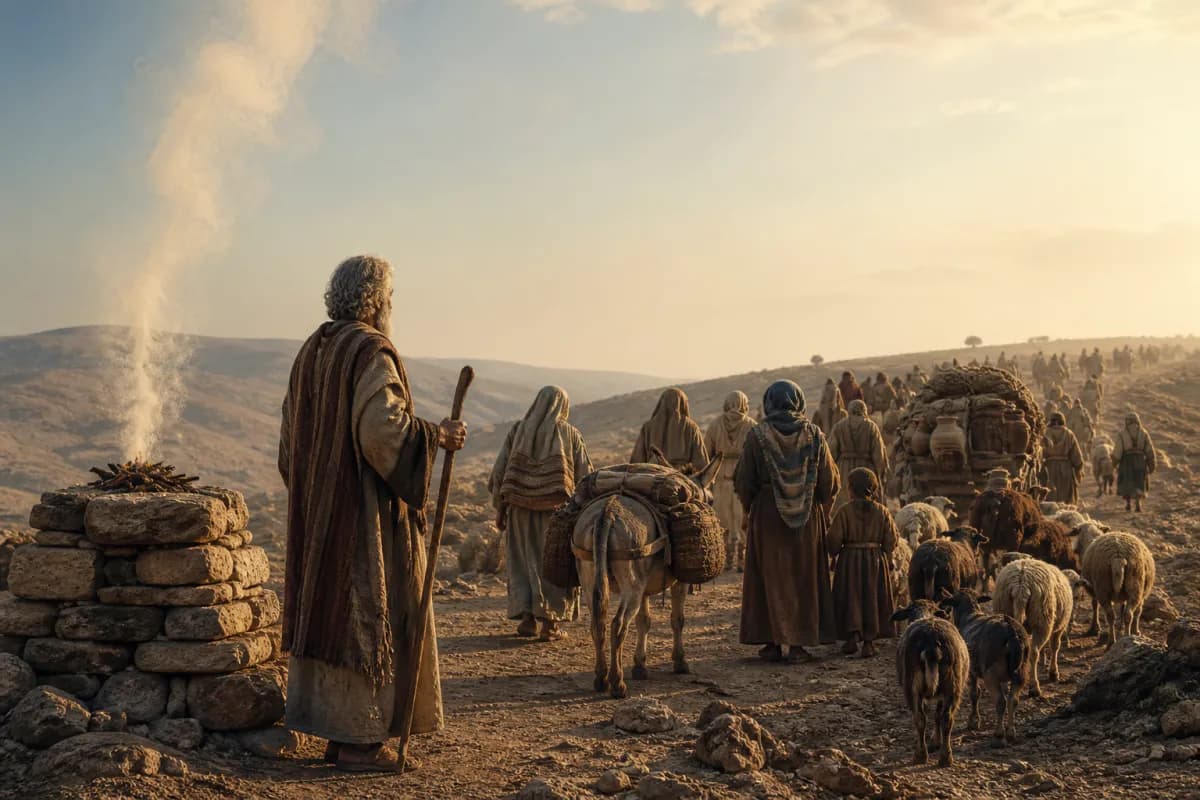
46:1Israel traveled with all that he had, and came to Beersheba, and offered sacrifices to the God of his father, Isaac.
46:2God spoke to Israel in the visions of the night, and said, “Jacob, Jacob!” He said, “Here I am.”
46:3He said, “I am God, the God of your father. Don’t be afraid to go down into Egypt, for there I will make of you a great nation.
46:4I will go down with you into Egypt. I will also surely bring you up again. Joseph’s hand will close your eyes.”
46:5Jacob rose up from Beersheba, and the sons of Israel carried Jacob, their father, their little ones, and their wives, in the wagons which Pharaoh had sent to carry him.
46:6They took their livestock, and their goods, which they had gotten in the land of Canaan, and came into Egypt—Jacob, and all his offspring with him,
46:7his sons, and his sons’ sons with him, his daughters, and his sons’ daughters, and he brought all his offspring with him into Egypt.
CONTEXTUAL OVERVIEW
Jacob has heard that Joseph is alive and has seen the wagons Joseph sent, yet the journey to Egypt is not emotionally simple. Canaan is the land promised to Abraham, and Jacob’s father Isaac had been warned not to settle in Egypt during a famine. At Beersheba, a place associated with the worship of Abraham and Isaac, Jacob stops to sacrifice before crossing the boundary into a foreign land.
God calls him by both names: “Jacob, Jacob,” and then calls him “Israel.” The doubled personal address meets the aged father in his fear, while the covenant name recalls the people who will come from him. God does not minimize the descent. He tells Israel plainly to go down to Egypt and promises His presence within the move.
HISTORICAL AND LITERARY CONTEXT
This passage turns the Joseph reunion into a covenant movement. Genesis has repeatedly tied God’s promise to land, offspring, and blessing. Egypt seems to threaten the land promise, but God reveals that the descent will serve the offspring promise: Israel will become a great nation there before the later exodus returns the people toward Canaan.
Beersheba lies at the southern edge of the land and has been a significant place in the family’s story. Its placement makes Jacob’s sacrifice fitting: he is not abandoning the God of the promise for Egypt’s security. He is leaving in response to the God who governs both the promised land and the foreign land beyond it.
SECTION-BY-SECTION ANALYSIS
- The sacrifice · Genesis 46:1Jacob worships before traveling, receiving the move as an act of trust rather than a flight toward material security.
- The descent · Genesis 46:3Egypt is not the promised destination, but God will use the foreign land to enlarge the covenant family.
- The presence · Genesis 46:2God’s promise to go down with Israel means that the land boundary does not limit His faithful care.
CHRIST IN THIS PASSAGE
Genesis 46 does not directly predict Jesus’ own movement into or out of Egypt. Its covenant pattern is God’s presence with His people in a place that feels like loss and its promise to bring them through death and displacement toward His future. The New Testament presents Jesus as the promised offspring through whom the blessing to Abraham reaches the nations.
Jesus takes this promise farther than Jacob could see. The Son enters our broken world, bears death, rises bodily, and promises to be with His people as they carry the gospel to every nation. His saving mission gives believers more than a safe route through change: it secures their final home with God through His death and resurrection.
REFLECTION
Faith sometimes means walking into a season that does not resemble the future we expected. Jacob’s fear is not rebuked as foolish; it is answered with God’s identity, promise, and presence. The passage invites believers to bring consequential decisions before God rather than treating practical provision as proof that no spiritual discernment is needed.
Jesus does not promise that every descent will quickly become visible blessing. He promises His presence and holds the final future of His people. That confidence frees the church to move faithfully where love, witness, or obedience require it, trusting the God who remains God in the familiar land and in the foreign place.
Original Hebrew Word Study
Genesis 46:3
יָרֵא
yare · H3372
Usually translated: to fear
Yare means to fear. God tells Israel not to fear going down to Egypt because the descent that feels like risk is the very place where He will make the family into a great nation.
Follow the Scripture trail
The Promise to Israel: Do Not Fear the Descent to Egypt in the larger story
The connection: Jacob’s descent to Egypt is held inside God’s covenant promise to make a people and bring them through the foreign land. That purpose reaches the nations through Jesus, Abraham’s promised offspring, who remains with His people and leads them toward their final home.
Respond to the passage
Bring a fearful transition before Jesus by name. Ask Him to make obedience clearer than self-protection, and trust His presence when the next faithful step takes you beyond what feels familiar.
- Why does Jacob stop to sacrifice at Beersheba before going to Egypt?
- What does God promise Israel besides a successful journey?
- How does Christ’s promise to be with His people shape the way you face an uncertain change?
Prayer
God of Abraham, Isaac, and Jacob, thank You that no place lies beyond Your faithful presence. When I fear a change I cannot control, fix my trust on Jesus, who has gone through death and opened the way home. Lead me in obedient faith. Amen.