Passage Study
Israel in Egypt: Reunion, Refuge, and Provision
Genesis 46:28–47:28
Genesis 46:28–47:12 brings Jacob’s household into Goshen, where Joseph embraces his father, presents his family to Pharaoh, and provides for them through famine. The passage shows God preserving the covenant family in a foreign land without erasing its identity. It points to Jesus, who brings estranged people into the Father’s welcome and sustains His people by grace.
- In this study
- 35 verses · 5 movements
Genesis 46
46:28Jacob sent Judah before him to Joseph, to show the way before him to Goshen, and they came into the land of Goshen.
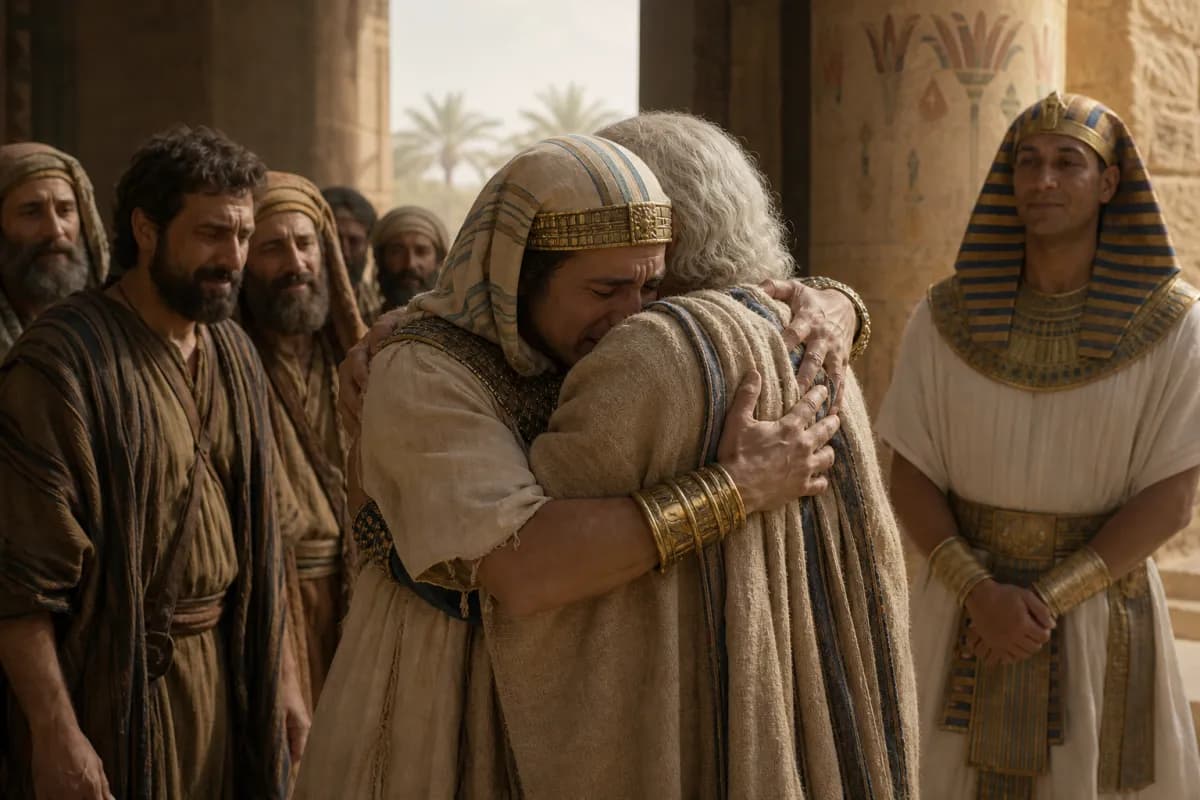
46:29Joseph prepared his chariot, and went up to meet Israel, his father, in Goshen. He presented himself to him, and fell on his neck, and wept on his neck a good while.
46:30Israel said to Joseph, “Now let me die, since I have seen your face, that you are still alive.”
46:31Joseph said to his brothers, and to his father’s house, “I will go up, and speak with Pharaoh, and will tell him, ‘My brothers, and my father’s house, who were in the land of Canaan, have come to me.
46:32These men are shepherds, for they have been keepers of livestock, and they have brought their flocks, and their herds, and all that they have.’
46:33It will happen, when Pharaoh summons you, and will say, ‘What is your occupation?’
46:34that you shall say, ‘Your servants have been keepers of livestock from our youth even until now, both we, and our fathers:’ that you may dwell in the land of Goshen; for every shepherd is an abomination to the Egyptians.”
Genesis 47
47:1Then Joseph went in and told Pharaoh, and said, “My father and my brothers, with their flocks, their herds, and all that they own, have come out of the land of Canaan; and behold, they are in the land of Goshen.”
47:2From among his brothers he took five men, and presented them to Pharaoh.
47:3Pharaoh said to his brothers, “What is your occupation?” They said to Pharaoh, “Your servants are shepherds, both we, and our fathers.”
47:4They also said to Pharaoh, “We have come to live as foreigners in the land, for there is no pasture for your servants’ flocks. For the famine is severe in the land of Canaan. Now therefore, please let your servants dwell in the land of Goshen.”
47:5Pharaoh spoke to Joseph, saying, “Your father and your brothers have come to you.
47:6The land of Egypt is before you. Make your father and your brothers dwell in the best of the land. Let them dwell in the land of Goshen. If you know any able men among them, then put them in charge of my livestock.”
47:7Joseph brought in Jacob, his father, and set him before Pharaoh; and Jacob blessed Pharaoh.
47:8Pharaoh said to Jacob, “How old are you?”
47:9Jacob said to Pharaoh, “The years of my pilgrimage are one hundred thirty years. The days of the years of my life have been few and evil. They have not attained to the days of the years of the life of my fathers in the days of their pilgrimage.”
47:10Jacob blessed Pharaoh, and went out from the presence of Pharaoh.
47:11Joseph placed his father and his brothers, and gave them a possession in the land of Egypt, in the best of the land, in the land of Rameses, as Pharaoh had commanded.
47:12Joseph provided his father, his brothers, and all of his father’s household with bread, according to the sizes of their families.
47:13There was no bread in all the land; for the famine was very severe, so that the land of Egypt and the land of Canaan fainted by reason of the famine.
47:14Joseph gathered up all the money that was found in the land of Egypt, and in the land of Canaan, for the grain which they bought: and Joseph brought the money into Pharaoh’s house.
47:15When the money was all spent in the land of Egypt, and in the land of Canaan, all the Egyptians came to Joseph, and said, “Give us bread, for why should we die in your presence? For our money fails.”
47:16Joseph said, “Give me your livestock; and I will give you food for your livestock, if your money is gone.”
47:17They brought their livestock to Joseph, and Joseph gave them bread in exchange for the horses, and for the flocks, and for the herds, and for the donkeys: and he fed them with bread in exchange for all their livestock for that year.
47:18When that year was ended, they came to him the second year, and said to him, “We will not hide from my lord how our money is all spent, and the herds of livestock are my lord’s. There is nothing left in the sight of my lord, but our bodies, and our lands.
47:19Why should we die before your eyes, both we and our land? Buy us and our land for bread, and we and our land will be servants to Pharaoh. Give us seed, that we may live, and not die, and that the land won’t be desolate.”
47:20So Joseph bought all the land of Egypt for Pharaoh, for every man of the Egyptians sold his field, because the famine was severe on them, and the land became Pharaoh’s.
47:21As for the people, he moved them to the cities from one end of the border of Egypt even to the other end of it.
47:22Only he didn’t buy the land of the priests, for the priests had a portion from Pharaoh, and ate their portion which Pharaoh gave them. That is why they didn’t sell their land.
47:23Then Joseph said to the people, “Behold, I have bought you and your land today for Pharaoh. Behold, here is seed for you, and you shall sow the land.
47:24It will happen at the harvests, that you shall give a fifth to Pharaoh, and four parts will be your own, for seed of the field, for your food, for them of your households, and for food for your little ones.”
47:25They said, “You have saved our lives! Let us find favor in the sight of my lord, and we will be Pharaoh’s servants.”
47:26Joseph made it a statute concerning the land of Egypt to this day, that Pharaoh should have the fifth. Only the land of the priests alone didn’t become Pharaoh’s.
47:27Israel lived in the land of Egypt, in the land of Goshen; and they got themselves possessions therein, and were fruitful, and multiplied exceedingly.
47:28Jacob lived in the land of Egypt seventeen years. So the days of Jacob, the years of his life, were one hundred forty-seven years.
CONTEXTUAL OVERVIEW
Judah goes ahead of the family to guide them toward Goshen, and Joseph rides out in his chariot to meet his father. Their embrace is the emotional center of the passage. Jacob had believed Joseph dead for years; now he sees him alive and is ready to die in peace. The reunion is not sentimental escape from the famine; it is the fruit of God’s providence through Joseph’s suffering and elevation.
Joseph then prepares his brothers for their audience with Pharaoh. They are to say plainly that they are keepers of livestock, and Joseph explains that Egyptians regard shepherds as an abomination. The family does not need to invent a social identity to be received. They enter the land honestly, and Pharaoh gives them room in Goshen.
HISTORICAL AND LITERARY CONTEXT
The scene completes Jacob’s descent to Egypt and establishes the setting from which Exodus will begin. Goshen offers pasture for the family’s animals and space for a growing household. The settlement is a provision during famine, but Genesis does not present Egypt as the final covenant home. Jacob’s later burial request will keep the land promise before the family even as Egypt sustains them.
Jacob’s blessing of Pharaoh is striking because Pharaoh is the ruler of the land that shelters the family. Jacob describes his years as few and difficult, refusing to portray prosperity in Egypt as the whole measure of God’s faithfulness. The old patriarch blesses the king, locating the covenant family’s significance in God’s promise rather than in its political rank.
SECTION-BY-SECTION ANALYSIS
- The embrace · Genesis 46:28Joseph and Jacob’s weeping reunion makes visible the restoration God has quietly prepared through the earlier years of separation.
- Truthful identity · Genesis 47:3The brothers identify themselves as shepherds rather than remaking themselves to gain Pharaoh’s favor.
- The blessing · Genesis 47:7Jacob blesses Pharaoh, showing that the covenant family brings God’s blessing even while it depends on Egyptian hospitality.
CHRIST IN THIS PASSAGE
Joseph’s reunion with Jacob and his provision for the family form a real narrative pattern, but Genesis does not say that Joseph’s chariot or Goshen directly predicts Christ. The stronger connection is God’s work of bringing a threatened, estranged household into welcome and sustaining it when it cannot provide for itself.
Jesus brings that saving purpose to its fullness. Through His death and resurrection, He reconciles sinners to the Father and makes them members of one household. He is also the good shepherd who gives His life for His sheep, so His mission gives more than temporary refuge in a famine: it grants forgiveness, communion with God, and life that death cannot end.
REFLECTION
This passage dignifies both provision and belonging. Jacob’s family needs pasture, food, and a place to live; none of those needs is treated as unspiritual. Yet their deepest preservation is that God has kept them together under His promise. The church should learn to care for concrete needs without mistaking material security for the whole of salvation.
Joseph’s family enters Egypt honestly rather than through a performance designed to impress Pharaoh. Jesus forms the same kind of community: people received by grace who no longer need to manufacture a false identity. His welcome gives courage to tell the truth about need and to extend practical hospitality to others.
Original Hebrew Word Study
Genesis 46:28
גֹּשֶׁן
Goshen · H1657
Usually translated: Goshen
Goshen names the region where Jacob’s family settles. Their residence there provides room for the household to grow while keeping their identity distinct within Egypt, setting the stage for Exodus.
Follow the Scripture trail
Israel in Egypt: Reunion, Refuge, and Provision in the larger story
The connection: God brings Jacob’s family into Goshen through Joseph’s provision, preserving a household that will become Israel. Jesus fulfills God’s reconciling mission by bringing estranged sinners into the Father’s household and sustaining them with life from Him.
Respond to the passage
Thank Jesus for the concrete ways He has provided for you, then ask Him to free you from performing a false self to earn welcome. Look for one person whose practical need or isolation you can meet with truthful, gracious hospitality.
- Why does the reunion between Jacob and Joseph matter more than a simple change in the family’s food supply?
- What does the family’s honest description of itself teach about receiving help?
- How does Christ’s work create a deeper and more lasting welcome than a refuge during famine?
Prayer
Father, thank You for preserving Jacob’s family and for the welcome You give through Jesus. Teach me to receive Your provision with humility, to tell the truth about my needs, and to make room for others with practical love and gospel hope. Amen.