Passage Study
The Names Going Down to Egypt: A Household Kept by Promise
Genesis 46:8–46:27
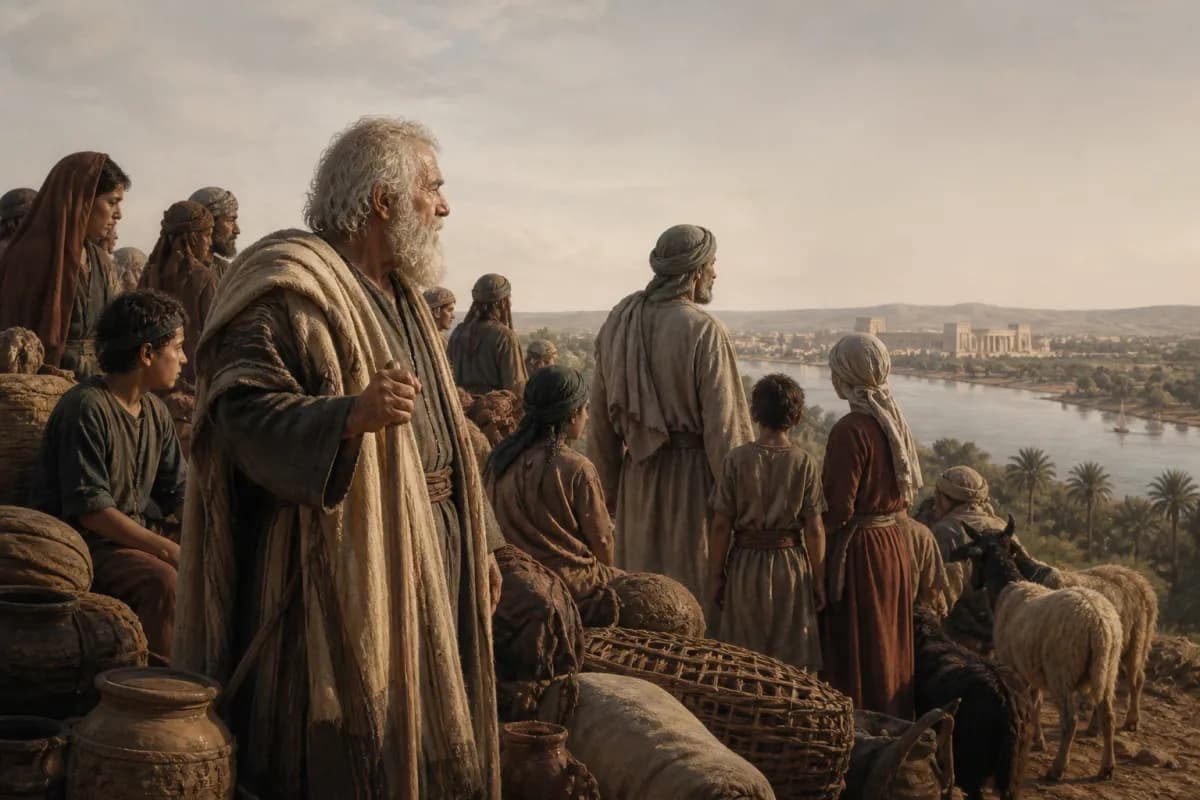
Genesis 46:8–27 records the names of Jacob’s descendants who go to Egypt. The genealogy makes the covenant family concrete: God’s promise is carried through real sons, daughters, servants’ children, griefs, and births. What appears to be a small household will become Israel, and the line reaches its saving purpose in Jesus Christ, the promised offspring who gathers a people from every nation.
- In this study
- 20 verses · 5 movements
Genesis 46
46:8These are the names of the children of Israel, who came into Egypt, Jacob and his sons: Reuben, Jacob’s firstborn.
46:9The sons of Reuben: Hanoch, Pallu, Hezron, and Carmi.
46:10The sons of Simeon: Jemuel, Jamin, Ohad, Jachin, Zohar, and Shaul the son of a Canaanite woman.
46:11The sons of Levi: Gershon, Kohath, and Merari.
46:12The sons of Judah: Er, Onan, Shelah, Perez, and Zerah; but Er and Onan died in the land of Canaan. The sons of Perez were Hezron and Hamul.
46:13The sons of Issachar: Tola, Puvah, Iob, and Shimron.
46:14The sons of Zebulun: Sered, Elon, and Jahleel.
46:15These are the sons of Leah, whom she bore to Jacob in Paddan Aram, with his daughter Dinah. All the souls of his sons and his daughters were thirty-three.
46:16The sons of Gad: Ziphion, Haggi, Shuni, Ezbon, Eri, Arodi, and Areli.
46:17The sons of Asher: Imnah, Ishvah, Ishvi, Beriah, and Serah their sister. The sons of Beriah: Heber and Malchiel.
46:18These are the sons of Zilpah, whom Laban gave to Leah, his daughter, and these she bore to Jacob, even sixteen souls.
46:19The sons of Rachel, Jacob’s wife: Joseph and Benjamin.
46:20To Joseph in the land of Egypt were born Manasseh and Ephraim, whom Asenath, the daughter of Potiphera, priest of On, bore to him.
46:21The sons of Benjamin: Bela, Becher, Ashbel, Gera, Naaman, Ehi, Rosh, Muppim, Huppim, and Ard.
46:22These are the sons of Rachel, who were born to Jacob: all the souls were fourteen.
46:23The son of Dan: Hushim.
46:24The sons of Naphtali: Jahzeel, Guni, Jezer, and Shillem.
46:25These are the sons of Bilhah, whom Laban gave to Rachel, his daughter, and these she bore to Jacob: all the souls were seven.
46:26All the souls who came with Jacob into Egypt, who were his direct offspring, in addition to Jacob’s sons’ wives, all the souls were sixty-six.
46:27The sons of Joseph, who were born to him in Egypt, were two souls. All the souls of the house of Jacob, who came into Egypt, were seventy.
CONTEXTUAL OVERVIEW
After God promises to go with Israel to Egypt, Genesis pauses over names. The pause is purposeful. Jacob’s migration is not an anonymous movement of people; it is the household through which God has promised to make a nation. The list binds the next chapter’s reunion to the earlier stories of Leah, Rachel, Bilhah, Zilpah, Dinah, Joseph, and Benjamin.
Some names recall loss and conflict as well as blessing. Er and Onan are named among Judah’s sons though they died in Canaan, and the families are organized according to the mothers whose rivalry shaped Jacob’s household. Genesis neither erases that history nor lets it cancel God’s covenant faithfulness. The promise moves through a family as fractured as any reader’s family story.
HISTORICAL AND LITERARY CONTEXT
Biblical genealogies preserve descent, inheritance, and covenant continuity. This one marks the moment when Jacob’s household enters Egypt, creating the bridge to Exodus, where Israel is described as multiplying from this family. The count is not decorative bookkeeping; it makes visible the small beginning from which a people will grow.
Genesis gives sixty-six as the number who come with Jacob from Canaan, excluding the wives of his sons, and then gives seventy when Joseph and his two sons in Egypt are included. Later biblical passages can cite a different total because they are counting in a different context. The chapter’s own count should be read on its stated terms rather than turned into a contradiction it does not claim to resolve.
SECTION-BY-SECTION ANALYSIS
- Named people · Genesis 46:8The genealogy treats members of the covenant household as persons with a place in the story, not as an interchangeable crowd.
- A mixed household · Genesis 46:15The list carries forward the complexity of Jacob’s marriages and losses without hiding the pain that shaped these families.
- A small beginning · Genesis 46:27Seventy people entering Egypt become the people Exodus will describe as numerous and fruitful under God’s care.
CHRIST IN THIS PASSAGE
A genealogy can feel distant until we remember that God’s promise takes shape in history. Genesis 46 preserves the family through which the promises to Abraham, Judah, and Israel continue. It does not identify Jesus by name, but the New Testament opens by tracing Jesus’ ancestry through this covenant history and presenting Him as the Messiah who fulfills it.
Jesus’ saving mission does not make ancestry a requirement for grace. He is the promised offspring through whom the blessing reaches the nations, and He gathers a redeemed family by faith. The list therefore points beyond itself: the God who kept the names of Jacob’s household keeps His promise in Christ and receives people from every people group into His kingdom.
REFLECTION
God’s work often advances through ordinary people whose histories are complicated and whose names are forgotten outside a family record. Genesis refuses the assumption that only dramatic moments count. The genealogy gives dignity to a household on the move and reminds readers that God’s faithfulness is worked out through generations, births, losses, and faithful endurance.
In Jesus, no believer is merely an anonymous addition to a crowd. He knows His people and joins them to a family defined by grace rather than status or a flawless past. That truth equips the church to honor the particular people God has placed among us and to welcome strangers as those whom Christ may draw into His household.
Original Hebrew Word Study
Genesis 46:26
נֶפֶשׁ
nephesh · H5315
Usually translated: person or life
Nephesh means a living person. The numbered family members make the move to Egypt concrete: the covenant line enters a foreign land as a small household that God will preserve and multiply.
Follow the Scripture trail
The Names Going Down to Egypt: A Household Kept by Promise in the larger story
The connection: The names of Genesis 46 show God carrying His promise through one vulnerable household into Egypt. From that family He forms Israel, and through Judah’s line He brings Jesus, whose saving mission gathers a redeemed people from every nation.
Respond to the passage
Thank Jesus that your life is not too ordinary, complicated, or obscure to matter in God’s purpose. Ask Him to make your home and church places where people are known, honored, and welcomed by grace.
- Why does Genesis slow down to name the members of Jacob’s household before describing life in Egypt?
- What does the genealogy preserve about the family’s painful and complicated history?
- How does Jesus’ place in this covenant history expand God’s family beyond natural descent?
Prayer
Faithful God, thank You for remembering the names and stories of Your people. Thank You for sending Jesus through the line of promise to bring me into Your family by grace. Help me to honor people as those known and valued by You. Amen.