Passage Study
The Deaths of Jacob and Joseph: Hope Beyond Egypt
Genesis 47:29–50:26
Genesis 47:29–50:26 closes the patriarchal story with Jacob’s oath about burial in Canaan, his blessings over Joseph’s sons and his own sons, Joseph’s burial of Jacob, and Joseph’s final assurance that God will preserve life despite his brothers’ evil. Joseph dies in Egypt still trusting God’s future visitation. The ending points to Jesus, whose death and resurrection secure the promised future for all who belong to Him.
- In this study
- 84 verses · 5 movements
Genesis 47
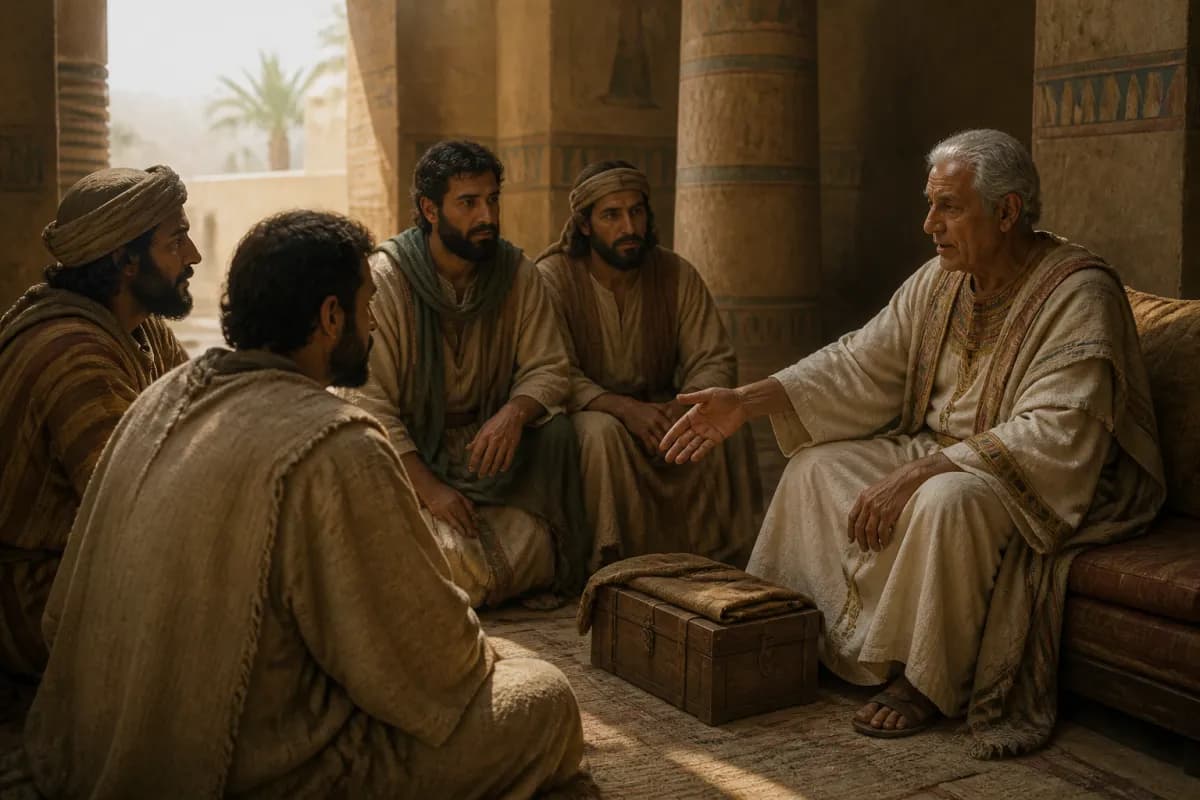
47:29The time came near that Israel must die, and he called his son Joseph, and said to him, “If now I have found favor in your sight, please put your hand under my thigh, and deal kindly and truly with me. Please don’t bury me in Egypt,
47:30but when I sleep with my fathers, you shall carry me out of Egypt, and bury me in their burying place.” Joseph said, “I will do as you have said.”
47:31Israel said, “Swear to me,” and he swore to him. Then Israel bowed himself on the bed’s head.
Genesis 48
48:1After these things, someone said to Joseph, “Behold, your father is sick.” He took with him his two sons, Manasseh and Ephraim.
48:2Someone told Jacob, and said, “Behold, your son Joseph comes to you,” and Israel strengthened himself, and sat on the bed.
48:3Jacob said to Joseph, “God Almighty appeared to me at Luz in the land of Canaan, and blessed me,
48:4and said to me, ‘Behold, I will make you fruitful, and multiply you, and I will make of you a company of peoples, and will give this land to your offspring after you for an everlasting possession.’
48:5Now your two sons, who were born to you in the land of Egypt before I came to you into Egypt, are mine; Ephraim and Manasseh, even as Reuben and Simeon, will be mine.
48:6Your offspring, whom you become the father of after them, will be yours. They will be called after the name of their brothers in their inheritance.
48:7As for me, when I came from Paddan, Rachel died beside me in the land of Canaan on the way, when there was still some distance to come to Ephrath, and I buried her there on the way to Ephrath (also called Bethlehem).”
48:8Israel saw Joseph’s sons, and said, “Who are these?”
48:9Joseph said to his father, “They are my sons, whom God has given me here.” He said, “Please bring them to me, and I will bless them.”
48:10Now the eyes of Israel were dim for age, so that he couldn’t see well. Joseph brought them near to him; and he kissed them, and embraced them.
48:11Israel said to Joseph, “I didn’t think I would see your face, and behold, God has let me see your offspring also.”
48:12Joseph brought them out from between his knees, and he bowed himself with his face to the earth.
48:13Joseph took them both, Ephraim in his right hand toward Israel’s left hand, and Manasseh in his left hand toward Israel’s right hand, and brought them near to him.
48:14Israel stretched out his right hand, and laid it on Ephraim’s head, who was the younger, and his left hand on Manasseh’s head, guiding his hands knowingly, for Manasseh was the firstborn.
48:15He blessed Joseph, and said, “The God before whom my fathers Abraham and Isaac walked, the God who has fed me all my life long to this day,
48:16the angel who has redeemed me from all evil, bless the lads, and let my name be named on them, and the name of my fathers Abraham and Isaac. Let them grow into a multitude upon the earth.”
48:17When Joseph saw that his father laid his right hand on the head of Ephraim, it displeased him. He held up his father’s hand, to remove it from Ephraim’s head to Manasseh’s head.
48:18Joseph said to his father, “Not so, my father, for this is the firstborn. Put your right hand on his head.”
48:19His father refused, and said, “I know, my son, I know. He also will become a people, and he also will be great. However, his younger brother will be greater than he, and his offspring will become a multitude of nations.”
48:20He blessed them that day, saying, “Israel will bless in your name, saying, ‘God make you as Ephraim and as Manasseh’” He set Ephraim before Manasseh.
48:21Israel said to Joseph, “Behold, I am dying, but God will be with you, and bring you again to the land of your fathers.
48:22Moreover I have given to you one portion above your brothers, which I took out of the hand of the Amorite with my sword and with my bow.”
Genesis 49
49:1Jacob called to his sons, and said: “Gather yourselves together, that I may tell you that which will happen to you in the days to come.
49:2Assemble yourselves, and hear, you sons of Jacob. Listen to Israel, your father.
49:3“Reuben, you are my firstborn, my might, and the beginning of my strength, excelling in dignity, and excelling in power.
49:4Boiling over like water, you shall not excel, because you went up to your father’s bed, then defiled it. He went up to my couch.
49:5“Simeon and Levi are brothers. Their swords are weapons of violence.
49:6My soul, don’t come into their council. My glory, don’t be united to their assembly; for in their anger they killed men. In their self-will they hamstrung cattle.
49:7Cursed be their anger, for it was fierce; and their wrath, for it was cruel. I will divide them in Jacob, and scatter them in Israel.
49:8“Judah, your brothers will praise you. Your hand will be on the neck of your enemies. Your father’s sons will bow down before you.
49:9Judah is a lion’s cub. From the prey, my son, you have gone up. He stooped down, he crouched as a lion, as a lioness. Who will rouse him up?
49:10The scepter will not depart from Judah, nor the ruler’s staff from between his feet, until he comes to whom it belongs. The obedience of the peoples will be to him.
49:11Binding his foal to the vine, his donkey’s colt to the choice vine, he has washed his garments in wine, his robes in the blood of grapes.
49:12His eyes will be red with wine, his teeth white with milk.
49:13“Zebulun will dwell at the haven of the sea. He will be for a haven of ships. His border will be on Sidon.
49:14“Issachar is a strong donkey, lying down between the saddlebags.
49:15He saw a resting place, that it was good, the land, that it was pleasant. He bows his shoulder to the burden, and becomes a servant doing forced labor.
49:16“Dan will judge his people, as one of the tribes of Israel.
49:17Dan will be a serpent on the trail, an adder in the path, that bites the horse’s heels, so that his rider falls backward.
49:18I have waited for your salvation, LORD.
49:19“A troop will press on Gad, but he will press on their heel.
49:20“Asher’s food will be rich. He will produce royal dainties.
49:21“Naphtali is a doe set free, who bears beautiful fawns.
49:22“Joseph is a fruitful vine, a fruitful vine by a spring. His branches run over the wall.
49:23The archers have severely grieved him, shot at him, and persecuted him:
49:24But his bow remained strong. The arms of his hands were made strong, by the hands of the Mighty One of Jacob, (from there is the shepherd, the stone of Israel),
49:25even by the God of your father, who will help you, by the Almighty, who will bless you, with blessings of heaven above, blessings of the deep that lies below, blessings of the breasts, and of the womb.
49:26The blessings of your father have prevailed above the blessings of my ancestors, above the boundaries of the ancient hills. They will be on the head of Joseph, on the crown of the head of him who is separated from his brothers.
49:27“Benjamin is a ravenous wolf. In the morning he will devour the prey. At evening he will divide the plunder.”
49:28All these are the twelve tribes of Israel, and this is what their father spoke to them, and blessed them. He blessed everyone according to his own blessing.
49:29He instructed them, and said to them, “I am to be gathered to my people. Bury me with my fathers in the cave that is in the field of Ephron the Hittite,
49:30in the cave that is in the field of Machpelah, which is before Mamre, in the land of Canaan, which Abraham bought with the field from Ephron the Hittite as a burial place.
49:31There they buried Abraham and Sarah, his wife. There they buried Isaac and Rebekah, his wife, and there I buried Leah:
49:32the field and the cave that is therein, which was purchased from the children of Heth.”
49:33When Jacob finished charging his sons, he gathered up his feet into the bed, breathed his last breath, and was gathered to his people.
Genesis 50
50:1Joseph fell on his father’s face, wept on him, and kissed him.
50:2Joseph commanded his servants, the physicians, to embalm his father; and the physicians embalmed Israel.
50:3Forty days were used for him, for that is how many days it takes to embalm. The Egyptians wept for Israel for seventy days.
50:4When the days of weeping for him were past, Joseph spoke to Pharaoh’s staff, saying, “If now I have found favor in your eyes, please speak in the ears of Pharaoh, saying,
50:5‘My father made me swear, saying, “Behold, I am dying. Bury me in my grave which I have dug for myself in the land of Canaan.” Now therefore, please let me go up and bury my father, and I will come again.’”
50:6Pharaoh said, “Go up, and bury your father, just like he made you swear.”
50:7Joseph went up to bury his father; and with him went up all the servants of Pharaoh, the elders of his house, all the elders of the land of Egypt,
50:8all the house of Joseph, his brothers, and his father’s house. Only their little ones, their flocks, and their herds, they left in the land of Goshen.
50:9Both chariots and horsemen went up with him. It was a very great company.
50:10They came to the threshing floor of Atad, which is beyond the Jordan, and there they lamented with a very great and severe lamentation. He mourned for his father seven days.
50:11When the inhabitants of the land, the Canaanites, saw the mourning in the floor of Atad, they said, “This is a grievous mourning by the Egyptians.” Therefore its name was called Abel Mizraim, which is beyond the Jordan.
50:12His sons did to him just as he commanded them,
50:13for his sons carried him into the land of Canaan, and buried him in the cave of the field of Machpelah, which Abraham bought with the field, as a possession for a burial site, from Ephron the Hittite, near Mamre.
50:14Joseph returned into Egypt—he, and his brothers, and all that went up with him to bury his father, after he had buried his father.
50:15When Joseph’s brothers saw that their father was dead, they said, “It may be that Joseph will hate us, and will fully pay us back for all the evil which we did to him.”
50:16They sent a message to Joseph, saying, “Your father commanded before he died, saying,
50:17‘You shall tell Joseph, “Now please forgive the disobedience of your brothers, and their sin, because they did evil to you.”’ Now, please forgive the disobedience of the servants of the God of your father.” Joseph wept when they spoke to him.
50:18His brothers also went and fell down before his face; and they said, “Behold, we are your servants.”
50:19Joseph said to them, “Don’t be afraid, for am I in the place of God?
50:20As for you, you meant evil against me, but God meant it for good, to save many people alive, as is happening today.
50:21Now therefore don’t be afraid. I will provide for you and your little ones.” He comforted them, and spoke kindly to them.
50:22Joseph lived in Egypt, he, and his father’s house. Joseph lived one hundred ten years.
50:23Joseph saw Ephraim’s children to the third generation. The children also of Machir, the son of Manasseh, were born on Joseph’s knees.
50:24Joseph said to his brothers, “I am dying, but God will surely visit you, and bring you up out of this land to the land which he swore to Abraham, to Isaac, and to Jacob.”
50:25Joseph took an oath from the children of Israel, saying, “God will surely visit you, and you shall carry up my bones from here.”
50:26So Joseph died, being one hundred ten years old, and they embalmed him, and he was put in a coffin in Egypt.
CONTEXTUAL OVERVIEW
Genesis ends in Egypt, but it refuses to end with Egypt as home. As Jacob nears death, he asks Joseph to place a hand under his thigh and swear not to bury him there. He wants to rest with Abraham and Isaac in the cave at Machpelah, the family’s burial place in Canaan. The request is an act of faith: the land promise still governs his hope even while his family is safe and well supplied in Egypt.
The closing chapters gather the family around death, inheritance, fear, and forgiveness. Jacob blesses Joseph’s sons with crossed hands, placing the younger Ephraim before Manasseh, then addresses his twelve sons with words that are both prophetic and morally honest. The patriarchal story does not conclude by declaring every family wound healed; it concludes by showing God’s promise outlasting them all.
HISTORICAL AND LITERARY CONTEXT
Jacob’s burial procession to Canaan and the return to Egypt mark a decisive contrast. The family can honor the promised land, but it must return to the country where it now lives. Joseph’s own death later repeats the unresolved tension: he is embalmed and placed in a coffin in Egypt, yet he makes the brothers swear to carry his bones up when God visits them.
Genesis 49 gives particular weight to Judah. Though Judah’s earlier life has been compromised by grave sin, Jacob speaks of royal authority continuing in his line. The passage does not identify every later ruler or give a full messianic timetable, but it establishes the royal promise that the Bible will carry forward toward David and ultimately to Jesus.
Did you know?
One Egyptian coffin held embalming supplies instead of a body. Excavated at Thebes and dated around 650–625 BCE, it contained bags of natron and sawdust; pots and other materials were carefully buried around it.
Why it matters: This later find reveals the material work behind the brief biblical references to embalming Jacob and Joseph.
SECTION-BY-SECTION ANALYSIS
- The burial oath · Genesis 49:30Jacob’s request places his body and his descendants’ hope under God’s promise concerning Canaan.
- Judah’s blessing · Genesis 49:8The royal language attached to Judah establishes a line of hope that later Scripture develops toward David and the Messiah.
- Joseph’s assurance · Genesis 50:17Joseph names the brothers’ evil without denying God’s life-preserving purpose, then chooses provision over retaliation.
CHRIST IN THIS PASSAGE
Genesis 47–50 directly develops the hope of Judah’s royal line and the promise that God will visit His people. The New Testament identifies Jesus as the Son of David and the Lion of Judah. He is the King for whom Judah’s blessing prepares the reader, though Genesis itself does not yet supply the whole portrait of His life and work.
Joseph’s final confidence also directs readers beyond death. He cannot keep the family alive forever, and his coffin remains in Egypt until the exodus. Jesus dies, rises, and reigns as the Savior who has defeated death itself. His saving mission gives forgiveness to guilty people, preserves them through death, and guarantees their final resurrection and home with God.
REFLECTION
Jacob and Joseph both die trusting promises they do not fully see fulfilled. Their faith is not optimism about their circumstances; it is confidence in the God who has been faithful across a long, difficult story. This gives believers a way to face mortality without pretending death is small. God’s future remains certain even when our individual work ends unfinished.
Joseph’s answer to his brothers offers a demanding mercy. He does not call their sale good, and he does not tell them the wound never mattered. He entrusts judgment to God and uses his position to preserve life. In Jesus, forgiven people receive strength to name evil truthfully, refuse personal vengeance, and seek the good of those God has placed in their care.
Original Hebrew Word Study
Genesis 47:31
שָׁבַע
shava · H7650
Usually translated: to swear or take an oath
Shava means to swear. Jacob requires Joseph’s oath concerning burial in Canaan because the promised land remains central to the family’s hope even as they prosper in Egypt.
Follow the Scripture trail
The Deaths of Jacob and Joseph: Hope Beyond Egypt in the larger story
The connection: Genesis closes with a coffin in Egypt and a promise of God’s future visitation. The covenant line moves through Judah toward Jesus, the risen King whose saving mission secures forgiveness, resurrection, and the final home God has promised His people.
Respond to the passage
Bring your fear of death, unfinished hopes, or old family wounds to Jesus. Trust the risen King with the future you cannot control, and ask Him to make you a person who names evil truthfully while practicing the mercy you have received.
- Why does Jacob insist on burial in Canaan while the family is being preserved in Egypt?
- What does Joseph’s answer to his brothers hold together about human evil and God’s purpose?
- How does Jesus’ resurrection give concrete hope to the faith expressed in Joseph’s final request?
Prayer
Risen Lord Jesus, thank You that death does not cancel Your promise. Teach me to trust Your future when I cannot see the whole road ahead. Make me truthful about evil, generous in mercy, and steady in the hope of resurrection and life with You. Amen.