Passage Study
The Divine Beings and the Beautiful Daughters: A World Reaching Its Limit
Genesis 6:1–6:4
Genesis 6:1–4 gives a compressed and difficult account of human multiplication, the “sons of God,” the “daughters of men,” God’s limit of one hundred twenty years, and the Nephilim. Its immediate purpose is clear even where details are debated: human self-assertion has become grievously disordered, and the flood narrative will reveal God’s holy judgment and preserving mercy.
- In this study
- 4 verses · 5 movements
Genesis 6
6:1When men began to multiply on the surface of the ground, and daughters were born to them,
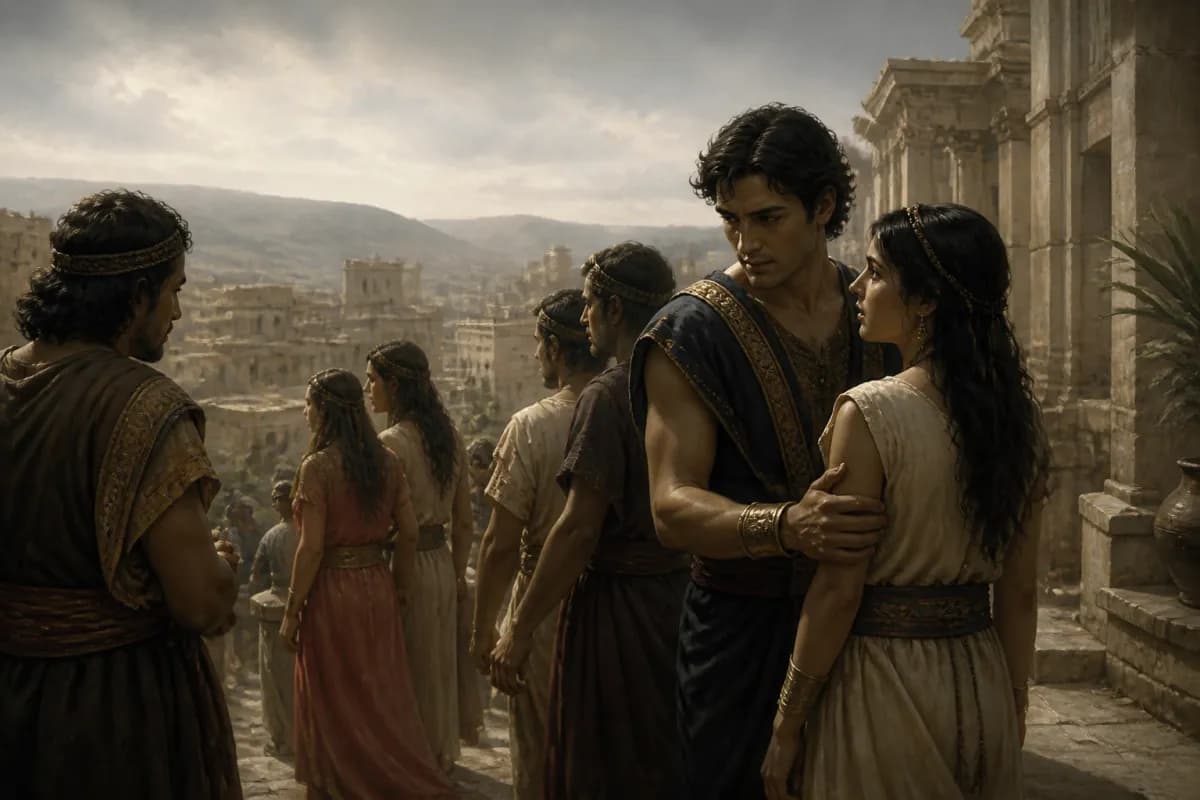
6:2God’s sons saw that men’s daughters were beautiful, and they took any that they wanted for themselves as wives.
6:3The LORD said, “My Spirit will not strive with man forever, because he also is flesh; so his days will be one hundred twenty years.”
6:4The Nephilim were in the earth in those days, and also after that, when God’s sons came in to men’s daughters and had children with them. Those were the mighty men who were of old, men of renown.
CONTEXTUAL OVERVIEW
Genesis 6:1–4 stands between the genealogy from Adam to Noah and the declaration that human wickedness is great on the earth. Its brevity creates real interpretive difficulty, but its placement is not obscure: the human story has moved from Cain’s violence and Lamech’s boasting to a world in which desire, power, and mortality are out of order.
The passage names the “sons of God,” “daughters of men,” and Nephilim without slowing to define them. It then records God’s decision that His Spirit will not remain in perpetual contention with humankind. Readers should resist using a hard text as an occasion for confident speculation while hearing its sobering movement toward divine judgment.
HISTORICAL AND LITERARY CONTEXT
The identity of the sons of God is debated. Some interpreters understand the phrase as heavenly beings, partly because similar language in Job refers to members of the heavenly court. Others understand it as a line of rulers or as the godly descendants of Seth. Genesis 6 itself does not settle every question, and the passage does not require Christians to build a full doctrine of angels or human ancestry on one compressed scene.
The Nephilim are likewise difficult to identify. The text connects them with mighty men and men of renown, but it gives no extended account of their origin or deeds. The ancient setting knew royal claims and heroic traditions; Genesis records the world’s celebrated power just before exposing its moral ruin. Fame and strength do not make a society righteous before God.
SECTION-BY-SECTION ANALYSIS
- Seeing and taking · Genesis 6:2The language portrays desire becoming possession without any stated concern for God’s order or the good of the women involved.
- God’s Spirit · Genesis 6:3God’s declaration emphasizes His patience and the seriousness of His coming judgment, not a technical explanation of human composition.
- Men of renown · Genesis 6:4The passage names celebrated strength just before the flood, exposing the failure of reputation to restrain evil.
CHRIST IN THIS PASSAGE
This text does not directly predict Jesus, and its disputed figures should not be converted into a secret map of the gospel. Its stronger Christ-centered connection is the shared biblical diagnosis: humanity does not save itself through strength, lineage, fame, or desire. The world before the flood needs God’s intervention because its evil has become pervasive.
Jesus enters the same fallen human world as the faithful Son who does the Father’s will rather than taking for Himself. At the cross He bears the judgment sin deserves, and in His resurrection He begins the new humanity. His saving mission offers repentance and cleansing to people whose desires have become destructive, while warning that God’s patience is meant to lead to repentance rather than presumption.
REFLECTION
A difficult passage can still address a familiar temptation: to treat beauty, strength, status, or another person as something we may simply take. Jesus calls His people to receive others as neighbors made in God’s image, never as material for appetite, conquest, or self-display.
The limit God announces is also a mercy. He does not ignore evil forever, and He does not leave sinners without warning. Receive His patience as an invitation to turn toward Christ now. Where desire has become controlling, bring it into the light with honest confession and seek accountable, life-giving help.
Original Hebrew Word Study
Genesis 6:2
טוֹב
tov · H2896
Usually translated: good, pleasing, or beautiful
Tov can mean good, pleasing, or beautiful. The phrase turns beauty into something taken according to desire, foreshadowing the wider corruption of a world where human appetite sets its own limits.
Follow the Scripture trail
The Divine Beings and the Beautiful Daughters: A World Reaching Its Limit in the larger story
The connection: Genesis 6 shows a world unable to restrain its own disordered desire and violence. Jesus comes as the obedient Son who bears judgment, calls sinners to repentance, and forms a new people marked by holiness and love rather than exploitation.
Respond to the passage
Ask Jesus to expose any place where desire, status, or power has become a reason to use another person. Receive God’s patience as a call to repent today, and take one concrete step toward integrity and accountable love.
- Which parts of Genesis 6:1–4 are clear, and which remain genuinely debated?
- Why does the passage place famous warriors before the flood’s judgment?
- How does Jesus confront the habit of treating people as possessions or instruments?
Prayer
Holy Lord, keep me from using the gifts You have made as excuses for selfishness. Thank You for Your patience and for Jesus, who bears sin and makes new hearts. Teach me repentance, self-control, and love that honors others. Amen.