Passage Study
Hezekiah, Assyria, and the Word of the Lord
Isaiah 36:1–39:8
Isaiah 36–39 places arrogant Assyria outside Jerusalem, records Hezekiah’s prayer and God’s deliverance, then turns to the king’s illness and his pride before Babylonian envoys. The passage reveals that God hears His people and humbles empire, while even a faithful king needs a greater Savior. It points to Jesus, the obedient Son of David who brings God’s salvation to the nations.
- In this study
- 90 verses · 5 movements
Isaiah 36
36:1Now in the fourteenth year of King Hezekiah, Sennacherib king of Assyria attacked all of the fortified cities of Judah and captured them.
36:2The king of Assyria sent Rabshakeh from Lachish to Jerusalem to King Hezekiah with a large army. He stood by the aqueduct from the upper pool in the fuller’s field highway.
36:3Then Eliakim the son of Hilkiah, who was over the household, and Shebna the scribe, and Joah, the son of Asaph the recorder came out to him.
36:4Rabshakeh said to them, “Now tell Hezekiah, ‘The great king, the king of Assyria, says, “What confidence is this in which you trust?
36:5I say that your counsel and strength for the war are only vain words. Now in whom do you trust, that you have rebelled against me?
36:6Behold, you trust in the staff of this bruised reed, even in Egypt, which if a man leans on it, it will go into his hand and pierce it. So is Pharaoh king of Egypt to all who trust in him.
36:7But if you tell me, ‘We trust in the LORD our God,’ isn’t that he whose high places and whose altars Hezekiah has taken away, and has said to Judah and to Jerusalem, ‘You shall worship before this altar’?”
36:8Now therefore, please make a pledge to my master the king of Assyria, and I will give you two thousand horses, if you are able on your part to set riders on them.
36:9How then can you turn away the face of one captain of the least of my master’s servants, and put your trust in Egypt for chariots and for horsemen?
36:10Have I come up now without the LORD against this land to destroy it? The LORD said to me, “Go up against this land, and destroy it.”’”
36:11Then Eliakim, Shebna and Joah said to Rabshakeh, “Please speak to your servants in Aramaic, for we understand it. Don’t speak to us in the Jews’ language in the hearing of the people who are on the wall.”
36:12But Rabshakeh said, “Has my master sent me only to your master and to you, to speak these words, and not to the men who sit on the wall, who will eat their own dung and drink their own urine with you?”
36:13Then Rabshakeh stood, and called out with a loud voice in the Jews’ language, and said, “Hear the words of the great king, the king of Assyria!
36:14The king says, ‘Don’t let Hezekiah deceive you; for he will not be able to deliver you.
36:15Don’t let Hezekiah make you trust in the LORD, saying, “The LORD will surely deliver us. This city won’t be given into the hand of the king of Assyria.”’
36:16Don’t listen to Hezekiah, for the king of Assyria says, ‘Make your peace with me, and come out to me; and each of you eat from his vine, and each one from his fig tree, and each one of you drink the waters of his own cistern;
36:17until I come and take you away to a land like your own land, a land of grain and new wine, a land of bread and vineyards.
36:18Beware lest Hezekiah persuade you, saying, “The LORD will deliver us.” Have any of the gods of the nations delivered their lands from the hand of the king of Assyria?
36:19Where are the gods of Hamath and Arpad? Where are the gods of Sepharvaim? Have they delivered Samaria from my hand?
36:20Who are they among all the gods of these countries that have delivered their country out of my hand, that the LORD should deliver Jerusalem out of my hand?’”
36:21But they remained silent, and said nothing in reply, for the king’s commandment was, “Don’t answer him.”
36:22Then Eliakim the son of Hilkiah, who was over the household, and Shebna the scribe, and Joah, the son of Asaph the recorder, came to Hezekiah with their clothes torn, and told him the words of Rabshakeh.
Isaiah 37
37:1When King Hezekiah heard it, he tore his clothes, covered himself with sackcloth, and went into the LORD’s house.
37:2He sent Eliakim, who was over the household, and Shebna the scribe, and the elders of the priests, covered with sackcloth, to Isaiah the prophet, the son of Amoz.
37:3They said to him, “Hezekiah says, ‘Today is a day of trouble, and of rebuke, and of rejection; for the children have come to the birth, and there is no strength to give birth.
37:4It may be the LORD your God will hear the words of Rabshakeh, whom the king of Assyria his master has sent to defy the living God, and will rebuke the words which the LORD your God has heard. Therefore lift up your prayer for the remnant that is left.’”
37:5So the servants of King Hezekiah came to Isaiah.
37:6Isaiah said to them, “Tell your master, ‘The LORD says, “Don’t be afraid of the words that you have heard, with which the servants of the king of Assyria have blasphemed me.
37:7Behold, I will put a spirit in him and he will hear news, and will return to his own land. I will cause him to fall by the sword in his own land.”’”
37:8So Rabshakeh returned, and found the king of Assyria warring against Libnah, for he heard that he had departed from Lachish.
37:9He heard news concerning Tirhakah king of Ethiopia, “He has come out to fight against you.” When he heard it, he sent messengers to Hezekiah, saying,
37:10“Thus you shall speak to Hezekiah king of Judah, saying, ‘Don’t let your God in whom you trust deceive you, saying, “Jerusalem won’t be given into the hand of the king of Assyria.”
37:11Behold, you have heard what the kings of Assyria have done to all lands, by destroying them utterly. Shall you be delivered?
37:12Have the gods of the nations delivered them, which my fathers have destroyed, Gozan, Haran, Rezeph, and the children of Eden who were in Telassar?
37:13Where is the king of Hamath, and the king of Arpad, and the king of the city of Sepharvaim, of Hena, and Ivvah?’”
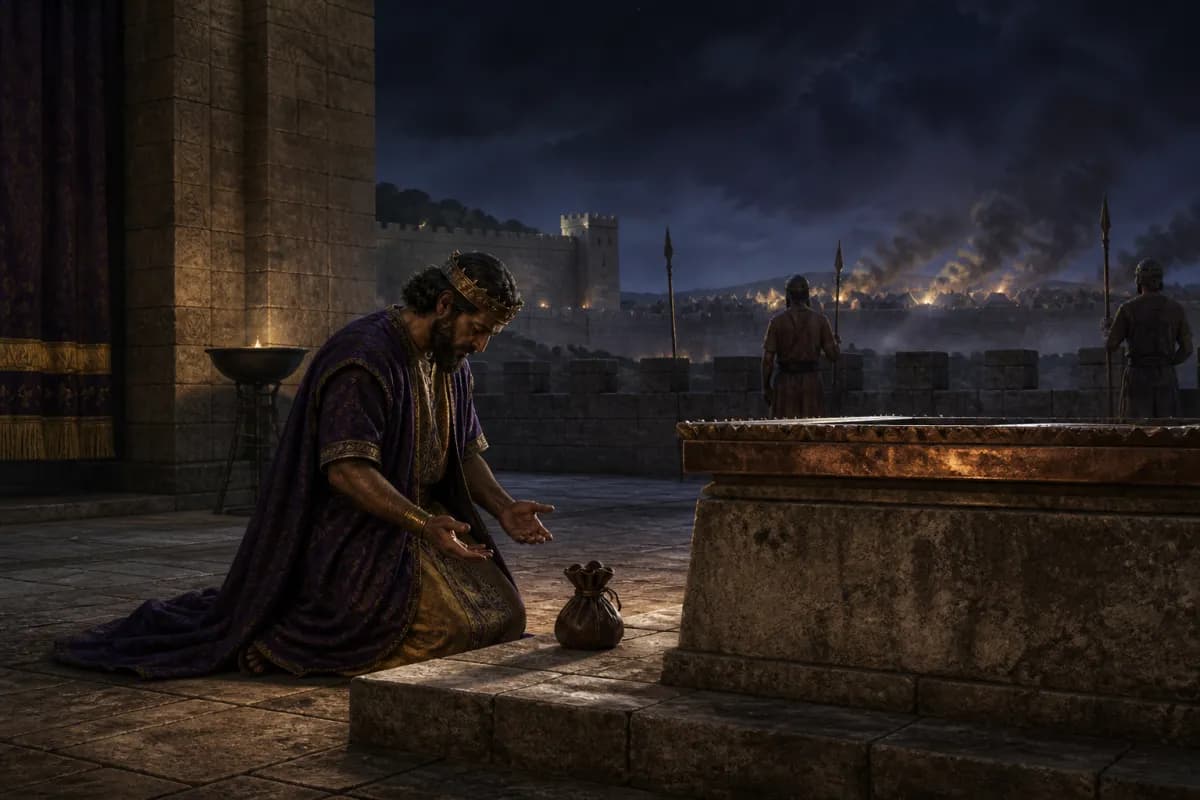
37:14Hezekiah received the letter from the hand of the messengers and read it. Then Hezekiah went up to the LORD’s house, and spread it before the LORD.
37:15Hezekiah prayed to the LORD, saying,
37:16“LORD of Armies, the God of Israel, who is enthroned among the cherubim, you are the God, even you alone, of all the kingdoms of the earth. You have made heaven and earth.
37:17Turn your ear, LORD, and hear. Open your eyes, LORD, and behold. Hear all of the words of Sennacherib, who has sent to defy the living God.
37:18Truly, LORD, the kings of Assyria have destroyed all the countries and their land,
37:19and have cast their gods into the fire; for they were no gods, but the work of men’s hands, wood and stone; therefore they have destroyed them.
37:20Now therefore, LORD our God, save us from his hand, that all the kingdoms of the earth may know that you are the LORD, even you only.”
37:21Then Isaiah the son of Amoz sent to Hezekiah, saying, “The LORD, the God of Israel says, ‘Because you have prayed to me against Sennacherib king of Assyria,
37:22this is the word which the LORD has spoken concerning him: The virgin daughter of Zion has despised you and ridiculed you. The daughter of Jerusalem has shaken her head at you.
37:23Whom have you defied and blasphemed? Against whom have you exalted your voice and lifted up your eyes on high? Against the Holy One of Israel.
37:24By your servants, you have defied the Lord, and have said, “With the multitude of my chariots I have come up to the height of the mountains, to the innermost parts of Lebanon. I will cut down its tall cedars and its choice cypress trees. I will enter into its farthest height, the forest of its fruitful field.
37:25I have dug and drunk water, and with the sole of my feet I will dry up all the rivers of Egypt.”
37:26“‘Have you not heard how I have done it long ago, and formed it in ancient times? Now I have brought it to pass, that it should be yours to destroy fortified cities, turning them into ruinous heaps.
37:27Therefore their inhabitants had little power. They were dismayed and confounded. They were like the grass of the field, and like the green herb, like the grass on the housetops, and like a field before its crop has grown.
37:28But I know your sitting down, your going out, your coming in, and your raging against me.
37:29Because of your raging against me, and because your arrogance has come up into my ears, therefore I will put my hook in your nose and my bridle in your lips, and I will turn you back by the way by which you came.
37:30“‘This shall be the sign to you: You will eat this year that which grows of itself, and in the second year that which springs from it; and in the third year sow and reap and plant vineyards, and eat their fruit.
37:31The remnant that is escaped of the house of Judah will again take root downward, and bear fruit upward.
37:32For out of Jerusalem a remnant will go out, and survivors will escape from Mount Zion. The zeal of the LORD of Armies will perform this.’
37:33“Therefore the LORD says concerning the king of Assyria, ‘He will not come to this city, nor shoot an arrow there, neither will he come before it with shield, nor cast up a mound against it.
37:34He will return the way that he came, and he won’t come to this city,’ says the LORD.
37:35‘For I will defend this city to save it, for my own sake, and for my servant David’s sake.’”
37:36Then the LORD’s angel went out and struck one hundred and eighty-five thousand men in the camp of the Assyrians. When men arose early in the morning, behold, these were all dead bodies.
37:37So Sennacherib king of Assyria departed, went away, returned to Nineveh, and stayed there.
37:38As he was worshiping in the house of Nisroch his god, Adrammelech and Sharezer his sons struck him with the sword; and they escaped into the land of Ararat. Esar Haddon his son reigned in his place.
Isaiah 38
38:1In those days Hezekiah was sick and near death. Isaiah the prophet, the son of Amoz, came to him, and said to him, “The LORD says, ‘Set your house in order, for you will die, and not live.’”
38:2Then Hezekiah turned his face to the wall and prayed to the LORD,
38:3and said, “Remember now, LORD, I beg you, how I have walked before you in truth and with a perfect heart, and have done that which is good in your sight.” Then Hezekiah wept bitterly.
38:4Then the LORD’s word came to Isaiah, saying,
38:5“Go, and tell Hezekiah, ‘The LORD, the God of David your father, says, “I have heard your prayer. I have seen your tears. Behold, I will add fifteen years to your life.
38:6I will deliver you and this city out of the hand of the king of Assyria, and I will defend this city.
38:7This shall be the sign to you from the LORD, that the LORD will do this thing that he has spoken.
38:8Behold, I will cause the shadow on the sundial, which has gone down on the sundial of Ahaz with the sun, to return backward ten steps.”’” So the sun returned ten steps on the sundial on which it had gone down.
38:9The writing of Hezekiah king of Judah, when he had been sick, and had recovered of his sickness:
38:10I said, “In the middle of my life I go into the gates of Sheol. I am deprived of the residue of my years.”
38:11I said, “I won’t see the LORD, the LORD in the land of the living. I will see man no more with the inhabitants of the world.
38:12My dwelling is removed, and is carried away from me like a shepherd’s tent. I have rolled up my life like a weaver. He will cut me off from the loom. From day even to night you will make an end of me.
38:13I waited patiently until morning. He breaks all my bones like a lion. From day even to night you will make an end of me.
38:14I chattered like a swallow or a crane. I moaned like a dove. My eyes weaken looking upward. Lord, I am oppressed. Be my security.”
38:15What will I say? He has both spoken to me, and himself has done it. I will walk carefully all my years because of the anguish of my soul.
38:16Lord, men live by these things; and my spirit finds life in all of them. You restore me, and cause me to live.
38:17Behold, for peace I had great anguish, but you have in love for my soul delivered it from the pit of corruption; for you have cast all my sins behind your back.
38:18For Sheol can’t praise you. Death can’t celebrate you. Those who go down into the pit can’t hope for your truth.
38:19The living, the living, he shall praise you, as I do today. The father shall make known your truth to the children.
38:20The LORD will save me. Therefore we will sing my songs with stringed instruments all the days of our life in the LORD’s house.
38:21Now Isaiah had said, “Let them take a cake of figs, and lay it for a poultice on the boil, and he shall recover.”
38:22Hezekiah also had said, “What is the sign that I will go up to the LORD’s house?”
Isaiah 39
39:1At that time, Merodach-baladan the son of Baladan, king of Babylon, sent letters and a present to Hezekiah, for he heard that he had been sick, and had recovered.
39:2Hezekiah was pleased with them, and showed them the house of his precious things, the silver, the gold, the spices, and the precious oil, and all the house of his armor, and all that was found in his treasures. There was nothing in his house, nor in all his dominion, that Hezekiah didn’t show them.
39:3Then Isaiah the prophet came to King Hezekiah, and asked him, “What did these men say? From where did they come to you?” Hezekiah said, “They have come from a country far from me, even from Babylon.”
39:4Then he asked, “What have they seen in your house?” Hezekiah answered, “They have seen all that is in my house. There is nothing among my treasures that I have not shown them.”
39:5Then Isaiah said to Hezekiah, “Hear the word of the LORD of Armies:
39:6‘Behold, the days are coming when all that is in your house, and that which your fathers have stored up until today, will be carried to Babylon. Nothing will be left,’ says the LORD.
39:7‘They will take away your sons who will issue from you, whom you shall father, and they will be eunuchs in the king of Babylon’s palace.’”
39:8Then Hezekiah said to Isaiah, “The LORD’s word which you have spoken is good.” He said moreover, “For there will be peace and truth in my days.”
CONTEXTUAL OVERVIEW
The Assyrian official speaks loudly in Hebrew at Jerusalem’s wall, attempting to detach the people from Hezekiah and from the Lord. His message mixes factual intimidation with theological blasphemy: he lists conquered cities and assumes their gods were the same as the Creator of heaven and earth.
Hezekiah answers in a sharply different way. He seeks Isaiah, enters the house of the Lord, and spreads Sennacherib’s letter before God. The crisis becomes a test of whether Judah will let empire define reality or will trust the Lord who is not contained by imperial propaganda.
HISTORICAL AND LITERARY CONTEXT
Sennacherib’s 701 BCE campaign is documented in Assyrian annals and in reliefs of Lachish from Nineveh. Those sources present Assyria’s own victory claims, including the statement that Hezekiah was shut up in Jerusalem. Isaiah’s account agrees that Judah’s fortified cities suffered while testifying that Jerusalem’s final outcome was not dictated by Assyrian power.
Isaiah 36–39 forms a bridge in the book. It concludes the Assyrian-era narratives and ends with Babylonian envoys and a prophecy of exile. The placement prepares readers for Isaiah 40’s address to a future exiled people, while preserving the truth that deliverance from one crisis does not remove the deeper problem of human pride.
SECTION-BY-SECTION ANALYSIS
- Do not let Hezekiah make you trust in the Lord · Isaiah 36:15Assyria understands that its real target is not merely a wall but the people’s confidence in God.
- He spread it before the Lord · Isaiah 37:14Hezekiah turns a specific threat into specific prayer before the God Assyria has insulted.
- What have they seen in your house? · Isaiah 39:4The question exposes the danger of turning God’s gifts into an occasion for pride.
CHRIST IN THIS PASSAGE
Hezekiah models dependent prayer, but his later pride shows that he cannot be the final Davidic hope. Jesus is the greater Son of David who perfectly reveals the Father’s glory and refuses the temptation to use power for self-exaltation. He entrusts Himself to God in suffering and receives resurrection life, not as a temporary reprieve but as victory over death.
Hezekiah asks that all kingdoms know the Lord. Jesus fulfills that mission through the cross and resurrection, which open forgiveness and reconciliation to the nations. His people may pray boldly for deliverance without assuming every crisis ends as Jerusalem’s did, because their ultimate hope rests in the risen King.
REFLECTION
Fear often speaks in a voice like Assyria’s: prayer is useless, faith is naïve, and the strongest visible power is final. Hezekiah teaches us to bring the actual letter, diagnosis, bill, or threat into God’s presence. Christian prayer is not denial of evidence; it is placing evidence before the God who reigns over it.
The Babylonian visitors also ask what we do after relief arrives. Thank God for answered prayer without making recovery, resources, or influence into a new source of self-importance. Ask Jesus to make every gift a means of humble witness to His grace.
Original Hebrew Word Study
Isaiah 37:17
שָׁמַע
shama · H8085
Usually translated: to hear or listen attentively
Shama means to hear with attentive regard. Hezekiah brings Assyria’s taunts before the Lord and asks Him to hear, trusting that the God of Israel is not an idol deaf to the crisis.
Follow the Scripture trail
Hezekiah, Assyria, and the Word of the Lord in the larger story
The connection: The Lord answers Hezekiah’s prayer and humbles Assyria, but Hezekiah’s pride keeps Davidic hope unresolved. Jesus is the faithful King whose saving death and resurrection make God’s name known among the nations.
Respond to the passage
Bring one concrete threat to Jesus in specific prayer, as Hezekiah spread the letter before the Lord. Then ask how a gift or recent recovery could become humble witness instead of an occasion for self-display.
- How does Assyria’s speech distort the nature of the Lord?
- What is significant about Hezekiah’s prayer after he receives the letter?
- Why does Isaiah include the Babylonian-envoy episode after Jerusalem’s rescue?
Prayer
Lord Jesus, when fear boasts loudly, teach me to bring the whole matter before You. Guard me from pride after relief, and let every deliverance serve Your name and Your saving mission. Amen.