Passage Study
When Brother Turns against Brother
Judges 12:1–12:15
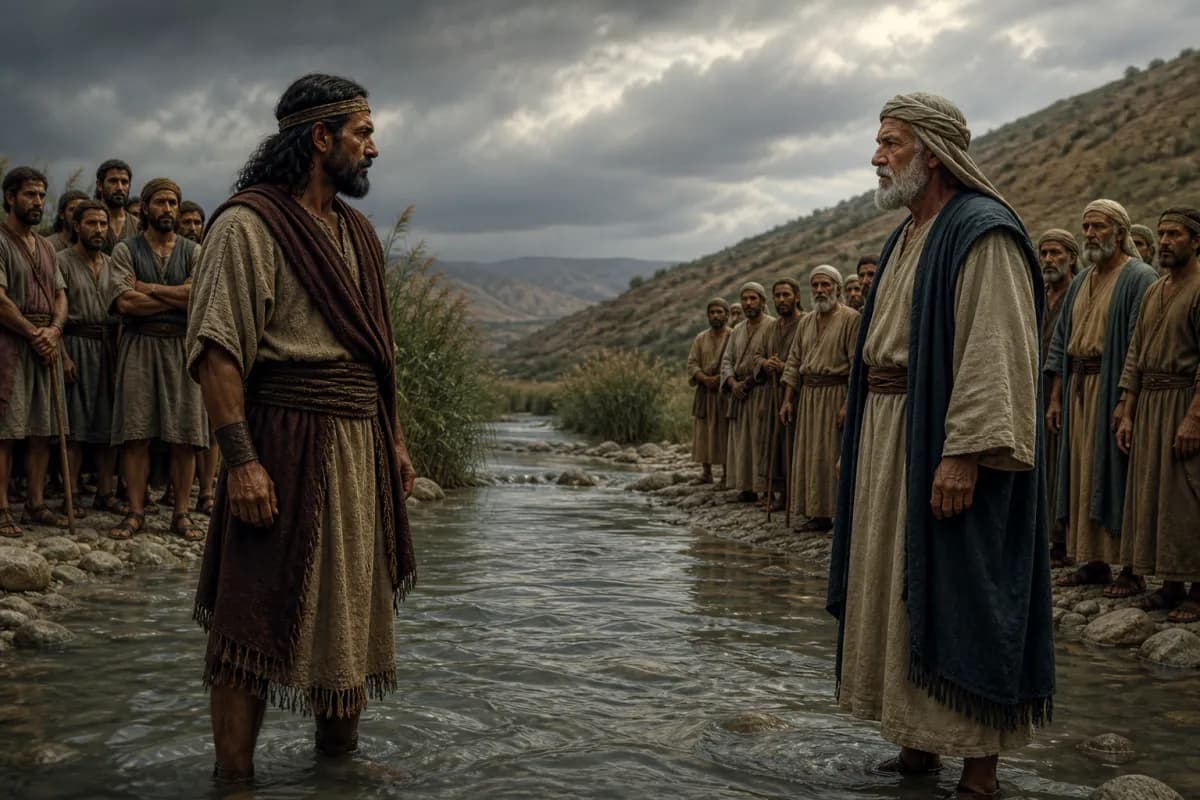
Judges 12 records Ephraim’s angry confrontation with Jephthah, the killing at the Jordan fords through the pronunciation test of “Shibboleth,” and the brief notices of three later judges. The passage exposes how tribal pride turns a shared deliverance into civil bloodshed and directs readers to Jesus, who creates peace among estranged people through His cross.
- In this study
- 15 verses · 5 movements
Judges 12
12:1The men of Ephraim were gathered together, and passed northward; and they said to Jephthah, “Why did you pass over to fight against the children of Ammon, and didn’t call us to go with you? We will burn your house around you with fire!”
12:2Jephthah said to them, “I and my people were at great strife with the children of Ammon; and when I called you, you didn’t save me out of their hand.
12:3When I saw that you didn’t save me, I put my life in my hand, and passed over against the children of Ammon, and the LORD delivered them into my hand. Why then have you come up to me today, to fight against me?”
12:4Then Jephthah gathered together all the men of Gilead, and fought with Ephraim. The men of Gilead struck Ephraim, because they said, “You are fugitives of Ephraim, you Gileadites, in the middle of Ephraim, and in the middle of Manasseh.”
12:5The Gileadites took the fords of the Jordan against the Ephraimites. Whenever a fugitive of Ephraim said, “Let me go over,” the men of Gilead said to him, “Are you an Ephraimite?” If he said, “No;”
12:6then they said to him, “Now say ‘Shibboleth;’” and he said “Sibboleth”; for he couldn’t manage to pronounce it correctly, then they seized him and killed him at the fords of the Jordan. At that time, forty-two thousand of Ephraim fell.
12:7Jephthah judged Israel six years. Then Jephthah the Gileadite died, and was buried in the cities of Gilead.
12:8After him Ibzan of Bethlehem judged Israel.
12:9He had thirty sons. He sent his thirty daughters outside his clan, and he brought in thirty daughters from outside his clan for his sons. He judged Israel seven years.
12:10Ibzan died, and was buried at Bethlehem.
12:11After him, Elon the Zebulunite judged Israel; and he judged Israel ten years.
12:12Elon the Zebulunite died, and was buried in Aijalon in the land of Zebulun.
12:13After him, Abdon the son of Hillel the Pirathonite judged Israel.
12:14He had forty sons and thirty sons’ sons who rode on seventy donkey colts. He judged Israel eight years.
12:15Abdon the son of Hillel the Pirathonite died, and was buried in Pirathon in the land of Ephraim, in the hill country of the Amalekites.
CONTEXTUAL OVERVIEW
The war with Ammon has ended, but Judges 12 immediately opens another conflict, this time inside Israel. Ephraim gathers and threatens to burn Jephthah’s house because it believes it was excluded from the battle. The accusation recalls Ephraim’s earlier complaint to Gideon, yet the outcome here is far more destructive.
The chapter’s most remembered detail is the word test at the Jordan crossings. Gileadites identify Ephraimite fugitives by their inability to pronounce “Shibboleth” in the Gileadite way. A feature of speech becomes a lethal boundary between brothers. The closing notices about Ibzan, Elon, and Abdon cannot erase the grief of the civil slaughter.
HISTORICAL AND LITERARY CONTEXT
Judges 12 continues the instability of the Jephthah narrative. Israel has been delivered from an external enemy, yet tribal rivalry remains unresolved. The book increasingly shows that the people’s deepest danger is not simply the army across a border but the covenant breakdown within its own life.
Shibboleth can refer to an ear of grain or a stream, but its narrative function is clear: pronunciation exposes regional identity. The passage is not a lesson in linguistic superiority. It is an indictment of a moment in which identity markers are weaponized against fellow Israelites in a time of fear and retaliation.
SECTION-BY-SECTION ANALYSIS
- Why did you not call us? · Judges 12:1Ephraim turns wounded honor into a threat rather than seeking truthful reconciliation.
- Shibboleth · Judges 12:6A spoken difference becomes a weapon when rival tribes treat belonging as grounds for exclusion and death.
- He judged Israel · Judges 12:7The repeated judge notices sustain the book’s chronology while showing the insufficiency of temporary leadership.
CHRIST IN THIS PASSAGE
Judges 12 does not directly predict Christ, but it names a fracture that human judges cannot heal. Jesus bears hostility in His body to create one reconciled people from those divided by former enmity. His peace is not denial of truth or justice; it is the costly reconciliation that turns enemies into members of one household.
The church therefore cannot use accent, culture, ethnicity, class, or preferred custom as a weapon of contempt. Christ sends His people to proclaim reconciliation among the nations. That mission requires humility about our own group and practical love across the boundaries Jesus has broken down.
REFLECTION
Conflicts become dangerous when belonging matters more than truth and love. A phrase, a regional identity, or a familiar custom can become a way of deciding who deserves suspicion. Judges 12 asks whether resentment has trained us to interpret every difference as a threat.
Ask Jesus to show you where group loyalty has hardened into contempt. Take one truthful step toward peace: listen without preparing your defense, refuse a mocking label, or seek reconciliation with a fellow believer. His cross gives courage to confess sin without losing identity.
Original Hebrew Word Study
Judges 12:6
שִׁבֹּלֶת
shibboleth · H7641
Usually translated: stream, ear of grain, or a distinguishing word
Shibboleth is a word that becomes a test of identity. The tragic pronunciation test shows Israel’s civil conflict turning even speech into a weapon against brothers.
Follow the Scripture trail
When Brother Turns against Brother in the larger story
The connection: Israel’s shared deliverance collapses into tribal contempt and bloodshed, revealing a need for deeper reconciliation. Jesus makes peace through His cross and sends a united people to bear witness to His reconciling love.
Respond to the passage
Ask Jesus where resentment or group pride has made you suspicious of another believer. Refuse one contemptuous habit, and take a concrete step toward listening, confession, or peace.
- What turns Ephraim’s grievance into a deadly conflict?
- Why is the Shibboleth test a tragedy rather than a clever detail?
- How does Christ’s peace reshape the way Christians handle identity and disagreement?
Prayer
Lord Jesus, You make peace by Your cross. Forgive my pride and contempt, teach me to seek truth without cruelty, and make Your church a credible sign of Your reconciling mission. Amen.