Passage Study
Samson’s Vengeance and the Lord’s Deliverance
Judges 15:1–15:20
Judges 15 follows Samson as one personal grievance becomes a widening cycle of retaliation between him and the Philistines. The Lord nevertheless uses Samson to strike Israel’s oppressors, even while Samson’s anger and Israel’s fearful surrender reveal how little the nation resembles a faithful people. The passage directs readers to Jesus, who defeats evil without being mastered by vengeance and creates a people who bear witness to His reconciling peace.
- In this study
- 20 verses · 5 movements
Judges 15
15:1But after a while, in the time of wheat harvest, Samson visited his wife with a young goat. He said, “I will go in to my wife’s room.” But her father wouldn’t allow him to go in.
15:2Her father said, “I most certainly thought that you utterly hated her; therefore I gave her to your companion. Isn’t her younger sister more beautiful than she? Please, take her instead.”
15:3Samson said to them, “This time I will be blameless in the case of the Philistines when I harm them.”
15:4Samson went and caught three hundred foxes, and took torches, and turned tail to tail, and put a torch in the middle between every two tails.
15:5When he had set the torches on fire, he let them go into the standing grain of the Philistines, and burned up both the shocks and the standing grain, and also the olive groves.
15:6Then the Philistines said, “Who has done this?” They said, “Samson, the son-in-law of the Timnite, because he has taken his wife and given her to his companion.” The Philistines came up, and burned her and her father with fire.
15:7Samson said to them, “If you behave like this, surely I will take revenge on you, and after that I will cease.”
15:8He struck them hip and thigh with a great slaughter; and he went down and lived in the cave in Etam’s rock.
15:9Then the Philistines went up, encamped in Judah, and spread themselves in Lehi.
15:10The men of Judah said, “Why have you come up against us?” They said, “We have come up to bind Samson, to do to him as he has done to us.”
15:11Then three thousand men of Judah went down to the cave in Etam’s rock, and said to Samson, “Don’t you know that the Philistines are rulers over us? What then is this that you have done to us?” He said to them, “As they did to me, so I have done to them.”
15:12They said to him, “We have come down to bind you, that we may deliver you into the hand of the Philistines.” Samson said to them, “Swear to me that you will not attack me yourselves.”
15:13They spoke to him, saying, “No, but we will bind you securely and deliver you into their hands; but surely we will not kill you.” They bound him with two new ropes, and brought him up from the rock.
15:14When he came to Lehi, the Philistines shouted as they met him. Then the LORD’s Spirit came mightily on him, and the ropes that were on his arms became as flax that was burned with fire; and his bands dropped from off his hands.
15:15He found a fresh jawbone of a donkey, put out his hand, took it, and struck a thousand men with it.
15:16Samson said, “With the jawbone of a donkey, heaps on heaps; with the jawbone of a donkey I have struck a thousand men.”
15:17When he had finished speaking, he threw the jawbone out of his hand; and that place was called Ramath Lehi.
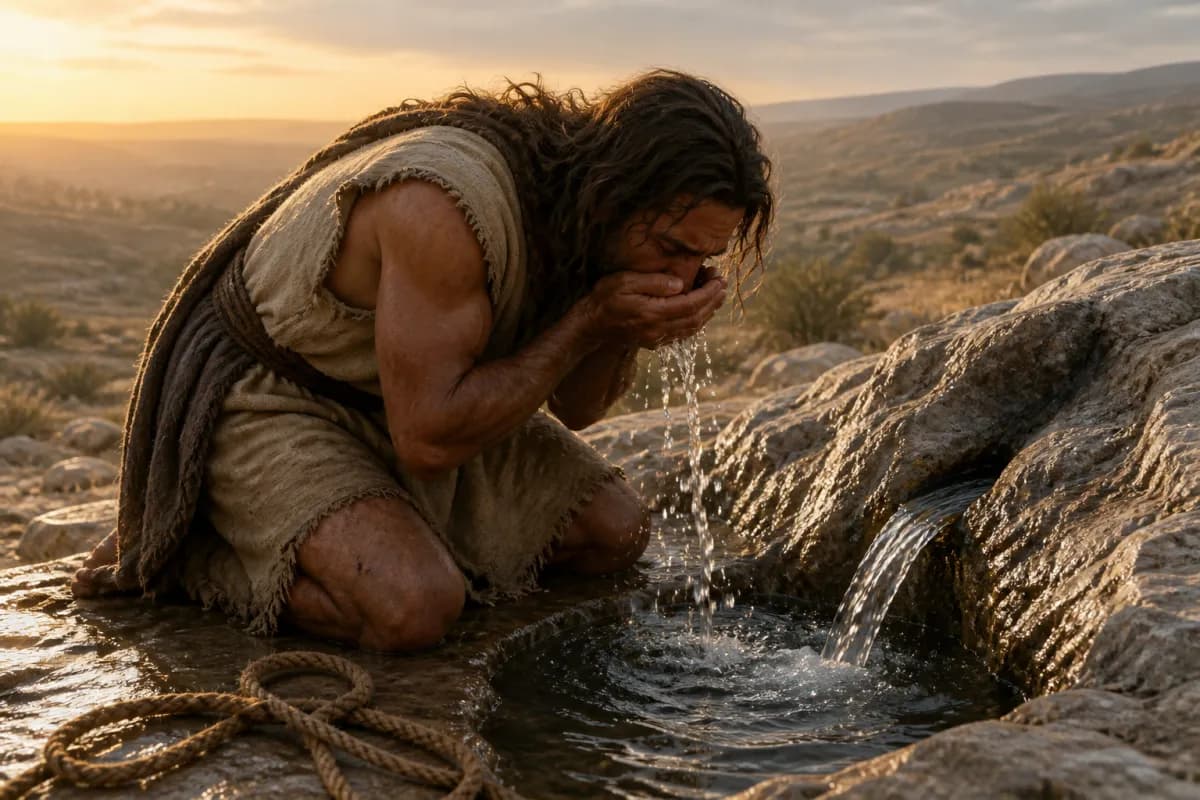
15:18He was very thirsty, and called on the LORD and said, “You have given this great deliverance by the hand of your servant; and now shall I die of thirst, and fall into the hands of the uncircumcised?”
15:19But God split the hollow place that is in Lehi, and water came out of it. When he had drunk, his spirit came again, and he revived. Therefore its name was called En Hakkore, which is in Lehi, to this day.
15:20He judged Israel twenty years in the days of the Philistines.
CONTEXTUAL OVERVIEW
Judges 15 begins with Samson returning to Timnah expecting to visit the woman he married, only to learn that her father has given her to another man. His response is not a measured appeal to justice. He catches foxes or jackals, ties torches between pairs, and sends them through Philistine grain, vineyards, and olive groves. A family rupture becomes agricultural devastation.
The Philistines answer by burning Samson’s wife and her father, the very outcome Samson’s wife had feared in the previous chapter. Samson then kills many Philistines, while the men of Judah bind their own deliverer and hand him over. The passage is deliberately bleak: Israel is so adjusted to Philistine rule that it treats God’s rescuer as the threat to manage.
HISTORICAL AND LITERARY CONTEXT
This episode continues the Samson narrative after the broken wedding feast of Judges 14. Samson’s actions are set in the borderlands between Judah and Philistine territory, where personal loyalty, clan honor, harvest wealth, and political power could all feed retaliation. The narrative neither disguises Philistine cruelty nor treats Samson’s private revenge as a simple model for Israel.
Judges repeatedly shows the Lord using compromised deliverers in a compromised nation. Samson’s calling from birth remains real, and the text explicitly says that the Spirit of the Lord comes upon him. Yet divine use does not turn every motive or method into an endorsement. That distinction matters when reading a story where God’s saving purpose moves through deeply damaged human choices.
SECTION-BY-SECTION ANALYSIS
- I will be blameless · Judges 15:3Samson frames retaliation as justified, but the chapter displays how self-vindication enlarges the damage.
- The Philistines rule over us · Judges 15:11Judah’s words reveal a people who have accepted oppression instead of trusting the Lord’s deliverance.
- You have granted this great victory · Judges 15:18Samson’s thirsty prayer finally acknowledges that the rescue did not originate in his own strength.
CHRIST IN THIS PASSAGE
Samson is not a pattern for Christian retaliation. His strength is used by God against Israel’s oppressors, but his personal anger cannot heal the conflict he escalates. Jesus confronts evil with perfect holiness, bears unjust violence without returning it in kind, and defeats the powers of sin and death through His self-giving cross. He alone joins justice and mercy without becoming captive to revenge.
Christ’s saving mission frees people from the rule of vengeance. The church can name real harm, seek truthful justice, protect the vulnerable, and entrust final judgment to God. It also bears witness to the crucified and risen Jesus by refusing to make personal retaliation its source of identity or hope.
REFLECTION
Judges 15 asks what happens when an injury becomes the story by which we live. Samson’s pain is not imaginary, and the Philistines’ violence is wicked. Yet his answer keeps creating new occasions for ruin. A follower of Jesus may bring a wrong into the light, pursue appropriate help and accountability, and still refuse the inward demand to repay hurt with hurt.
Notice also Judah’s fear. It is possible to become so accustomed to an enslaving pattern—sin, pressure, addiction, abuse, or public approval—that freedom feels dangerous. Ask Jesus where resignation has replaced faith, and seek help from wise believers as you take a concrete step toward truthful freedom.
Original Hebrew Word Study
Judges 15:7
נָקַם
naqam · H5358
Usually translated: to take vengeance
Naqam is vengeance. Samson’s retaliation escalates personal injury into wider violence, even as the Lord uses his actions against Israel’s oppressors.
Follow the Scripture trail
Samson’s Vengeance and the Lord’s Deliverance in the larger story
The connection: Samson’s revenge exposes Israel’s bondage to both Philistine power and the spiral of retaliation. Jesus defeats the deeper slavery of sin through His cross and sends a reconciled people to announce His peace.
Respond to the passage
Name the wrong you are tempted to repay. Bring it honestly to Jesus, take any appropriate step toward safety or justice, and ask Him to free you from carrying vengeance as your identity.
- How does the conflict grow as each party calls its own retaliation justified?
- What does Judah’s willingness to hand Samson over reveal about its spiritual condition?
- How does Jesus make it possible to pursue justice without becoming ruled by vengeance?
Prayer
Lord Jesus, You see every injury and You judge with truth. Guard me from revenge, give courage where I have grown resigned to bondage, and make me a witness to Your costly peace. Amen.