Passage Study
Samson’s Fall and His Final Cry
Judges 16:1–16:31
Judges 16 records Samson’s repeated compromise, Delilah’s betrayal, the loss of his strength, humiliation before the Philistines, and final prayer in their temple. God uses Samson’s death to strike Israel’s oppressors, but the story refuses to make his ruin admirable. It directs readers to Jesus, the faithful Savior whose willing death conquers sin and death without moral failure and whose resurrection gives lasting life.
- In this study
- 31 verses · 5 movements
Judges 16
16:1Samson went to Gaza, and saw there a prostitute, and went in to her.
16:2The Gazites were told, “Samson is here!” They surrounded him and laid wait for him all night in the gate of the city, and were quiet all the night, saying, “Wait until morning light; then we will kill him.”
16:3Samson lay until midnight, then arose at midnight and took hold of the doors of the gate of the city, with the two posts, and plucked them up, bar and all, and put them on his shoulders and carried them up to the top of the mountain that is before Hebron.
16:4It came to pass afterward that he loved a woman in the valley of Sorek, whose name was Delilah.
16:5The lords of the Philistines came up to her and said to her, “Entice him, and see in which his great strength lies, and by what means we may prevail against him, that we may bind him to afflict him; and we will each give you eleven hundred pieces of silver.”
16:6Delilah said to Samson, “Please tell me where your great strength lies, and what you might be bound to afflict you.”
16:7Samson said to her, “If they bind me with seven green cords that were never dried, then shall I become weak, and be as another man.”
16:8Then the lords of the Philistines brought up to her seven green cords which had not been dried, and she bound him with them.
16:9Now she had an ambush waiting in the inner room. She said to him, “The Philistines are on you, Samson!” He broke the cords as a flax thread is broken when it touches the fire. So his strength was not known.
16:10Delilah said to Samson, “Behold, you have mocked me, and told me lies. Now please tell me how you might be bound.”
16:11He said to her, “If they only bind me with new ropes with which no work has been done, then I will become weak, and be as another man.”
16:12So Delilah took new ropes and bound him with them, then said to him, “The Philistines are on you, Samson!” The ambush was waiting in the inner room. He broke them off his arms like a thread.
16:13Delilah said to Samson, “Until now, you have mocked me and told me lies. Tell me with what you might be bound.” He said to her, “If you weave the seven locks of my head with the fabric on the loom.”
16:14She fastened it with the pin, and said to him, “The Philistines are on you, Samson!” He awakened out of his sleep, and plucked away the pin of the beam and the fabric.
16:15She said to him, “How can you say, ‘I love you,’ when your heart is not with me? You have mocked me these three times, and have not told me where your great strength lies.”
16:16When she pressed him daily with her words and urged him, his soul was troubled to death.
16:17He told her all his heart and said to her, “No razor has ever come on my head; for I have been a Nazirite to God from my mother’s womb. If I am shaved, then my strength will go from me and I will become weak, and be like any other man.”
16:18When Delilah saw that he had told her all his heart, she sent and called for the lords of the Philistines, saying, “Come up this once, for he has told me all his heart.” Then the lords of the Philistines came up to her and brought the money in their hand.
16:19She made him sleep on her knees; and she called for a man and shaved off the seven locks of his head; and she began to afflict him, and his strength went from him.
16:20She said, “The Philistines are upon you, Samson!” He awoke out of his sleep, and said, “I will go out as at other times, and shake myself free.” But he didn’t know that the LORD had departed from him.
16:21The Philistines laid hold on him and put out his eyes; and they brought him down to Gaza and bound him with fetters of bronze; and he ground at the mill in the prison.
16:22However, the hair of his head began to grow again after he was shaved.
16:23The lords of the Philistines gathered together to offer a great sacrifice to Dagon their god, and to rejoice; for they said, “Our god has delivered Samson our enemy into our hand.”
16:24When the people saw him, they praised their god; for they said, “Our god has delivered our enemy and the destroyer of our country, who has slain many of us, into our hand.”
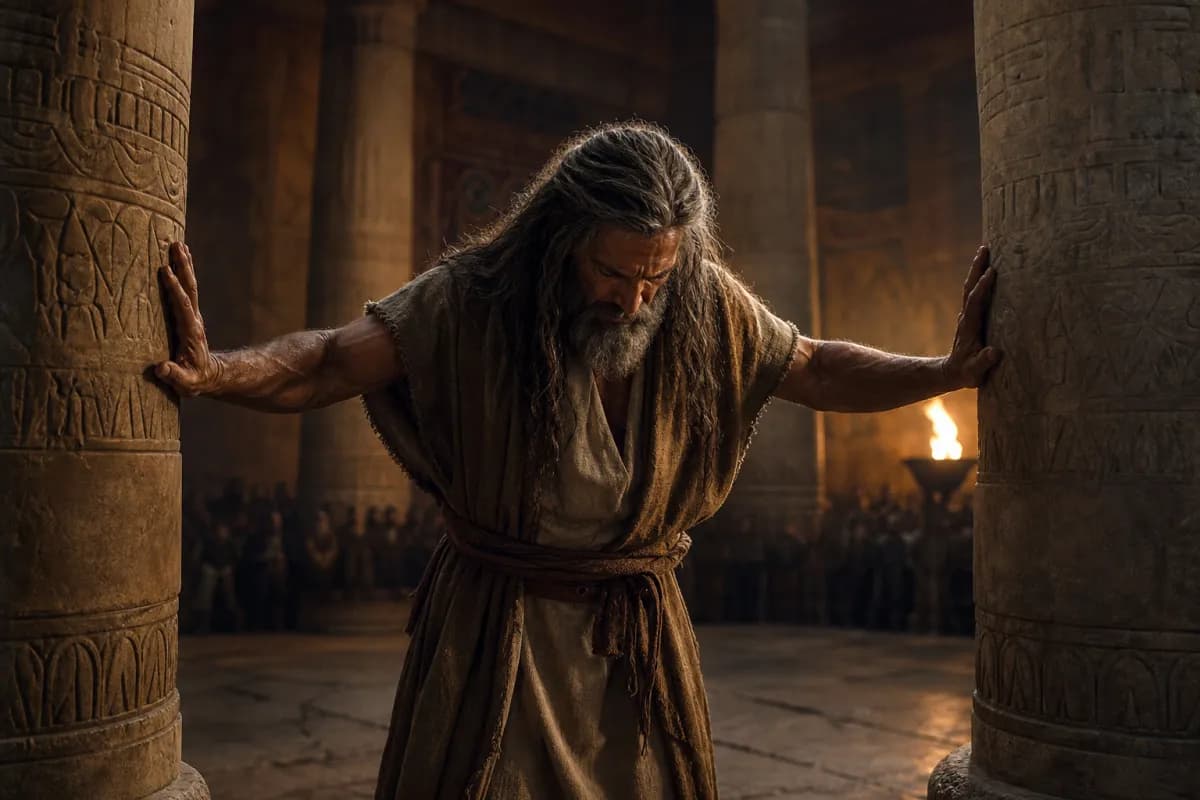
16:25When their hearts were merry, they said, “Call for Samson, that he may entertain us.” They called for Samson out of the prison; and he performed before them. They set him between the pillars;
16:26and Samson said to the boy who held him by the hand, “Allow me to feel the pillars on which the house rests, that I may lean on them.”
16:27Now the house was full of men and women; and all the lords of the Philistines were there; and there were on the roof about three thousand men and women, who saw while Samson performed.
16:28Samson called to the LORD, and said, “Lord GOD, remember me, please, and strengthen me, please, only this once, God, that I may be at once avenged of the Philistines for my two eyes.”
16:29Samson took hold of the two middle pillars on which the house rested and leaned on them, the one with his right hand and the other with his left.
16:30Samson said, “Let me die with the Philistines!” He bowed himself with all his might; and the house fell on the lords, and on all the people who were in it. So the dead that he killed at his death were more than those who he killed in his life.
16:31Then his brothers and all the house of his father came down and took him, and brought him up and buried him between Zorah and Eshtaol in the burial site of Manoah his father. He judged Israel twenty years.
CONTEXTUAL OVERVIEW
Samson’s story reaches its most painful turn in Judges 16. He first walks into Gaza, a Philistine stronghold, visits a prostitute, and escapes an ambush by carrying off the city gate. The feat displays extraordinary strength, but it does not signal spiritual health. His power repeatedly coexists with a pattern of yielding himself to places and relationships that draw him away from the calling marked on him from birth.
Delilah’s repeated questioning becomes a slow unmaking of Samson’s trust. Three times he deceives her, and three times Philistines wait to seize him. When he finally discloses the sign of his Nazirite consecration, he treats a holy calling as a secret to be managed. The chapter’s terror lies in the sentence that he did not know the Lord had left him.
HISTORICAL AND LITERARY CONTEXT
Judges 16 closes the Samson cycle begun by the annunciation in chapter 13. His uncut hair is not a magical source of strength; it is the visible sign of a consecration to God. The narrative links the shaving of his head to his persistent betrayal of that calling, while making clear that the Lord, rather than a physical object, is the source of Samson’s strength.
The Philistine celebration in Dagon’s temple gives the episode a public religious dimension. Their rulers credit Dagon with Samson’s capture and gather to mock the man who had struck them. The final collapse therefore becomes a judgment on Philistine confidence in a god that cannot finally save, though the passage should never be read as a license for religious violence or self-destruction.
SECTION-BY-SECTION ANALYSIS
- He did not know the Lord had left him · Judges 16:20Samson’s confidence in himself cannot preserve the divine empowerment he has repeatedly treated lightly.
- His hair began to grow · Judges 16:22The detail signals that judgment is not the final word and prepares the reader for God’s merciful action.
- Remember me and strengthen me · Judges 16:28Samson’s final prayer acknowledges dependence, though it remains shaped by the enemies who have harmed him.
CHRIST IN THIS PASSAGE
Samson’s final death can only be compared to Jesus by contrast as well as resemblance. Samson dies while bringing judgment on enemies, but his death follows a life of compromise and does not atone for anyone’s sin. Jesus freely lays down His life in flawless obedience, bears the judgment sinners deserve, and rises bodily in victory. His death is not a tragic end to failed potential; it is the decisive saving work He came to accomplish.
The Philistines praise Dagon for their apparent victory, but God overturns their boast. At the cross, hostile powers also appear to triumph; in the resurrection, Jesus decisively disarms them. His mission now calls people from every nation—including former enemies—into forgiveness, new life, and worship of the living God.
REFLECTION
Samson’s collapse warns against confusing giftedness with faithfulness. A person may possess ability, influence, opportunity, or a long history of God’s kindness while quietly treating consecration as expendable. The repeated compromises in this chapter did not make Samson feel immediately powerless, which is part of the warning. Sin can numb perception long before its consequences become visible.
Yet the final prayer also keeps despair from having the last word. Bring failure to Jesus without minimizing it. Receive His mercy, accept the real work of repentance and repair, and resist the fantasy that strength is found in hiding weakness. The risen Christ gives a cleaner hope than Samson’s final hour: forgiveness and new obedience that continue beyond death.
Original Hebrew Word Study
Judges 16:28
חָזַק
chazaq · H2388
Usually translated: to strengthen
Chazaq means to strengthen. Samson’s final prayer asks God for strength once more, and his death brings deliverance while exposing the cost of his unfaithful life.
Follow the Scripture trail
Samson’s Fall and His Final Cry in the larger story
The connection: Samson’s calling and collapse show that Israel needs more than a powerful but compromised judge. Jesus is the faithful Savior whose death and resurrection conquer the powers of sin and death and open mercy to the nations.
Respond to the passage
Ask Jesus to expose any place where ability or past blessing has made you careless with obedience. Confess it plainly, seek trustworthy help, and receive the mercy that leads into a changed life.
- Why is Samson’s hair a sign of consecration rather than a magical source of strength?
- What does the phrase that Samson did not know the Lord had left him communicate about compromise?
- How is Jesus’ death fundamentally different from Samson’s final act?
Prayer
Lord Jesus, keep me from treating Your gifts as proof that I can ignore Your call. Meet me in honest repentance, break the power of hidden compromise, and form in me the faithful life Your grace makes possible. Amen.