Passage Study
When Worship Is Remade at Home
Judges 17:1–17:13
Judges 17 tells how Micah turns silver tied to theft, a mother’s blessing, household images, and a wandering Levite into a private religious system. The chapter exposes the danger of using the Lord’s name to bless worship shaped by personal preference. It directs readers to Jesus, the true revelation of God who gathers His people around His word rather than around self-made religion.
- In this study
- 13 verses · 5 movements
Judges 17
17:1There was a man of the hill country of Ephraim, whose name was Micah.
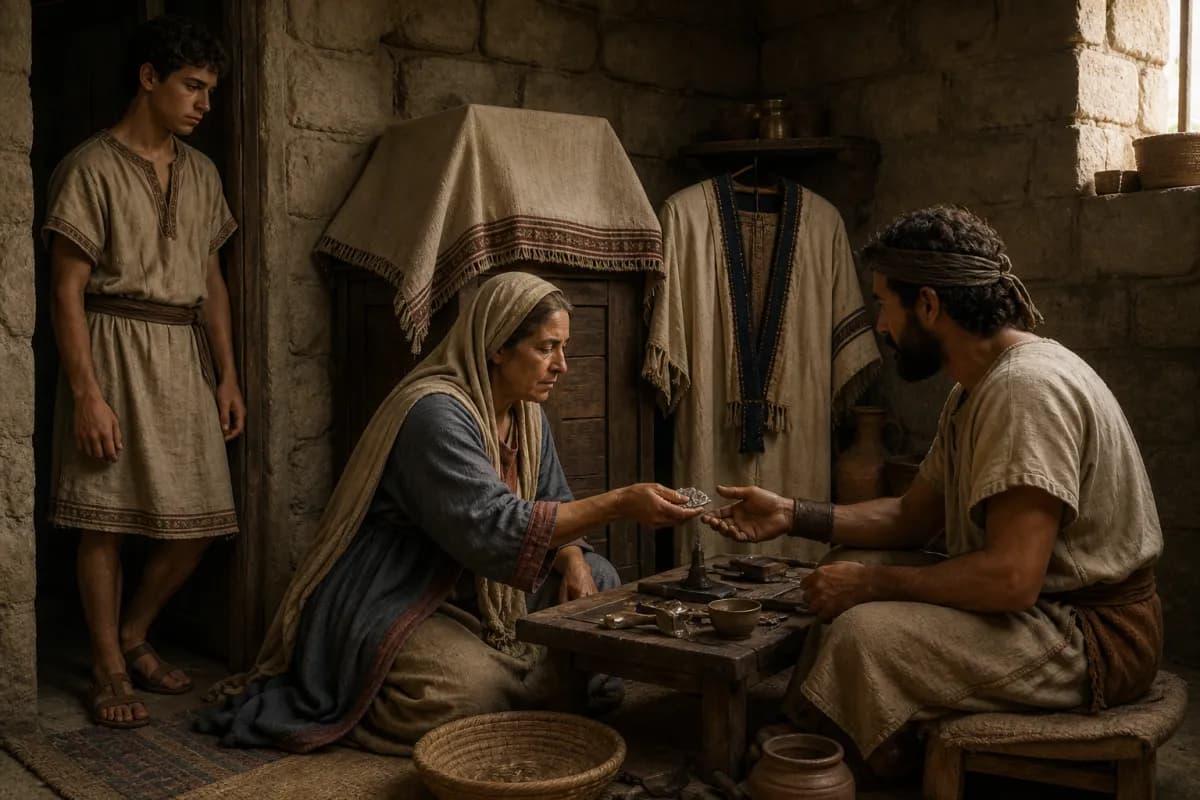
17:2He said to his mother, “The eleven hundred pieces of silver that were taken from you, about which you uttered a curse, and also spoke it in my ears—behold, the silver is with me. I took it.” His mother said, “May the LORD bless my son!”
17:3He restored the eleven hundred pieces of silver to his mother, then his mother said, “I most certainly dedicate the silver to the LORD from my hand for my son, to make a carved image and a molten image. Now therefore I will restore it to you.”
17:4When he restored the money to his mother, his mother took two hundred pieces of silver, and gave them to a silversmith, who made a carved image and a molten image out of it. It was in the house of Micah.
17:5The man Micah had a house of gods, and he made an ephod, and teraphim, and consecrated one of his sons, who became his priest.
17:6In those days there was no king in Israel. Everyone did that which was right in his own eyes.
17:7There was a young man out of Bethlehem Judah, of the family of Judah, who was a Levite; and he lived there.
17:8The man departed out of the city, out of Bethlehem Judah, to live where he could find a place, and he came to the hill country of Ephraim, to the house of Micah, as he traveled.
17:9Micah said to him, “Where did you come from?” He said to him, “I am a Levite of Bethlehem Judah, and I am looking for a place to live.”
17:10Micah said to him, “Dwell with me, and be to me a father and a priest, and I will give you ten pieces of silver per year, a suit of clothing, and your food.” So the Levite went in.
17:11The Levite was content to dwell with the man; and the young man was to him as one of his sons.
17:12Micah consecrated the Levite, and the young man became his priest, and was in the house of Micah.
17:13Then Micah said, “Now I know that the LORD will do good to me, since I have a Levite as my priest.”
CONTEXTUAL OVERVIEW
After Samson’s death, Judges turns from battles with Philistines to the disintegration of Israel’s worship from within. Micah confesses that he stole eleven hundred pieces of silver from his mother because he heard her curse. She blesses him when he returns it and declares the silver dedicated to the Lord, yet a portion becomes a carved image and a cast image for Micah’s house.
The story is strange on purpose. God-language appears everywhere: dedication to the Lord, a household shrine, an ephod, and a Levite hired as priest. But the arrangement is built around Micah’s wishes and resources. The narrator’s explanation—everyone did what was right in his own eyes—shows that the problem is not a lack of religious activity but worship detached from God’s instruction.
HISTORICAL AND LITERARY CONTEXT
Judges 17–21 form the book’s closing appendix. These chapters do not simply continue the chronology after Samson; they gather stories that reveal what life looked like when covenant order fractured in worship, tribe, and household. The refrain about no king in Israel points ultimately to the need for faithful rule under God, not merely for any human strongman.
Levites had particular responsibilities connected to Israel’s worship, but the arrival of an individual Levite does not make Micah’s private sanctuary legitimate. The story contrasts a purchased religious professional with the worship God had ordered for His people. It cautions readers against assuming that religious language, credentials, or rituals can sanctify a system created to serve private control.
SECTION-BY-SECTION ANALYSIS
- Dedicated to the Lord · Judges 17:2The Lord’s name is invoked, but the object made from the silver contradicts the worship He commanded.
- A Levite as priest · Judges 17:13Micah treats a Levite’s presence as spiritual insurance rather than submitting his household to God.
- Right in his own eyes · Judges 17:6The refrain diagnoses moral and religious autonomy, not a healthy diversity of spiritual practice.
CHRIST IN THIS PASSAGE
Micah’s shrine reveals the human impulse to make religion manageable: a visible object, a paid priest, and a promise of prosperity. Jesus refuses to be controlled in that way. He is the true image of the invisible God and the final priest who brings people to the Father through His own sacrifice, not through systems designed to secure personal advantage.
Christ’s mission calls people out of self-made worship into truth. The church does not offer a religious mechanism for guaranteeing success. It announces Jesus crucified and risen, forms disciples under His word, and invites people to know God as Father by grace rather than to manipulate Him for gain.
REFLECTION
Micah’s story asks whether we want God Himself or a spirituality that keeps us in charge. A Christian can use correct words, attend worship, and still quietly expect God to bless a life ordered around control, money, approval, or comfort. The question is not whether religious practices are present, but whether they are receiving their shape from Jesus and Scripture.
Bring your expectations of God into the open. Where have you treated prayer, generosity, service, a church role, or a leader as a way to secure an outcome? Ask Jesus to replace bargaining with trust and to make your worship responsive to who He truly is.
Original Hebrew Word Study
Judges 17:3
פֶּסֶל
pesel · H6459
Usually translated: carved image
Pesel is a carved image. Micah’s household religion combines language about the Lord with an idol, showing how easily worship is remade around personal preference.
Follow the Scripture trail
When Worship Is Remade at Home in the larger story
The connection: Micah tries to secure blessing through a religion he controls. Jesus reveals the Father truly, brings sinners to God by His sacrifice, and sends the church to invite people from self-made worship into life with Him.
Respond to the passage
Ask Jesus to reveal one way you have tried to manage God rather than trust Him. Release that bargain in prayer and reorder one practice of worship around His word and His grace.
- Why does the repeated use of the Lord’s name not make Micah’s shrine faithful worship?
- What does Micah expect the Levite to accomplish for him?
- How does Jesus free people from treating religion as a way to control outcomes?
Prayer
Lord Jesus, forgive me for every attempt to use You for my own security or success. Reveal the Father to me, shape my worship by Your truth, and make my life an honest invitation for others to know You. Amen.