Passage Study
Gibeah and the Horror of a People Without Restraint
Judges 19:1–19:30
Judges 19 tells of a Levite, his concubine, a hospitable old man, and the men of Gibeah whose assault and violence end in the woman’s death. The chapter is a devastating indictment of Israel’s moral collapse, especially its failure to protect the vulnerable. It directs readers to Jesus, who sees hidden violence, bears human sin’s judgment, and forms a people committed to truth, protection, repentance, and costly love.
- In this study
- 30 verses · 5 movements
Judges 19
19:1In those days, when there was no king in Israel, there was a certain Levite living on the farther side of the hill country of Ephraim, who took for himself a concubine out of Bethlehem Judah.
19:2His concubine played the prostitute against him, and went away from him to her father’s house to Bethlehem Judah, and was there for four months.
19:3Her husband arose and went after her to speak kindly to her, to bring her again, having his servant with him and a couple of donkeys. She brought him into her father’s house; and when the father of the young lady saw him, he rejoiced to meet him.
19:4His father-in-law, the young lady’s father, kept him there; and he stayed with him three days. So they ate and drank, and stayed there.
19:5On the fourth day, they got up early in the morning, and he rose up to depart. The young lady’s father said to his son-in-law, “Strengthen your heart with a morsel of bread, and afterward you shall go your way.”
19:6So they sat down, ate, and drank, both of them together. Then the young lady’s father said to the man, “Please be pleased to stay all night, and let your heart be merry.”
19:7The man rose up to depart; but his father-in-law urged him, and he stayed there again.
19:8He arose early in the morning on the fifth day to depart; and the young lady’s father said, “Please strengthen your heart and stay until the day declines;” and they both ate.
19:9When the man rose up to depart, he, and his concubine, and his servant, his father-in-law, the young lady’s father, said to him, “Behold, now the day draws toward evening, please stay all night. Behold, the day is ending. Stay here, that your heart may be merry; and tomorrow go on your way early, that you may go home.”
19:10But the man wouldn’t stay that night, but he rose up and went near Jebus (also called Jerusalem). With him were a couple of saddled donkeys. His concubine also was with him.
19:11When they were by Jebus, the day was far spent; and the servant said to his master, “Please come and let’s enter into this city of the Jebusites, and stay in it.”
19:12His master said to him, “We won’t enter into the city of a foreigner that is not of the children of Israel; but we will pass over to Gibeah.”
19:13He said to his servant, “Come and let’s draw near to one of these places; and we will lodge in Gibeah, or in Ramah.”
19:14So they passed on and went their way; and the sun went down on them near Gibeah, which belongs to Benjamin.
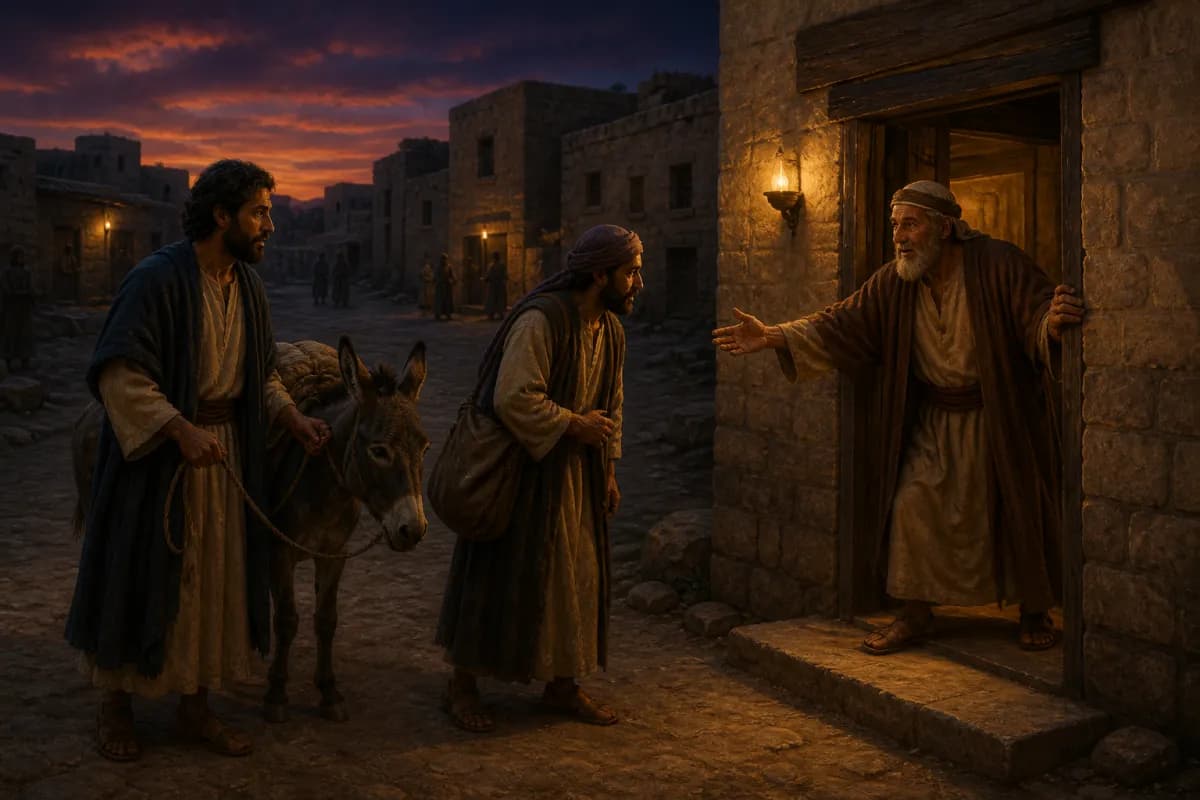
19:15They went over there, to go in to stay in Gibeah. He went in, and sat down in the street of the city; for there was no one who took them into his house to stay.
19:16Behold, an old man came from his work out of the field at evening. Now the man was from the hill country of Ephraim, and he lived in Gibeah; but the men of the place were Benjamites.
19:17He lifted up his eyes, and saw the wayfaring man in the street of the city; and the old man said, “Where are you going? Where did you come from?”
19:18He said to him, “We are passing from Bethlehem Judah to the farther side of the hill country of Ephraim. I am from there, and I went to Bethlehem Judah. I am going to the LORD’s house; and there is no one who has taken me into his house.
19:19Yet there is both straw and feed for our donkeys; and there is bread and wine also for me, and for your servant, and for the young man who is with your servants. There is no lack of anything.”
19:20The old man said, “Peace be to you! Just let me supply all your needs, but don’t sleep in the street.”
19:21So he brought him into his house, and gave the donkeys fodder. Then they washed their feet, and ate and drank.
19:22As they were making their hearts merry, behold, the men of the city, certain wicked fellows, surrounded the house, beating at the door; and they spoke to the master of the house, the old man, saying, “Bring out the man who came into your house, that we can have sex with him!”
19:23The man, the master of the house, went out to them, and said to them, “No, my brothers, please don’t act so wickedly; since this man has come into my house, don’t do this folly.
19:24Behold, here is my virgin daughter and his concubine. I will bring them out now. Humble them, and do with them what seems good to you; but to this man don’t do any such folly.”
19:25But the men wouldn’t listen to him; so the man grabbed his concubine, and brought her out to them; and they had sex with her, and abused her all night until the morning. When the day began to dawn, they let her go.
19:26Then the woman came in the dawning of the day, and fell down at the door of the man’s house where her lord was, until it was light.
19:27Her lord rose up in the morning and opened the doors of the house, and went out to go his way; and behold, the woman his concubine had fallen down at the door of the house, with her hands on the threshold.
19:28He said to her, “Get up, and let’s get going!” but no one answered. Then he took her up on the donkey; and the man rose up, and went to his place.
19:29When he had come into his house, he took a knife and cut up his concubine, and divided her, limb by limb, into twelve pieces, and sent her throughout all the borders of Israel.
19:30It was so, that all who saw it said, “Such a deed has not been done or seen from the day that the children of Israel came up out of the land of Egypt to this day! Consider it, take counsel, and speak.”
CONTEXTUAL OVERVIEW
Judges 19 is one of Scripture’s most grievous narratives. It does not invite detached curiosity or turn violence into spectacle. The story begins with travel and hospitality but descends into abuse, cowardice, and death. Its opening and closing reminders that there was no king in Israel frame the event as evidence of a society in which people have abandoned God’s moral order.
The woman is described as a concubine, a socially vulnerable position, and the narrative repeatedly shows men making decisions over her rather than protecting her. The men of Gibeah demand to abuse the Levite. The host offers his daughter and the concubine; the Levite seizes the concubine and sends her outside. The text does not excuse these choices. It exposes a community in which hospitality, leadership, and sexual integrity have been grotesquely inverted.
HISTORICAL AND LITERARY CONTEXT
The narrative deliberately echoes Genesis 19, where visitors in Sodom are threatened and Lot offers his daughters. The resemblance is a judgment: Gibeah, a town within Benjamin and Israel, behaves like the city that had become a symbol of notorious wickedness. Israel cannot comfort itself by locating corruption only among outsiders.
The chapter stands immediately before the civil-war account in Judges 20–21. The Levite’s dismemberment of the woman’s body summons a national response, but it is itself horrifying and does not make him a reliable moral hero. The reader is meant to feel the enormity of the crime and the inadequacy of the men whose actions have brought the nation to this point.
SECTION-BY-SECTION ANALYSIS
- No one took them into his house · Judges 19:15Gibeah’s failure begins with neglected hospitality and culminates in public violence.
- Do not do this vile thing · Judges 19:12The host names the mob’s proposed act as wicked, even while his own proposed response fails to protect the women.
- Consider it, take counsel, and speak · Judges 19:30Israel must face the crime truthfully; silence and denial cannot restore justice.
CHRIST IN THIS PASSAGE
Judges 19 does not set up a simple individual type of Christ. Its central witness is negative: the book displays what human rule becomes when no one protects the vulnerable and each person treats desire as final. Jesus is the righteous King Israel lacks. He welcomes the overlooked, confronts exploitation, and gives Himself to bear sin’s judgment rather than handing the powerless over to harm.
Christ’s saving mission does not allow the church to spiritualize or conceal abuse. Jesus calls His people into light, truth, repentance, protection of those at risk, and honest accountability. He offers forgiveness to sinners who repent, comfort to the wounded, and a kingdom where violence will not have the final word.
REFLECTION
This passage requires particular care for anyone harmed by sexual violence or betrayal. The Bible names such evil as vile; it does not make the victim responsible for the sin committed against her. If this story surfaces personal danger, trauma, or fear, seek immediate support from a trusted person and appropriate local authorities or care professionals. The church should be a place that believes, protects, and accompanies the vulnerable.
For every reader, Judges 19 asks whether we are willing to tell the truth when wrongdoing threatens a community’s reputation or comfort. Following Jesus includes refusing euphemism, listening to those who have been harmed, supporting just reporting and care, and examining places where self-protection has muted compassion.
Original Hebrew Word Study
Judges 19:23
נָבָל
naval · H5039
Usually translated: outrage, disgrace, or wickedness
Naval names disgraceful wickedness. The story exposes a moral collapse in which hospitality, leadership, and care for the vulnerable have been violently overturned.
Follow the Scripture trail
Gibeah and the Horror of a People Without Restraint in the larger story
The connection: Gibeah’s violence reveals a people without righteous rule or protection for the vulnerable. Jesus is the righteous King who bears sin’s judgment and sends His church to protect, tell the truth, care for the wounded, and announce His restoring grace.
Respond to the passage
Ask Jesus to make you truthful and protective where another person is vulnerable. If this passage connects to harm in your life, tell a trusted person today and seek the support and safety you need.
- How does the echo of Sodom sharpen the judgment on Gibeah?
- Which failures of hospitality and leadership allow the violence to unfold?
- What should Jesus-shaped care for vulnerable people look like in a church or community?
Prayer
Lord Jesus, You see every hidden act of violence and every person who has been abandoned by those meant to protect them. Bring truth into the light, comfort the wounded, judge evil rightly, and make Your church a faithful place of safety, repentance, and love. Amen.