Passage Study
Israel’s War against Benjamin: Justice Entangled with Vengeance
Judges 20:1–20:48
Judges 20 records Israel gathering to answer Gibeah’s atrocity, Benjamin’s refusal to hand over the guilty men, and a civil war that leaves Benjamin nearly destroyed. The chapter insists that grievous evil cannot be ignored, yet it also shows how a people already disordered by sin can pursue justice through escalating devastation. It directs readers to Jesus, the righteous Judge who exposes evil, bears judgment for sinners, and makes peace through His cross.
- In this study
- 48 verses · 5 movements
Judges 20
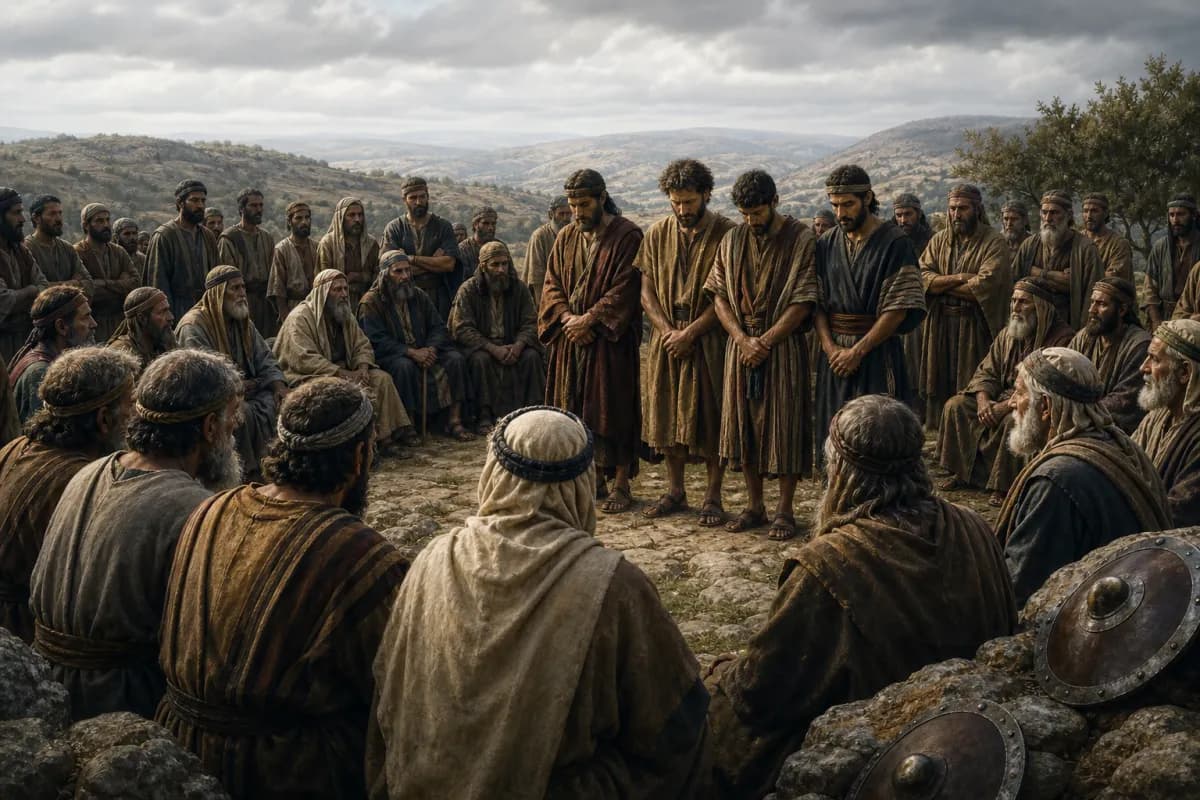
20:1Then all the children of Israel went out, and the congregation was assembled as one man, from Dan even to Beersheba, with the land of Gilead, to the LORD at Mizpah.
20:2The chiefs of all the people, even of all the tribes of Israel, presented themselves in the assembly of the people of God, four hundred thousand footmen who drew sword.
20:3(Now the children of Benjamin heard that the children of Israel had gone up to Mizpah.) The children of Israel said, “Tell us, how did this wickedness happen?”
20:4The Levite, the husband of the woman who was murdered, answered, “I came into Gibeah that belongs to Benjamin, I and my concubine, to spend the night.
20:5The men of Gibeah rose against me, and surrounded the house by night. They intended to kill me and they raped my concubine, and she is dead.
20:6I took my concubine and cut her in pieces, and sent her throughout all the country of the inheritance of Israel; for they have committed lewdness and folly in Israel.
20:7Behold, you children of Israel, all of you, give here your advice and counsel.”
20:8All the people arose as one man, saying, “None of us will go to his tent, neither will any of us turn to his house.
20:9But now this is the thing which we will do to Gibeah: we will go up against it by lot;
20:10and we will take ten men of one hundred throughout all the tribes of Israel, and one hundred of one thousand, and a thousand out of ten thousand to get food for the people, that they may do, when they come to Gibeah of Benjamin, according to all the folly that the men of Gibeah have done in Israel.”
20:11So all the men of Israel were gathered against the city, knit together as one man.
20:12The tribes of Israel sent men through all the tribe of Benjamin, saying, “What wickedness is this that has happened among you?
20:13Now therefore deliver up the men, the wicked fellows who are in Gibeah, that we may put them to death and put away evil from Israel.” But Benjamin would not listen to the voice of their brothers, the children of Israel.
20:14The children of Benjamin gathered themselves together out of the cities to Gibeah, to go out to battle against the children of Israel.
20:15The children of Benjamin were counted on that day out of the cities twenty-six thousand men who drew the sword, in addition to the inhabitants of Gibeah, who were counted seven hundred chosen men.
20:16Among all these soldiers there were seven hundred chosen men who were left-handed. Every one of them could sling a stone at a hair and not miss.
20:17The men of Israel, besides Benjamin, were counted four hundred thousand men who drew sword. All these were men of war.
20:18The children of Israel arose, went up to Bethel, and asked counsel of God. They asked, “Who shall go up for us first to battle against the children of Benjamin?” The LORD said, “Judah first.”
20:19The children of Israel rose up in the morning and encamped against Gibeah.
20:20The men of Israel went out to battle against Benjamin; and the men of Israel set the battle in array against them at Gibeah.
20:21The children of Benjamin came out of Gibeah, and on that day destroyed twenty-two thousand of the Israelite men down to the ground.
20:22The people, the men of Israel, encouraged themselves, and set the battle again in array in the place where they set themselves in array the first day.
20:23The children of Israel went up and wept before the LORD until evening; and they asked of the LORD, saying, “Shall I again draw near to battle against the children of Benjamin my brother?” The LORD said, “Go up against him.”
20:24The children of Israel came near against the children of Benjamin the second day.
20:25Benjamin went out against them out of Gibeah the second day, and destroyed down to the ground of the children of Israel again eighteen thousand men. All these drew the sword.
20:26Then all the children of Israel and all the people went up, and came to Bethel, and wept, and sat there before the LORD, and fasted that day until evening; then they offered burnt offerings and peace offerings before the LORD.
20:27The children of Israel asked the LORD (for the ark of the covenant of God was there in those days,
20:28and Phinehas, the son of Eleazar, the son of Aaron, stood before it in those days), saying, “Shall I yet again go out to battle against the children of Benjamin my brother, or shall I cease?” The LORD said, “Go up; for tomorrow I will deliver him into your hand.”
20:29Israel set ambushes all around Gibeah.
20:30The children of Israel went up against the children of Benjamin on the third day, and set themselves in array against Gibeah, as at other times.
20:31The children of Benjamin went out against the people, and were drawn away from the city; and they began to strike and kill of the people as at other times, in the highways, of which one goes up to Bethel and the other to Gibeah, in the field, about thirty men of Israel.
20:32The children of Benjamin said, “They are struck down before us, as at the first.” But the children of Israel said, “Let’s flee, and draw them away from the city to the highways.”
20:33All the men of Israel rose up out of their place and set themselves in array at Baal Tamar. Then the ambushers of Israel broke out of their place, even out of Maareh Geba.
20:34Ten thousand chosen men out of all Israel came over against Gibeah, and the battle was severe; but they didn’t know that disaster was close to them.
20:35The LORD struck Benjamin before Israel; and the children of Israel destroyed of Benjamin that day twenty-five thousand one hundred men. All these drew the sword.
20:36So the children of Benjamin saw that they were struck, for the men of Israel yielded to Benjamin because they trusted the ambushers whom they had set against Gibeah.
20:37The ambushers hurried, and rushed on Gibeah; then the ambushers spread out, and struck all the city with the edge of the sword.
20:38Now the appointed sign between the men of Israel and the ambushers was that they should make a great cloud of smoke rise up out of the city.
20:39The men of Israel turned in the battle, and Benjamin began to strike and kill of the men of Israel about thirty persons; for they said, “Surely they are struck down before us, as in the first battle.”
20:40But when the cloud began to arise up out of the city in a pillar of smoke, the Benjamites looked behind them; and behold, the whole city went up in smoke to the sky.
20:41The men of Israel turned, and the men of Benjamin were dismayed; for they saw that disaster had come on them.
20:42Therefore they turned their backs before the men of Israel to the way of the wilderness, but the battle followed hard after them; and those who came out of the cities destroyed them in the middle of it.
20:43They surrounded the Benjamites, chased them, and trod them down at their resting place, as far as near Gibeah toward the sunrise.
20:44Eighteen thousand men of Benjamin fell; all these were men of valor.
20:45They turned and fled toward the wilderness to the rock of Rimmon. They gleaned five thousand men of them in the highways, and followed hard after them to Gidom, and struck two thousand men of them.
20:46So that all who fell that day of Benjamin were twenty-five thousand men who drew the sword. All these were men of valor.
20:47But six hundred men turned and fled toward the wilderness to the rock of Rimmon, and stayed in the rock of Rimmon four months.
20:48The men of Israel turned again on the children of Benjamin, and struck them with the edge of the sword—including the entire city, the livestock, and all that they found. Moreover they set all the cities which they found on fire.
CONTEXTUAL OVERVIEW
Judges 20 continues directly from the horror at Gibeah. Israel gathers “as one man” from Dan to Beersheba and Gilead, a rare display of national unity in a book marked by fragmentation. The assembly rightly recognizes that the assault and death in chapter 19 demand a public response; indifference would leave violence to govern the covenant community.
Yet the chapter does not allow the reader to turn Israel into a clean moral hero. The Levite’s account emphasizes the men of Gibeah and omits his own abandonment of the woman. Benjamin’s refusal to surrender the perpetrators turns a demand for justice into a tribal war, and the war’s final scale reveals a nation whose moral collapse reaches far beyond one city.
HISTORICAL AND LITERARY CONTEXT
Mizpah functions here as a gathering place for Israel’s assembly. The phrase “all the people of Israel came out” heightens the seriousness of the moment: this is not a private dispute but a crisis touching the identity of a people called to live under the Lord’s covenant. The proposed judgment on Gibeah echoes the Torah’s concern to remove grave evil from the community.
The narrative belongs to Judges’ closing indictment of life when everyone does what is right in his own eyes. The Lord is consulted repeatedly, but consultation alone does not make every choice morally uncomplicated. Israel’s first two losses humble the confident force, and its later victory arrives through an ambush, leaving the reader with both the reality of judgment and the terrible cost of fraternal war.
SECTION-BY-SECTION ANALYSIS
- As one man · Judges 20:1National unity can be necessary for public accountability, but unity does not by itself heal the sins inside the nation.
- Give up the men · Judges 20:10Benjamin’s refusal converts protection of the guilty into a wider act of shared rebellion.
- At the rock of Rimmon · Judges 20:47The six hundred survivors leave Benjamin on the edge of extinction and set up the desperate decisions of chapter 21.
CHRIST IN THIS PASSAGE
Judges 20 reveals a genuine need for judgment, but no human army in the chapter can administer it without becoming entangled in the nation’s own violence. Jesus is the Judge who never conceals evil or protects the powerful at the expense of the wounded. At the cross He also bears the judgment sinners deserve, making forgiveness possible without calling evil insignificant.
His saving mission forms a different kind of people. The church must tell the truth about grievous wrong, protect those at risk, and pursue just accountability; it must not treat retaliation, tribal loyalty, or collective fury as redemption. Jesus makes peace by His blood and sends reconciled people to witness to justice joined to mercy.
REFLECTION
This chapter asks whether our loyalties have made us slow to confront wrongdoing close to home. Families, churches, teams, and nations can mistake protecting their own name for protecting what is good. Love for a community includes refusing to hide its violence, listening carefully to those harmed, and supporting truthful processes of accountability.
It also warns against believing that righteous anger gives us permission to become destructive. Bring your anger to Jesus. Ask Him to make it truthful, patient, and directed toward protection and repair rather than humiliation or revenge. His cross gives both courage to name sin and hope that repentance need not end in despair.
Original Hebrew Word Study
Judges 20:1
עֵדָה
edah · H5712
Usually translated: assembly or congregation
Edah is the assembly. Israel gathers as one people to address Gibeah’s crime, but the civil war shows the devastation when justice becomes entangled with vengeance.
Follow the Scripture trail
Israel’s War against Benjamin: Justice Entangled with Vengeance in the larger story
The connection: Israel’s civil war shows that evil must be faced, yet wounded and sinful people cannot finally heal themselves through force. Jesus judges sin truthfully, bears its penalty, and creates a reconciled people who pursue protection, accountability, mercy, and His gospel mission.
Respond to the passage
Ask Jesus whether loyalty to your group has made you minimize harm or whether anger has tempted you toward retaliation. Choose one truthful step that protects the vulnerable and seeks repair under His rule.
- Why is Benjamin’s refusal to surrender Gibeah’s offenders such a decisive turn in the chapter?
- What do Israel’s early defeats reveal about treating a just cause as a reason for self-confidence?
- How does Christ’s judgment and mercy guide a community confronting serious wrongdoing today?
Prayer
Lord Jesus, You see evil clearly and never abandon those harmed by it. Give me courage to tell the truth, humility to examine my loyalties, and love that seeks justice without surrendering to revenge. Make Your church a place of safety, repentance, and reconciling hope. Amen.