Passage Study
Wives for Benjamin and the Bitter End of Moral Collapse
Judges 21:1–21:25
Judges 21 shows Israel grieving Benjamin’s near destruction while trying to repair it through new oaths, another massacre, and the seizure of women at Shiloh. The chapter refuses to call desperate expediency wisdom. Its final line—there was no king in Israel, and each person did what was right in his own eyes—names the need for righteous rule. It directs readers to Jesus, the true King who restores people without sacrificing the vulnerable and gathers a redeemed people by grace.
- In this study
- 25 verses · 5 movements
Judges 21
21:1Now the men of Israel had sworn in Mizpah, saying, “None of us will give his daughter to Benjamin as a wife.”
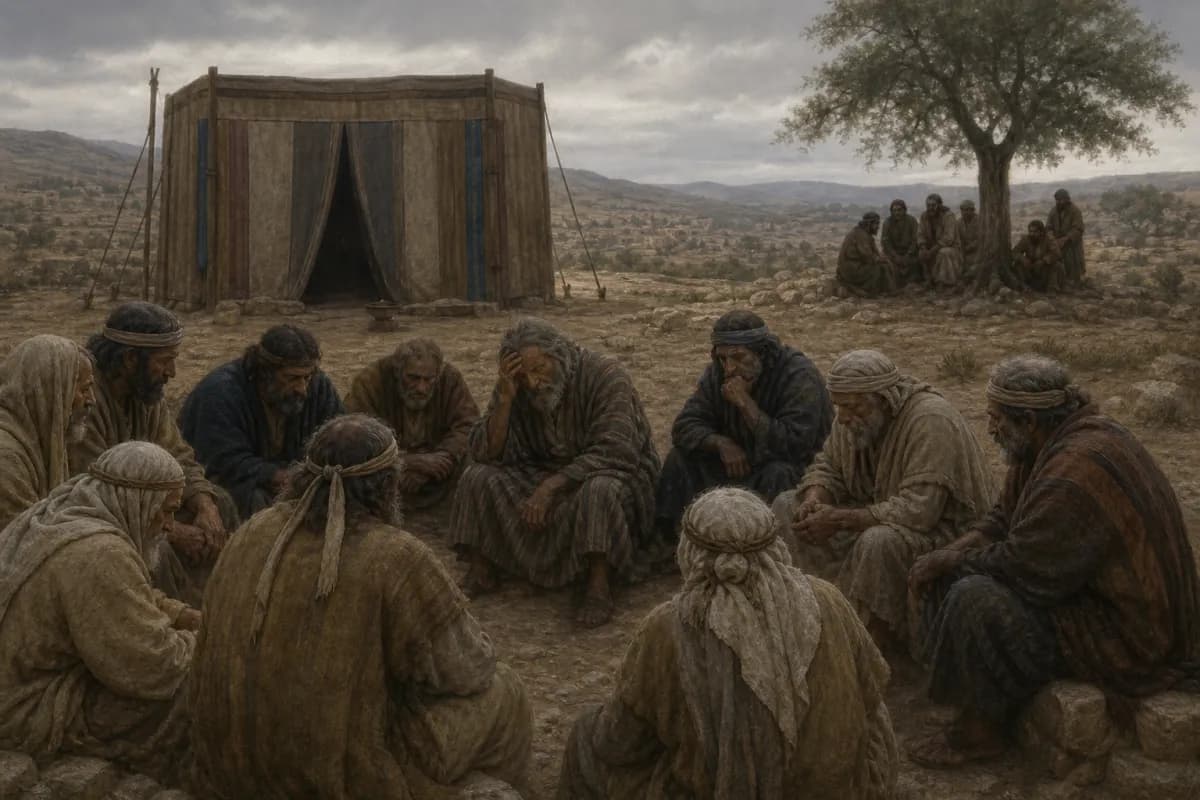
21:2The people came to Bethel and sat there until evening before God, and lifted up their voices, and wept severely.
21:3They said, “The LORD, the God of Israel, why has this happened in Israel, that there should be one tribe lacking in Israel today?”
21:4On the next day, the people rose early and built an altar there, and offered burnt offerings and peace offerings.
21:5The children of Israel said, “Who is there among all the tribes of Israel who didn’t come up in the assembly to the LORD?” For they had made a great oath concerning him who didn’t come up to the LORD to Mizpah, saying, “He shall surely be put to death.”
21:6The children of Israel grieved for Benjamin their brother, and said, “There is one tribe cut off from Israel today.
21:7How shall we provide wives for those who remain, since we have sworn by the LORD that we will not give them of our daughters to wives?”
21:8They said, “What one is there of the tribes of Israel who didn’t come up to the LORD to Mizpah?” Behold, no one came from Jabesh Gilead to the camp to the assembly.
21:9For when the people were counted, behold, there were none of the inhabitants of Jabesh Gilead there.
21:10The congregation sent twelve thousand of the most valiant men there, and commanded them, saying, “Go and strike the inhabitants of Jabesh Gilead with the edge of the sword, with the women and the little ones.
21:11This is the thing that you shall do: you shall utterly destroy every male, and every woman who has lain with a man.”
21:12They found among the inhabitants of Jabesh Gilead four hundred young virgins who had not known man by lying with him; and they brought them to the camp to Shiloh, which is in the land of Canaan.
21:13The whole congregation sent and spoke to the children of Benjamin who were in the rock of Rimmon, and proclaimed peace to them.
21:14Benjamin returned at that time; and they gave them the women whom they had saved alive of the women of Jabesh Gilead. There still weren’t enough for them.
21:15The people grieved for Benjamin, because the LORD had made a breach in the tribes of Israel.
21:16Then the elders of the congregation said, “How shall we provide wives for those who remain, since the women are destroyed out of Benjamin?”
21:17They said, “There must be an inheritance for those who are escaped of Benjamin, that a tribe not be blotted out from Israel.
21:18However, we may not give them wives of our daughters, for the children of Israel had sworn, saying, ‘Cursed is he who gives a wife to Benjamin.’”
21:19They said, “Behold, there is a feast of the LORD from year to year in Shiloh, which is on the north of Bethel, on the east side of the highway that goes up from Bethel to Shechem, and on the south of Lebonah.”
21:20They commanded the children of Benjamin, saying, “Go and lie in wait in the vineyards,
21:21and see, and behold, if the daughters of Shiloh come out to dance in the dances, then come out of the vineyards, and each man catch his wife of the daughters of Shiloh, and go to the land of Benjamin.
21:22It shall be, when their fathers or their brothers come to complain to us, that we will say to them, ‘Grant them graciously to us, because we didn’t take for each man his wife in battle, neither did you give them to them; otherwise you would now be guilty.’”
21:23The children of Benjamin did so, and took wives for themselves according to their number, of those who danced, whom they carried off. They went and returned to their inheritance, built the cities, and lived in them.
21:24The children of Israel departed from there at that time, every man to his tribe and to his family, and they each went out from there to his own inheritance.
21:25In those days there was no king in Israel. Everyone did that which was right in his own eyes.
CONTEXTUAL OVERVIEW
Judges 21 opens with Israel weeping at Bethel because one tribe may disappear from Israel. Their grief is understandable: Benjamin is a brother tribe, and the civil war has exposed how close the nation stands to destroying itself. But the chapter traces the tragic consequences of decisions made without the wisdom, justice, and mercy the people need.
Earlier, Israel swore not to give daughters to Benjamin. Now it seeks a way around that oath. The solution is not repentance that restores trust; it is another use of violence. Jabesh-gilead is attacked because it did not join the assembly, and its surviving young women are given to Benjamin. When four hundred are not enough, the remaining men are told to seize women dancing at Shiloh.
HISTORICAL AND LITERARY CONTEXT
Bethel and Shiloh are places associated with Israel’s worship, which makes the setting especially searching. Sacrifices and weeping occur near the Lord’s sanctuary, yet the people continue to devise plans that leave women without agency and solve one communal crisis by creating fresh victims. Religious activity has not become covenant faithfulness.
The chapter completes the epilogue that began with Micah’s idol and ends with the book’s fourth declaration that there was no king in Israel. The statement is not a simple endorsement of any ruler who claims power. Judges has shown that Israel needs a king who lives under God’s rule and protects the weak rather than multiplying the nation’s disorder.
SECTION-BY-SECTION ANALYSIS
- Why should one tribe be missing? · Judges 21:3Israel’s sorrow over Benjamin is real, but grief does not make every proposed remedy righteous.
- From the vineyards · Judges 21:21The seizure at Shiloh turns a public festival into danger for women who should have been protected.
- No king in Israel · Judges 21:25The closing diagnosis explains the book’s collapse: human desire has displaced God’s just and life-giving rule.
CHRIST IN THIS PASSAGE
Judges 21 ends by making readers long for a king who will not exploit people to stabilize a broken society. Jesus is that King. He does not preserve His people by taking from the powerless; He gives Himself for them. His authority is marked by service, His judgment by truth, and His kingdom by the restoration of those whom sin has used and discarded.
The church therefore cannot treat women or any vulnerable people as instruments for solving institutional problems. Christ’s saving mission brings people into a new family through faith and grace, where each member is received as one for whom He died. His people are sent to protect dignity, practice truthful repentance, and invite others into His healing reign.
REFLECTION
The chapter is a warning against solutions that sound practical because they preserve a group while placing the burden on people with less power. Ask where a family, ministry, workplace, or community is tempted to treat someone as a means to an end. Jesus calls His people to slow down, name the cost, and refuse repairs that require another person’s harm.
If you carry grief over a broken community, bring it to Christ before trying to control the outcome. He can lead His people into confession, protection, patient repair, and hope. His reign gives a steadier foundation than the hurried arrangements of people who fear they must save themselves.
Original Hebrew Word Study
Judges 21:25
מֶלֶךְ
melekh · H4428
Usually translated: king
Melekh is king. “There was no king in Israel” summarizes a society where each person does what is right in his own eyes, preparing the need for righteous rule under God.
Follow the Scripture trail
Wives for Benjamin and the Bitter End of Moral Collapse in the larger story
The connection: Judges closes with a people unable to repair their ruin without creating new victims. Jesus is the righteous King Israel needs: He gives Himself to save, gathers His people by grace, and sends them to embody His protecting, restorative love.
Respond to the passage
Bring to Jesus the problem you feel pressured to solve quickly. Ask whose dignity could be overlooked by your proposed solution, then take one step that protects the vulnerable and submits the outcome to His wise rule.
- Why do Israel’s efforts to preserve Benjamin deepen rather than resolve the book’s moral crisis?
- What makes the Shiloh festival scene especially painful in the context of Judges 21?
- How does Jesus’ servant kingship reshape the way Christians pursue repair in broken communities?
Prayer
Lord Jesus, reign over the places where fear and self-protection distort our judgment. Forgive every way I have treated another person as a means to my own end. Make me attentive to the vulnerable, patient in repair, and faithful to the restoring love of Your kingdom. Amen.