Passage Study
The Lord Defeats Sisera through Deborah, Barak, and Jael
Judges 4:1–4:24
Judges 4 tells how the Lord answers Israel’s cry under Jabin and Sisera through Deborah’s prophetic leadership, Barak’s obedience, and Jael’s unexpected action. The victory belongs to the Lord, not to Israel’s military strength, and the promised honor goes to a woman. The passage directs readers to Jesus, the true King who defeats the enemies of God’s people through humble, surprising, and righteous saving power.
- In this study
- 24 verses · 5 movements
Judges 4
4:1The children of Israel again did that which was evil in the LORD’s sight, when Ehud was dead.
4:2The LORD sold them into the hand of Jabin king of Canaan, who reigned in Hazor; the captain of whose army was Sisera, who lived in Harosheth of the Gentiles.
4:3The children of Israel cried to the LORD, for he had nine hundred chariots of iron; and he mightily oppressed the children of Israel for twenty years.
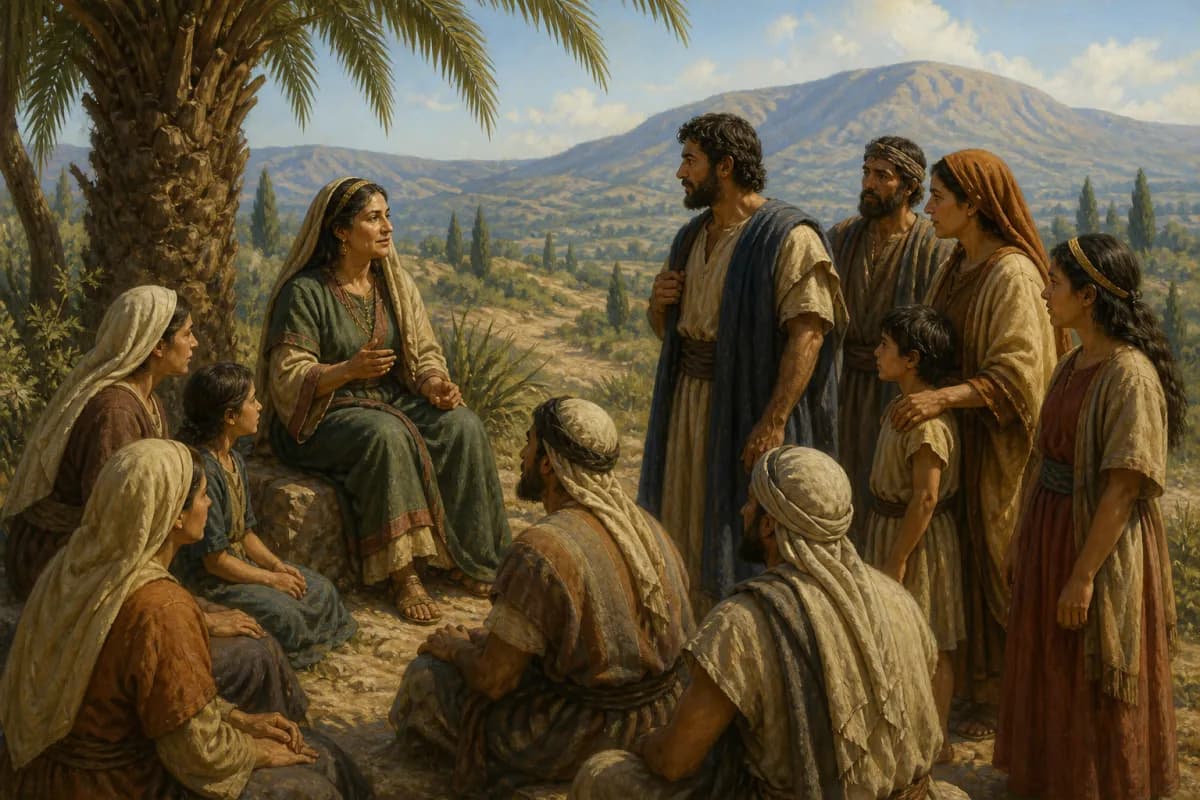
4:4Now Deborah, a prophetess, the wife of Lappidoth, judged Israel at that time.
4:5She lived under Deborah’s palm tree between Ramah and Bethel in the hill country of Ephraim; and the children of Israel came up to her for judgment.
4:6She sent and called Barak the son of Abinoam out of Kedesh Naphtali, and said to him, “Hasn’t the LORD, the God of Israel, commanded, ‘Go and lead the way to Mount Tabor, and take with you ten thousand men of the children of Naphtali and of the children of Zebulun?
4:7I will draw to you, to the river Kishon, Sisera, the captain of Jabin’s army, with his chariots and his multitude; and I will deliver him into your hand.’”
4:8Barak said to her, “If you will go with me, then I will go; but if you will not go with me, I will not go.”
4:9She said, “I will surely go with you. Nevertheless, the journey that you take won’t be for your honor; for the LORD will sell Sisera into a woman’s hand.” Deborah arose, and went with Barak to Kedesh.
4:10Barak called Zebulun and Naphtali together to Kedesh. Ten thousand men followed him; and Deborah went up with him.
4:11Now Heber the Kenite had separated himself from the Kenites, even from the children of Hobab, Moses’ brother-in-law, and had pitched his tent as far as the oak in Zaanannim, which is by Kedesh.
4:12They told Sisera that Barak the son of Abinoam had gone up to Mount Tabor.
4:13Sisera gathered together all his chariots, even nine hundred chariots of iron, and all the people who were with him, from Harosheth of the Gentiles, to the river Kishon.
4:14Deborah said to Barak, “Go; for this is the day in which the LORD has delivered Sisera into your hand. Hasn’t the LORD gone out before you?” So Barak went down from Mount Tabor, and ten thousand men after him.
4:15The LORD confused Sisera, all his chariots, and all his army, with the edge of the sword before Barak. Sisera abandoned his chariot and fled away on his feet.
4:16But Barak pursued the chariots and the army to Harosheth of the Gentiles; and all the army of Sisera fell by the edge of the sword. There was not a man left.
4:17However Sisera fled away on his feet to the tent of Jael the wife of Heber the Kenite; for there was peace between Jabin the king of Hazor and the house of Heber the Kenite.
4:18Jael went out to meet Sisera, and said to him, “Turn in, my lord, turn in to me; don’t be afraid.” He came in to her into the tent, and she covered him with a rug.
4:19He said to her, “Please give me a little water to drink; for I am thirsty.” She opened a container of milk, and gave him a drink, and covered him.
4:20He said to her, “Stand in the door of the tent, and if any man comes and inquires of you, and says, ‘Is there any man here?’ you shall say, ‘No.’”
4:21Then Jael, Heber’s wife, took a tent peg, and took a hammer in her hand, and went softly to him, and struck the pin into his temples, and it pierced through into the ground, for he was in a deep sleep; so he fainted and died.
4:22Behold, as Barak pursued Sisera, Jael came out to meet him, and said to him, “Come, and I will show you the man whom you seek.” He came to her; and behold, Sisera lay dead, and the tent peg was in his temples.
4:23So God subdued Jabin the king of Canaan before the children of Israel on that day.
4:24The hand of the children of Israel prevailed more and more against Jabin the king of Canaan, until they had destroyed Jabin king of Canaan.
CONTEXTUAL OVERVIEW
After Ehud’s death Israel again does evil, and the Lord gives it into the hand of Jabin, king of Canaan. Sisera’s nine hundred iron chariots make the oppression terrifying, especially in the Jezreel Valley’s open terrain. For twenty years Israel cries out under a force it cannot overcome by ordinary tribal strength.
Deborah is introduced as a prophet and as one who judges Israel beneath her palm tree. She speaks the Lord’s command to Barak: gather troops from Naphtali and Zebulun at Mount Tabor, and the Lord will draw Sisera to the Kishon and give him into Barak’s hand. The story’s center is God’s word and action, not a contest for human prestige.
HISTORICAL AND LITERARY CONTEXT
Judges 4 is paired with the song in Judges 5. Chapter 4 narrates the deliverance; chapter 5 celebrates and interprets it in poetry. Deborah’s leadership is neither treated as an anomaly to apologize for nor used as a shortcut for every question about later church offices. The passage explicitly presents her as a prophet through whom the Lord gives Israel direction.
The account belongs to the cycle explained in Judges 2: sin, oppression, crying out, and divinely given rescue. Its ancient warfare setting must be read within Israel’s particular history. Christians receive no mandate here for personal vengeance. Jesus teaches His followers to love enemies while trusting God’s final justice.
SECTION-BY-SECTION ANALYSIS
- The Lord has commanded · Judges 4:6Deborah’s authority in the scene is prophetic: she delivers God’s concrete word for Israel’s crisis.
- The Lord goes before you · Judges 4:15Barak’s army acts, but the victory is attributed first to God’s action against Sisera.
- Into the hand of a woman · Judges 4:9The fulfilled word prevents Israel from locating its salvation in conventional military honor.
CHRIST IN THIS PASSAGE
Deborah, Barak, and Jael are not simple one-to-one portraits of Jesus. The enduring pattern is that God defeats an enemy His people cannot overcome and does so in ways that strip away self-congratulation. Jesus achieves the decisive victory over sin, death, and the devil through the apparent weakness of the cross and the power of His resurrection.
Christ’s victory also defines His church’s mission. Believers do not advance His kingdom by adopting Sisera’s or Israel’s weapons. They proclaim the crucified and risen Lord, serve the vulnerable, and trust Him to establish justice. The story gives courage because the Lord can act beyond the resources His people can see.
REFLECTION
Barak’s request for Deborah’s presence should not be used to reduce the chapter to a verdict on his character. The text lets us see both a hesitant leader and a God who still keeps His word. God’s faithfulness does not require a flawless human instrument, yet His people are called to take His command seriously.
Bring the intimidating force in front of you to Jesus: the situation you cannot control, the task that exposes your weakness, or the injustice that has made you afraid. Ask for courage to obey what He has made clear and for humility to welcome the help He provides through people you may not have expected.
Original Hebrew Word Study
Judges 4:4
נָבִיאָה
neviah · H5031
Usually translated: prophetess
Neviah is a female prophet. Deborah speaks God’s word and judges Israel, making the victory depend on the Lord’s command rather than conventional expectations.
Follow the Scripture trail
The Lord Defeats Sisera through Deborah, Barak, and Jael in the larger story
The connection: The Lord defeats Sisera through people and means that confound ordinary expectations, revealing that Israel’s rescue is His work. Jesus wins the deeper victory over sin and death and sends His people to bear witness to His kingdom with humble courage.
Respond to the passage
Bring Jesus the situation that makes you feel outmatched. Obey the next clear command He gives through Scripture, receive help without pride, and remember that the outcome belongs to the Lord rather than your ability to control it.
- Why does the chapter introduce Deborah first as a prophet and judge?
- How does the promise that Sisera will fall by a woman protect the story from human boasting?
- What does Christ’s cross add to our understanding of God’s victory through apparent weakness?
Prayer
Lord Jesus, You have won the victory I could never win. Give me courage for faithful obedience, humility to receive help, and confidence that Your saving power is not limited by my weakness. Amen.