Passage Study
Sing of the Lord Who Went Before His People
Judges 5:1–5:31
Judges 5 is Deborah and Barak’s poetic answer to the defeat of Sisera. It praises the Lord as the warrior who marched from Seir, calls Israel’s tribes to remember their willing or withheld response, honors Jael’s decisive act, and turns the enemy commander’s imagined homecoming into a picture of defeated arrogance. The song brings readers to Jesus, whose saving victory deserves public praise and whose mission forms a people who join His work rather than stand apart.
- In this study
- 31 verses · 5 movements
Judges 5
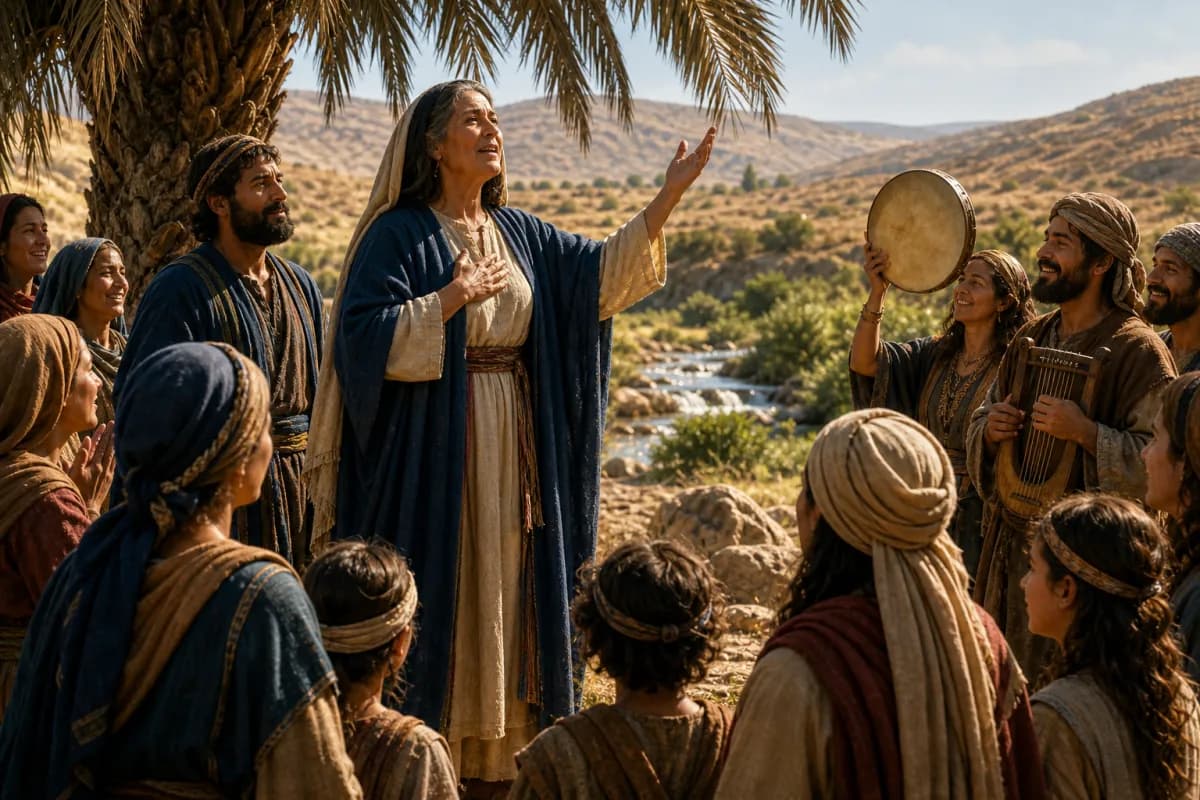
5:1Then Deborah and Barak the son of Abinoam sang on that day, saying,
5:2“Because the leaders took the lead in Israel, because the people offered themselves willingly, be blessed, LORD!
5:3“Hear, you kings! Give ear, you princes! I, even I, will sing to the LORD. I will sing praise to the LORD, the God of Israel.
5:4“LORD, when you went out of Seir, when you marched out of the field of Edom, the earth trembled, the sky also dropped. Yes, the clouds dropped water.
5:5The mountains quaked at the LORD’s presence, even Sinai at the presence of the LORD, the God of Israel.
5:6“In the days of Shamgar the son of Anath, in the days of Jael, the highways were unoccupied. The travelers walked through byways.
5:7The rulers ceased in Israel. They ceased until I, Deborah, arose; Until I arose a mother in Israel.
5:8They chose new gods. Then war was in the gates. Was there a shield or spear seen among forty thousand in Israel?
5:9My heart is toward the governors of Israel, who offered themselves willingly among the people. Bless the LORD!
5:10“Speak, you who ride on white donkeys, you who sit on rich carpets, and you who walk by the way.
5:11Far from the noise of archers, in the places of drawing water, there they will rehearse the LORD’s righteous acts, the righteous acts of his rule in Israel. “Then the LORD’s people went down to the gates.
5:12‘Awake, awake, Deborah! Awake, awake, utter a song! Arise, Barak, and lead away your captives, you son of Abinoam.’
5:13“Then a remnant of the nobles and the people came down. The LORD came down for me against the mighty.
5:14Those whose root is in Amalek came out of Ephraim, after you, Benjamin, among your peoples. Governors come down out of Machir. Those who handle the marshal’s staff came out of Zebulun.
5:15The princes of Issachar were with Deborah. As was Issachar, so was Barak. They rushed into the valley at his feet. By the watercourses of Reuben, there were great resolves of heart.
5:16Why did you sit among the sheepfolds? To hear the whistling for the flocks? At the watercourses of Reuben, there were great searchings of heart.
5:17Gilead lived beyond the Jordan. Why did Dan remain in ships? Asher sat still at the haven of the sea, and lived by his creeks.
5:18Zebulun was a people that jeopardized their lives to the death; Naphtali also, on the high places of the field.
5:19“The kings came and fought, then the kings of Canaan fought at Taanach by the waters of Megiddo. They took no plunder of silver.
5:20From the sky the stars fought. From their courses, they fought against Sisera.
5:21The river Kishon swept them away, that ancient river, the river Kishon. My soul, march on with strength.
5:22Then the horse hoofs stamped because of the prancing, the prancing of their strong ones.
5:23‘Curse Meroz,’ said the LORD’s angel. ‘Curse bitterly its inhabitants, because they didn’t come to help the LORD, to help the LORD against the mighty.’
5:24“Jael shall be blessed above women, the wife of Heber the Kenite; blessed shall she be above women in the tent.
5:25He asked for water. She gave him milk. She brought him butter in a lordly dish.
5:26She put her hand to the tent peg, and her right hand to the workmen’s hammer. With the hammer she struck Sisera. She struck through his head. Yes, she pierced and struck through his temples.
5:27At her feet he bowed, he fell, he lay. At her feet he bowed, he fell. Where he bowed, there he fell down dead.
5:28“Through the window she looked out, and cried: Sisera’s mother looked through the lattice. ‘Why is his chariot so long in coming? Why do the wheels of his chariots wait?’
5:29Her wise ladies answered her, Yes, she returned answer to herself,
5:30‘Have they not found, have they not divided the plunder? A lady, two ladies to every man; to Sisera a plunder of dyed garments, a plunder of dyed garments embroidered, of dyed garments embroidered on both sides, on the necks of the plunder?’
5:31“So let all your enemies perish, LORD, but let those who love him be as the sun when it rises in its strength.” Then the land had rest forty years.
CONTEXTUAL OVERVIEW
Judges 5 does not simply repeat the battle in chapter 4. It sings the meaning of that battle. Deborah and Barak begin by blessing the Lord because leaders took the lead and people offered themselves willingly. The song makes clear that the victory belongs first to God, while also calling the tribes to account for how they did or did not answer the moment of need.
Its imagery is expansive: the Lord marches from Seir, mountains quake, roads are deserted, stars fight from heaven, and the Kishon sweeps away the enemy. Poetry gives theological weight to the event. Israel was not rescued by a lucky military reversal; the God who rules creation acted for His oppressed people.
HISTORICAL AND LITERARY CONTEXT
The song is paired with the prose account in Judges 4. Ancient victory songs often praise a deity and commemorate a battle, but this poem is also covenant instruction. It remembers particular tribes, names the danger caused by the lack of weapons and secure roads, and makes worship the proper response to divine rescue.
The poem’s difficult phrases and compressed geography have generated different scholarly readings. Its central claims are clear: Israel had been oppressed, the Lord intervened, some tribes came to help while others remained at a distance, and Sisera’s defeat shattered the confidence of his household. The song is not a template for Christians to curse personal enemies; it teaches God’s people to entrust justice to Him and praise His righteous deliverance.
SECTION-BY-SECTION ANALYSIS
- Bless the Lord · Judges 5:9The first response to rescue is worship directed to God, not celebration of human skill.
- Why did you sit? · Judges 5:16The questions to the absent tribes expose the cost of self-protective distance when neighbors are in need.
- The Kishon swept them away · Judges 5:21The torrent becomes a poetic witness that creation itself is under the Lord’s command.
CHRIST IN THIS PASSAGE
Judges 5 does not directly predict the death and resurrection of Jesus, but its central pattern reaches forward: God wins a deliverance His people could not secure and teaches them to praise Him rather than themselves. Jesus brings the decisive victory over sin, death, and the powers that accuse and enslave. His cross looks weak to the world, yet His resurrection proves that God’s saving rule has prevailed.
The song also gives the church a mission-shaped response to Christ’s victory. Those redeemed by Jesus are not spectators. He gathers people from every nation into worship and sends them to serve one another, bear witness to His gospel, and refuse the detached comfort that leaves suffering neighbors alone. Christian praise is joined to willing obedience.
REFLECTION
It is possible to enjoy the benefits of another person’s courage while avoiding the cost of shared obedience. Judges 5 names that temptation without flattening every absence into the same failure. Ask where you have stayed safely among your own concerns while a clear need for prayer, service, truth-telling, or practical help stood before you.
Let Jesus turn gratitude into participation. Thank Him specifically for a rescue He has given, and ask what faithful response He is inviting now. That response may be quiet and local: showing up for a burdened believer, supporting gospel work, speaking truth with gentleness, or refusing a habit of passive complaint.
Original Hebrew Word Study
Judges 5:2
פָּרַע
para · H6544
Usually translated: to lead freely or let loose
Para can speak of leaders taking the lead. Deborah’s song praises willing participation because Israel’s deliverance calls the tribes to respond to the Lord’s summons.
Follow the Scripture trail
Sing of the Lord Who Went Before His People in the larger story
The connection: Deborah and Barak sing because the Lord has defeated an enemy beyond Israel’s strength and summoned His people into grateful participation. Jesus wins the deeper victory over sin and death and gathers a praising people to carry His good news into the world.
Respond to the passage
Thank Jesus for one specific rescue or mercy, then identify one concrete need you have watched from a distance. Ask Him for courage to join His work through prayer, service, generosity, or truthful witness.
- How does the song interpret the battle differently from a simple military report?
- Why are some tribes named for coming while others are questioned for remaining apart?
- How does Christ’s victory turn worship into mission rather than passive celebration?
Prayer
Lord Jesus, You have won a salvation I could never accomplish. Teach me to praise You without taking credit for Your work, give me courage to serve where You call, and make my life a willing witness to Your victory. Amen.