Passage Study
The Lord Saves through Three Hundred
Judges 7:1–7:25
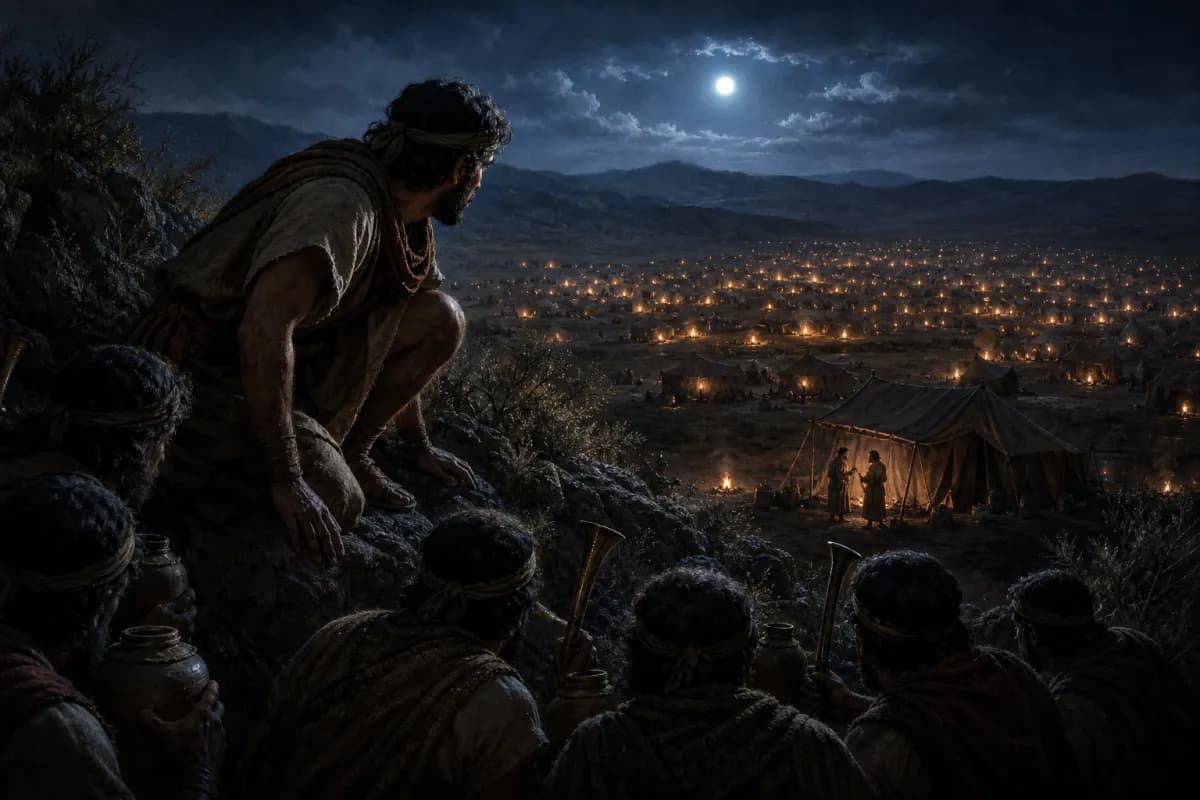
Judges 7 records the Lord reducing Gideon’s army from thousands to three hundred so Israel cannot claim Midian’s defeat as its own achievement. God strengthens Gideon through a Midianite dream, gives a strange battle plan of trumpets, jars, and torches, and throws the invading camp into confusion. The passage directs readers to Jesus, whose saving work overturns human boasting and whose mission advances by God’s power rather than impressive force.
- In this study
- 25 verses · 5 movements
Judges 7
7:1Then Jerubbaal, who is Gideon, and all the people who were with him, rose up early and encamped beside the spring of Harod. Midian’s camp was on the north side of them, by the hill of Moreh, in the valley.
7:2The LORD said to Gideon, “The people who are with you are too many for me to give the Midianites into their hand, lest Israel brag against me, saying, ‘My own hand has saved me.’
7:3Now therefore proclaim in the ears of the people, saying, ‘Whoever is fearful and trembling, let him return and depart from Mount Gilead.’” So twenty-two thousand of the people returned, and ten thousand remained.
7:4The LORD said to Gideon, “There are still too many people. Bring them down to the water, and I will test them for you there. It shall be, that those whom I tell you, ‘This shall go with you,’ shall go with you; and whoever I tell you, ‘This shall not go with you,’ shall not go.”
7:5So he brought down the people to the water; and the LORD said to Gideon, “Everyone who laps of the water with his tongue, like a dog laps, you shall set him by himself; likewise everyone who bows down on his knees to drink.”
7:6The number of those who lapped, putting their hand to their mouth, was three hundred men; but all the rest of the people bowed down on their knees to drink water.
7:7The LORD said to Gideon, “I will save you by the three hundred men who lapped, and deliver the Midianites into your hand. Let all the other people go, each to his own place.”
7:8So the people took food in their hand, and their trumpets; and he sent all the rest of the men of Israel to their own tents, but retained the three hundred men; and the camp of Midian was beneath him in the valley.
7:9That same night, the LORD said to him, “Arise, go down into the camp, for I have delivered it into your hand.
7:10But if you are afraid to go down, go with Purah your servant down to the camp.
7:11You will hear what they say; and afterward your hands will be strengthened to go down into the camp.” Then went he down with Purah his servant to the outermost part of the armed men who were in the camp.
7:12The Midianites and the Amalekites and all the children of the east lay along in the valley like locusts for multitude; and their camels were without number, as the sand which is on the seashore for multitude.
7:13When Gideon had come, behold, there was a man telling a dream to his fellow. He said, “Behold, I dreamed a dream; and behold, a cake of barley bread tumbled into the camp of Midian, came to the tent, and struck it so that it fell, and turned it upside down, so that the tent lay flat.”
7:14His fellow answered, “This is nothing other than the sword of Gideon the son of Joash, a man of Israel. God has delivered Midian into his hand, with all the army.”
7:15It was so, when Gideon heard the telling of the dream and its interpretation, that he worshiped. Then he returned into the camp of Israel and said, “Arise, for the LORD has delivered the army of Midian into your hand!”
7:16He divided the three hundred men into three companies, and he put into the hands of all of them trumpets and empty pitchers, with torches within the pitchers.
7:17He said to them, “Watch me, and do likewise. Behold, when I come to the outermost part of the camp, it shall be that, as I do, so you shall do.
7:18When I blow the trumpet, I and all who are with me, then blow the trumpets also on every side of all the camp, and shout, ‘For the LORD and for Gideon!’”
7:19So Gideon and the hundred men who were with him came to the outermost part of the camp in the beginning of the middle watch, when they had but newly set the watch. Then they blew the trumpets and broke in pieces the pitchers that were in their hands.
7:20The three companies blew the trumpets, broke the pitchers, and held the torches in their left hands and the trumpets in their right hands with which to blow; and they shouted, “The sword of the LORD and of Gideon!”
7:21They each stood in his place around the camp, and all the army ran; and they shouted, and put them to flight.
7:22They blew the three hundred trumpets, and the LORD set every man’s sword against his fellow and against all the army; and the army fled as far as Beth Shittah toward Zererah, as far as the border of Abel Meholah, by Tabbath.
7:23The men of Israel were gathered together out of Naphtali, out of Asher, and out of all Manasseh, and pursued Midian.
7:24Gideon sent messengers throughout all the hill country of Ephraim, saying, “Come down against Midian and take the waters before them as far as Beth Barah, even the Jordan!” So all the men of Ephraim were gathered together and took the waters as far as Beth Barah, even the Jordan.
7:25They took the two princes of Midian, Oreb and Zeeb. They killed Oreb at Oreb’s rock, and Zeeb they killed at Zeeb’s wine press, as they pursued Midian. Then they brought the heads of Oreb and Zeeb to Gideon beyond the Jordan.
CONTEXTUAL OVERVIEW
Judges 7 begins with Gideon’s camp near the spring of Harod and Midian’s camp in the valley below. The military disparity is already severe, but the Lord says Gideon has too many people. The stated reason is startling: Israel might boast against God and say that its own hand saved it.
The chapter therefore teaches dependence before it tells a battle story. Twenty-two thousand leave because they are afraid; ten thousand remain; then only three hundred are retained. The selection at the water should not be made into a hidden test of spiritual superiority. The text’s explicit point is that God chooses a small force through which His deliverance cannot reasonably be credited to Israel’s strength.
HISTORICAL AND LITERARY CONTEXT
The Midianites are described in the surrounding chapters as a vast encampment with camels beyond counting. Judges uses that scale to heighten the contrast between the enemy’s apparent abundance and the Lord’s chosen means. Gideon’s forces carry trumpets, jars, and torches, objects that create noise, light, and the impression of a much larger army at night.
This ancient battle belongs to Israel’s particular period under the judges. The chapter does not authorize churches to seek military victory or to manufacture tricks in God’s name. Its enduring theological claim is that the Lord saves in a way that exposes human self-reliance and calls His people to trust His word.
SECTION-BY-SECTION ANALYSIS
- Too many people · Judges 7:4God deliberately removes grounds for Israel to interpret rescue as a monument to its own power.
- If you are afraid · Judges 7:10God does not shame Gideon for fear; He provides a concrete word of assurance that calls him forward.
- The Lord set every man’s sword against his fellow · Judges 7:22The enemy’s collapse is attributed to God’s action, not to the three hundred’s tactical brilliance.
CHRIST IN THIS PASSAGE
The three hundred do not directly symbolize the church, but the chapter’s rejection of boasting coheres with the gospel. Jesus saves through a cross the world regards as weakness and raises a people who have no basis for congratulating themselves. His grace exposes the illusion that moral effort, religious pedigree, or public strength can deliver us from sin.
Christ’s mission is carried forward in that same dependence. The church is called to wise planning and faithful labor, yet it cannot manufacture conversion or renewal by force of personality, money, or visibility. Jesus sends ordinary disciples with the gospel and promises His presence, so that the praise for transformed lives belongs to God.
REFLECTION
Many pressures tempt us to prove ourselves by accumulating visible strength. Judges 7 asks whether we can receive a calling that makes our inadequacy obvious. Gideon’s worship after hearing the dream is instructive: assurance does not make him passive; it sends him into obedient action with a clear awareness that the outcome belongs to the Lord.
Bring to Jesus the place where you are trying to secure yourself through numbers, credentials, or control. Work faithfully with what He has placed in your hands, but release the demand to be impressive. Ask Him to make your weakness a place where His mercy, truth, and saving power can be seen.
Original Hebrew Word Study
Judges 7:7
יָשַׁע
yasha · H3467
Usually translated: to save or deliver
Yasha means to save. God reduces Gideon’s army so Israel cannot claim the victory as its own strength; deliverance belongs to the Lord.
Follow the Scripture trail
The Lord Saves through Three Hundred in the larger story
The connection: The Lord reduces Gideon’s force so Israel will know that rescue is His gift rather than its achievement. Jesus saves through the apparent weakness of the cross and sends a dependent people to announce His grace without boasting.
Respond to the passage
Tell Jesus where you feel pressure to look strong or self-sufficient. Do the faithful work in front of you, but surrender the outcome and ask that His power, rather than your image, would be visible through your life.
- Why does the Lord say Gideon has too many soldiers?
- How does God address Gideon’s fear before the battle?
- What kinds of boasting does the gospel disarm in Christian ministry and ordinary life?
Prayer
Lord Jesus, forgive my desire to make myself look sufficient. Teach me to trust Your strength in weakness, to act on Your word with humility, and to give You the praise for every true work of rescue and renewal. Amen.