Passage Study
When Deliverance Drifts toward Idolatry
Judges 8:1–8:35
Judges 8 begins with Gideon’s wise answer to Ephraim’s resentment and ends with an ephod that becomes a snare to Israel. Between those scenes he pursues Midian’s kings, refuses a royal dynasty in words, takes vengeance on towns that would not help, receives wealth from the victory, and dies while Israel soon returns to Baal. The passage warns that even genuine deliverance can be twisted by pride and directs readers to Jesus, the faithful King who never turns God’s rescue into self-exaltation.
- In this study
- 35 verses · 5 movements
Judges 8
8:1The men of Ephraim said to him, “Why have you treated us this way, that you didn’t call us when you went to fight with Midian?” They rebuked him sharply.
8:2He said to them, “What have I now done in comparison with you? Isn’t the gleaning of the grapes of Ephraim better than the vintage of Abiezer?
8:3God has delivered into your hand the princes of Midian, Oreb and Zeeb! What was I able to do in comparison with you?” Then their anger was abated toward him when he had said that.
8:4Gideon came to the Jordan and passed over, he and the three hundred men who were with him, faint, yet pursuing.
8:5He said to the men of Succoth, “Please give loaves of bread to the people who follow me; for they are faint, and I am pursuing after Zebah and Zalmunna, the kings of Midian.”
8:6The princes of Succoth said, “Are the hands of Zebah and Zalmunna now in your hand, that we should give bread to your army?”
8:7Gideon said, “Therefore when the LORD has delivered Zebah and Zalmunna into my hand, then I will tear your flesh with the thorns of the wilderness and with briers.”
8:8He went up there to Penuel, and spoke to them in the same way; and the men of Penuel answered him as the men of Succoth had answered.
8:9He spoke also to the men of Penuel, saying, “When I come again in peace, I will break down this tower.”
8:10Now Zebah and Zalmunna were in Karkor, and their armies with them, about fifteen thousand men, all who were left of all the army of the children of the east; for there fell one hundred twenty thousand men who drew sword.
8:11Gideon went up by the way of those who lived in tents on the east of Nobah and Jogbehah, and struck the army; for the army felt secure.
8:12Zebah and Zalmunna fled and he pursued them. He took the two kings of Midian, Zebah and Zalmunna, and confused all the army.
8:13Gideon the son of Joash returned from the battle from the ascent of Heres.
8:14He caught a young man of the men of Succoth, and inquired of him; and he described for him the princes of Succoth, and its elders, seventy-seven men.
8:15He came to the men of Succoth, and said, “See Zebah and Zalmunna, concerning whom you taunted me, saying, ‘Are the hands of Zebah and Zalmunna now in your hand, that we should give bread to your men who are weary?’”
8:16He took the elders of the city, and thorns of the wilderness and briers, and with them he taught the men of Succoth.
8:17He broke down the tower of Penuel, and killed the men of the city.
8:18Then he said to Zebah and Zalmunna, “What kind of men were they whom you killed at Tabor?” They answered, “They were like you. They all resembled the children of a king.”
8:19He said, “They were my brothers, the sons of my mother. As the LORD lives, if you had saved them alive, I would not kill you.”
8:20He said to Jether his firstborn, “Get up and kill them!” But the youth didn’t draw his sword; for he was afraid, because he was yet a youth.
8:21Then Zebah and Zalmunna said, “You rise and fall on us; for as the man is, so is his strength.” Gideon arose, and killed Zebah and Zalmunna, and took the crescents that were on their camels’ necks.
8:22Then the men of Israel said to Gideon, “Rule over us, both you, your son, and your son’s son also; for you have saved us out of the hand of Midian.”
8:23Gideon said to them, “I will not rule over you, neither shall my son rule over you. The LORD shall rule over you.”
8:24Gideon said to them, “I do have a request: that you would each give me the earrings of his plunder.” (For they had golden earrings, because they were Ishmaelites.)
8:25They answered, “We will willingly give them.” They spread a garment, and every man threw the earrings of his plunder into it.
8:26The weight of the golden earrings that he requested was one thousand and seven hundred shekels of gold, in addition to the crescents, and the pendants, and the purple clothing that was on the kings of Midian, and in addition to the chains that were about their camels’ necks.
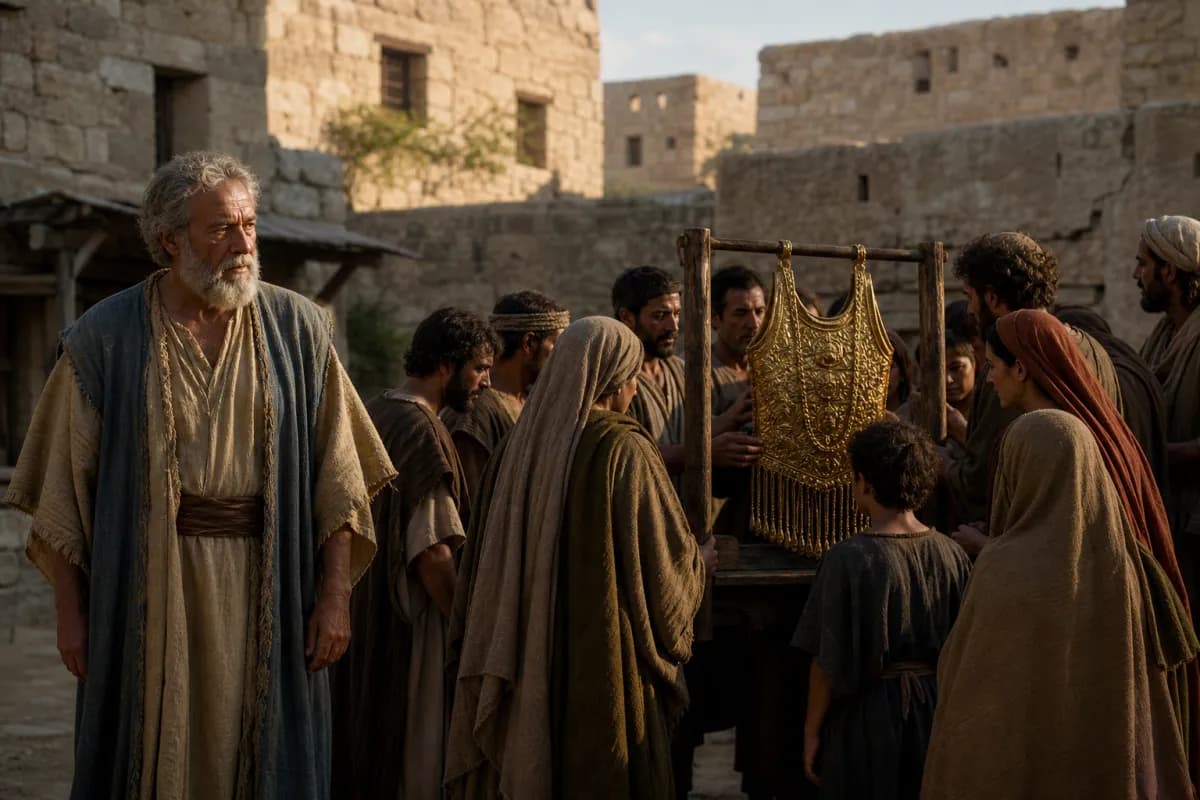
8:27Gideon made an ephod out of it, and put it in Ophrah, his city. Then all Israel played the prostitute with it there; and it became a snare to Gideon and to his house.
8:28So Midian was subdued before the children of Israel, and they lifted up their heads no more. The land had rest forty years in the days of Gideon.
8:29Jerubbaal the son of Joash went and lived in his own house.
8:30Gideon had seventy sons conceived from his body, for he had many wives.
8:31His concubine who was in Shechem also bore him a son, and he named him Abimelech.
8:32Gideon the son of Joash died in a good old age, and was buried in the tomb of Joash his father, in Ophrah of the Abiezrites.
8:33As soon as Gideon was dead, the children of Israel turned again and played the prostitute following the Baals, and made Baal Berith their god.
8:34The children of Israel didn’t remember the LORD their God, who had delivered them out of the hand of all their enemies on every side;
8:35neither did they show kindness to the house of Jerubbaal, that is, Gideon, according to all the goodness which he had shown to Israel.
CONTEXTUAL OVERVIEW
The first movement of Judges 8 shows Gideon at his best. Ephraim is angry that it was not called earlier to battle, but Gideon answers with a humble comparison that honors its capture of Oreb and Zeeb. Their anger subsides. The scene contrasts sharply with what follows, as Gideon’s pursuit of Midian becomes entangled with retaliation, royal-like power, and accumulated wealth.
The chapter is not content to leave Gideon as the uncomplicated hero of Judges 7. Israel’s victory over Midian is real, and the land receives peace for forty years. Yet the narrator traces how success itself can become dangerous when the deliverer begins to look and act like the kind of ruler Israel is not meant to need.
HISTORICAL AND LITERARY CONTEXT
Judges 8 completes the Gideon narrative and prepares the way for the disastrous rule of his son Abimelech in chapter 9. The vocabulary of ruling, tribute, wives, sons, and a personal ephod creates pressure around kingship long before Israel formally asks for a king in 1 Samuel.
The ephod in this chapter should not be confused casually with the authorized high-priestly garment described in Exodus. The text says Gideon makes an ephod from gold taken as spoil and places it in Ophrah, where all Israel “prostituted themselves” after it. Its exact form is debated, but its effect is not: a memorial associated with a divinely given victory becomes an object of unfaithful worship and a trap for Gideon’s household.
SECTION-BY-SECTION ANALYSIS
- The Lord will rule over you · Judges 8:23Gideon’s confession is true, but his later actions test whether he will live under the rule he names.
- Gideon made an ephod · Judges 8:27A religious object connected to victory becomes a rival focus of worship and a spiritual snare.
- They did not remember the Lord · Judges 8:34Israel’s amnesia after deliverance reveals the deeper instability that no single judge can cure.
CHRIST IN THIS PASSAGE
Gideon’s mixed legacy reveals why Israel needs more than a successful deliverer. He can speak rightly about the Lord’s kingship while allowing the fruits of victory to gather around himself. Jesus is the faithful King Gideon is not. He refuses self-exaltation, serves rather than grasps, and gives His life so that sinners may be brought under God’s good rule.
The chapter also corrects mission that seeks a platform more than obedience. Jesus sends His people to proclaim His name, not to build devotional attention around a leader, artifact, or brand. His saving mission creates communities that remember God’s grace, resist idolatry, and keep their confidence fixed on Christ rather than the human instruments He uses.
REFLECTION
Spiritual danger does not end when the immediate crisis passes. Success can quietly teach us to trust the person, process, or symbol that God used rather than the God who gave the rescue. Gideon’s ephod asks us to consider whether a good gift, ministry achievement, or religious practice has become a substitute for humble dependence on the Lord.
Thank Jesus for every means He has used to help you, but do not make that means your savior. Ask Him to expose where achievement has grown into self-protection or self-display. Choose a practice of gratitude and accountability that keeps His rule, not your reputation, at the center.
Original Hebrew Word Study
Judges 8:23
מָשַׁל
mashal · H4910
Usually translated: to rule
Mashal means to rule. Gideon refuses a dynasty in words but the ephod and later household politics reveal how easily deliverance can drift toward idolatry and self-rule.
Follow the Scripture trail
When Deliverance Drifts toward Idolatry in the larger story
The connection: Gideon’s deliverance is real, yet his later life shows how easily rescue can become a stage for self and a doorway to idolatry. Jesus is the true King who serves without self-exaltation and sends His people to remember God’s grace rather than glorify human instruments.
Respond to the passage
Ask Jesus whether a good gift, achievement, ministry, or religious practice has begun to carry the weight that belongs to Him. Thank Him for the gift, release your claim to its glory, and take one step that re-centers your life on His rule.
- How does Gideon’s answer to Ephraim differ from his treatment of Succoth and Penuel?
- Why is the ephod’s effect more important than trying to identify its precise form?
- What does Gideon’s story teach about success, memory, and spiritual idolatry?
Prayer
Lord Jesus, keep Your gifts from becoming replacements for You. Forgive my need to turn success into self-importance, make me grateful and accountable, and teach me to live joyfully beneath Your faithful rule. Amen.