Passage Study
The Servant King Who Brings His People Home
John 13:1–14:31
John 13–14 begins Jesus’ final evening with His disciples. Knowing that His hour has come, He washes their feet, exposes Judas’s betrayal, gives the command to love one another, and prepares His troubled followers for His departure. Jesus promises a place in the Father’s house, identifies Himself as the way, truth, and life, reveals the Father, and pledges the Spirit who will dwell with them and teach them.
- In this study
- 69 verses · 5 movements
John 13
13:1Now before the feast of the Passover, Jesus, knowing that his time had come that he would depart from this world to the Father, having loved his own who were in the world, he loved them to the end.
13:2During supper, the devil having already put into the heart of Judas Iscariot, Simon’s son, to betray him,
13:3Jesus, knowing that the Father had given all things into his hands, and that he came from God and was going to God,
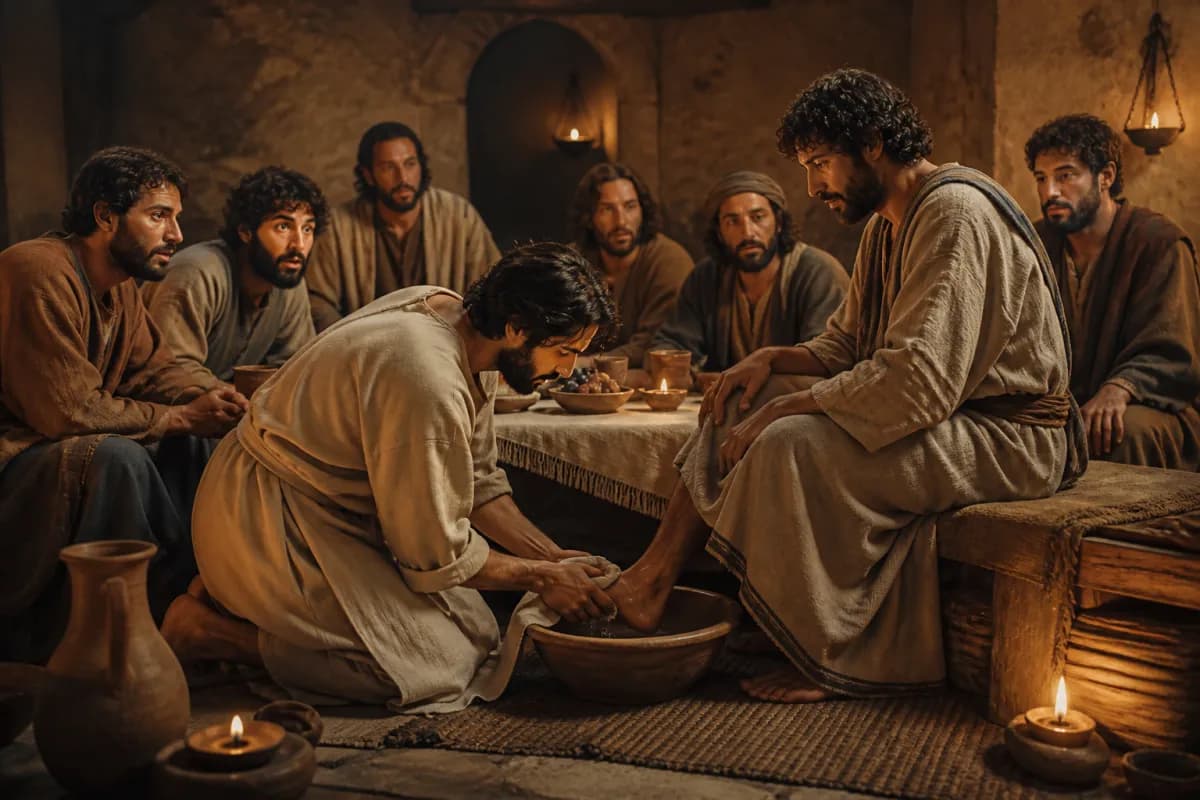
13:4arose from supper, and laid aside his outer garments. He took a towel and wrapped a towel around his waist.
13:5Then he poured water into the basin, and began to wash the disciples’ feet and to wipe them with the towel that was wrapped around him.
13:6Then he came to Simon Peter. He said to him, “Lord, do you wash my feet?”
13:7Jesus answered him, “You don’t know what I am doing now, but you will understand later.”
13:8Peter said to him, “You will never wash my feet!” Jesus answered him, “If I don’t wash you, you have no part with me.”
13:9Simon Peter said to him, “Lord, not my feet only, but also my hands and my head!”
13:10Jesus said to him, “Someone who has bathed only needs to have his feet washed, but is completely clean. You are clean, but not all of you.”
13:11For he knew him who would betray him; therefore he said, “You are not all clean.”
13:12So when he had washed their feet, put his outer garment back on, and sat down again, he said to them, “Do you know what I have done to you?
13:13You call me, ‘Teacher’ and ‘Lord.’ You say so correctly, for so I am.
13:14If I then, the Lord and the Teacher, have washed your feet, you also ought to wash one another’s feet.
13:15For I have given you an example, that you should also do as I have done to you.
13:16Most certainly I tell you, a servant is not greater than his lord, neither is one who is sent greater than he who sent him.
13:17If you know these things, blessed are you if you do them.
13:18I don’t speak concerning all of you. I know whom I have chosen; but that the Scripture may be fulfilled, ‘He who eats bread with me has lifted up his heel against me.’
13:19From now on, I tell you before it happens, that when it happens, you may believe that I am he.
13:20Most certainly I tell you, he who receives whomever I send, receives me; and he who receives me, receives him who sent me.”
13:21When Jesus had said this, he was troubled in spirit, and testified, “Most certainly I tell you that one of you will betray me.”
13:22The disciples looked at one another, perplexed about whom he spoke.
13:23One of his disciples, whom Jesus loved, was at the table, leaning against Jesus’ chest.
13:24Simon Peter therefore beckoned to him, and said to him, “Tell us who it is of whom he speaks.”
13:25He, leaning back, as he was, on Jesus’ chest, asked him, “Lord, who is it?”
13:26Jesus therefore answered, “It is he to whom I will give this piece of bread when I have dipped it.” So when he had dipped the piece of bread, he gave it to Judas, the son of Simon Iscariot.
13:27After the piece of bread, then Satan entered into him. Then Jesus said to him, “What you do, do quickly.”
13:28Now nobody at the table knew why he said this to him.
13:29For some thought, because Judas had the money box, that Jesus said to him, “Buy what things we need for the feast,” or that he should give something to the poor.
13:30Therefore having received that morsel, he went out immediately. It was night.
13:31When he had gone out, Jesus said, “Now the Son of Man has been glorified, and God has been glorified in him.
13:32If God has been glorified in him, God will also glorify him in himself, and he will glorify him immediately.
13:33Little children, I will be with you a little while longer. You will seek me, and as I said to the Jews, ‘Where I am going, you can’t come,’ so now I tell you.
13:34A new commandment I give to you, that you love one another. Just as I have loved you, you also love one another.
13:35By this everyone will know that you are my disciples, if you have love for one another.”
13:36Simon Peter said to him, “Lord, where are you going?” Jesus answered, “Where I am going, you can’t follow now, but you will follow afterwards.”
13:37Peter said to him, “Lord, why can’t I follow you now? I will lay down my life for you.”
13:38Jesus answered him, “Will you lay down your life for me? Most certainly I tell you, the rooster won’t crow until you have denied me three times.
John 14
14:1“Don’t let your heart be troubled. Believe in God. Believe also in me.
14:2In my Father’s house are many homes. If it weren’t so, I would have told you. I am going to prepare a place for you.
14:3If I go and prepare a place for you, I will come again and will receive you to myself; that where I am, you may be there also.
14:4You know where I go, and you know the way.”
14:5Thomas said to him, “Lord, we don’t know where you are going. How can we know the way?”
14:6Jesus said to him, “I am the way, the truth, and the life. No one comes to the Father, except through me.
14:7If you had known me, you would have known my Father also. From now on, you know him and have seen him.”
14:8Philip said to him, “Lord, show us the Father, and that will be enough for us.”
14:9Jesus said to him, “Have I been with you such a long time, and do you not know me, Philip? He who has seen me has seen the Father. How do you say, ‘Show us the Father’?
14:10Don’t you believe that I am in the Father, and the Father in me? The words that I tell you, I speak not from myself; but the Father who lives in me does his works.
14:11Believe me that I am in the Father, and the Father in me; or else believe me for the very works’ sake.
14:12Most certainly I tell you, he who believes in me, the works that I do, he will do also; and he will do greater works than these, because I am going to my Father.
14:13Whatever you will ask in my name, I will do it, that the Father may be glorified in the Son.
14:14If you will ask anything in my name, I will do it.
14:15If you love me, keep my commandments.
14:16I will pray to the Father, and he will give you another Counselor, that he may be with you forever:
14:17the Spirit of truth, whom the world can’t receive, for it doesn’t see him and doesn’t know him. You know him, for he lives with you and will be in you.
14:18I will not leave you orphans. I will come to you.
14:19Yet a little while, and the world will see me no more; but you will see me. Because I live, you will live also.
14:20In that day you will know that I am in my Father, and you in me, and I in you.
14:21One who has my commandments and keeps them, that person is one who loves me. One who loves me will be loved by my Father, and I will love him, and will reveal myself to him.”
14:22Judas (not Iscariot) said to him, “Lord, what has happened that you are about to reveal yourself to us, and not to the world?”
14:23Jesus answered him, “If a man loves me, he will keep my word. My Father will love him, and we will come to him and make our home with him.
14:24He who doesn’t love me doesn’t keep my words. The word which you hear isn’t mine, but the Father’s who sent me.
14:25“I have said these things to you while still living with you.
14:26But the Counselor, the Holy Spirit, whom the Father will send in my name, will teach you all things, and will remind you of all that I said to you.
14:27Peace I leave with you. My peace I give to you; not as the world gives, I give to you. Don’t let your heart be troubled, neither let it be fearful.
14:28You heard how I told you, ‘I am going away, and I will come back to you.’ If you loved me, you would have rejoiced because I said ‘I am going to my Father;’ for the Father is greater than I.
14:29Now I have told you before it happens so that when it happens, you may believe.
14:30I will no more speak much with you, for the prince of the world comes, and he has nothing in me.
14:31But that the world may know that I love the Father, and as the Father commanded me, even so I do. Arise, let’s go from here.
CONTEXTUAL OVERVIEW
John introduces the footwashing by telling readers what Jesus knows: His hour has come, He came from God, He is returning to God, and the Father has given all things into His hands. That knowledge does not lead Him to demand ceremony. He rises from supper, takes the posture of a household servant, and washes the feet of men who will soon misunderstand, flee, deny, and in Judas’s case betray Him. The enacted lesson reveals the character of His kingly authority.
The room grows darker as Judas departs and Jesus tells Peter that he will deny Him. The promises of chapter 14 are therefore spoken to troubled disciples, not to people who have already proved their courage. Jesus’ departure will mean death, resurrection, ascension, and return to the Father; He does not leave them with a technique for religious confidence, but with Himself, the Father’s home, the coming Spirit, and a peace the world cannot give.
HISTORICAL AND LITERARY CONTEXT
Footwashing was an ordinary act of hospitality in a world of dusty roads and sandals, normally performed by a servant or person of lower status. John makes the reversal unmistakable: the Teacher and Lord performs it. Peter’s initial refusal shows how easily pride can receive a majestic Christ while resisting the cleansing and humble fellowship He insists upon. Jesus does not say every detail of the act is a separate rite; He gives it as an example of the love and service that must mark His community.
Chapters 13–17 are John’s Farewell Discourse, spoken on the eve of Jesus’ arrest. The disciples know He is leaving, but they cannot yet see how His death will open access to the Father or how His presence will continue through the Spirit. The repeated language of Father, Son, love, dwelling, and commandment makes this a covenant-shaped farewell: Jesus creates a people who know God through Him and who will remain in His love after His visible departure.
SECTION-BY-SECTION ANALYSIS
- John 13:3–17 · John 13:23Jesus’ conscious authority is displayed in service; the disciples receive His cleansing and learn that love in His household takes a servant’s form.
- John 13:34–38 · John 13:1The new command is measured by Jesus’ own love, while Peter’s predicted denial exposes the weakness of self-confident devotion.
- John 14:6–11 · John 14:9Jesus alone brings people to the Father because He is the incarnate Son who perfectly reveals the Father in word and work.
CHRIST IN THIS PASSAGE
Jesus’ footwashing points toward His saving mission without collapsing the action into a vague symbol. He tells Peter that sharing in Him depends on receiving His washing, and the following passion narrative shows the full cost of that cleansing. The Lord who washes feet is about to give His life for friends who cannot cleanse themselves from sin. His command to serve rests on grace received, not on an attempt to earn a place at the table.
The way-to-the-Father claim is explicit and exclusive in its saving meaning. Jesus is not one guide among many because His person and work bring sinners to God: He came from the Father, reveals the Father, goes by the cross to prepare a place, and sends the Spirit so His people are not orphaned. His promise of peace arises from His completed mission, not from the disciples’ ability to avoid betrayal, fear, or failure.
REFLECTION
Peter wants the honor of loyalty without first receiving Jesus’ humbling gift. Where do you resist being served by Christ because admitting need feels costly? Come to Him for cleansing and forgiveness before attempting to make yourself useful. Then consider whose ordinary, uncelebrated need you can meet this week in the pattern of the Master who knelt at the basin.
Jesus speaks His strongest comfort into a room facing abandonment, denial, and loss. When your heart is troubled, return to the particular promises of this chapter: the Father’s house, the Son who brings you there, the Spirit who remains, and Jesus’ peace. Let love for fellow believers become a visible answer to the fear that makes us withdraw from one another.
Original Greek Word Study
John 14:6
ὁδός
hodos · G3598
Usually translated: way, road, or path
Hodos means way or path. Jesus does not simply point toward the Father; He is the way because His person and saving work bring His disciples into the Father’s presence.
Follow the Scripture trail
The Servant King Who Brings His People Home in the larger story
The connection: On the night before the cross, Jesus reveals His royal authority by serving and His saving mission by preparing access to the Father. His death cleanses His people, His resurrection and ascension secure their home with God, and His Spirit sustains them as a community marked by the same self-giving love.
Respond to the passage
Receive Jesus’ cleansing where shame or self-reliance makes you keep Him at a distance. Then take one concrete, hidden act of service for a believer or neighbor, asking the Spirit to make it an expression of the love Jesus has first shown you.
- Why does John emphasize that Jesus knows He came from the Father and is returning to the Father before describing the footwashing?
- How does Peter’s denial change the way we hear Jesus’ promises in chapter 14?
- What makes Jesus the way to the Father according to these chapters?
Prayer
Lord Jesus, Teacher and Lord, wash the pride and sin I cannot remove. Thank You for opening the way to the Father through Your cross. Give me Your Spirit, steady my troubled heart, and make my love for others resemble Yours. Amen.