Passage Study
Living Water and Light in a Divided Feast
John 7:1–8:59
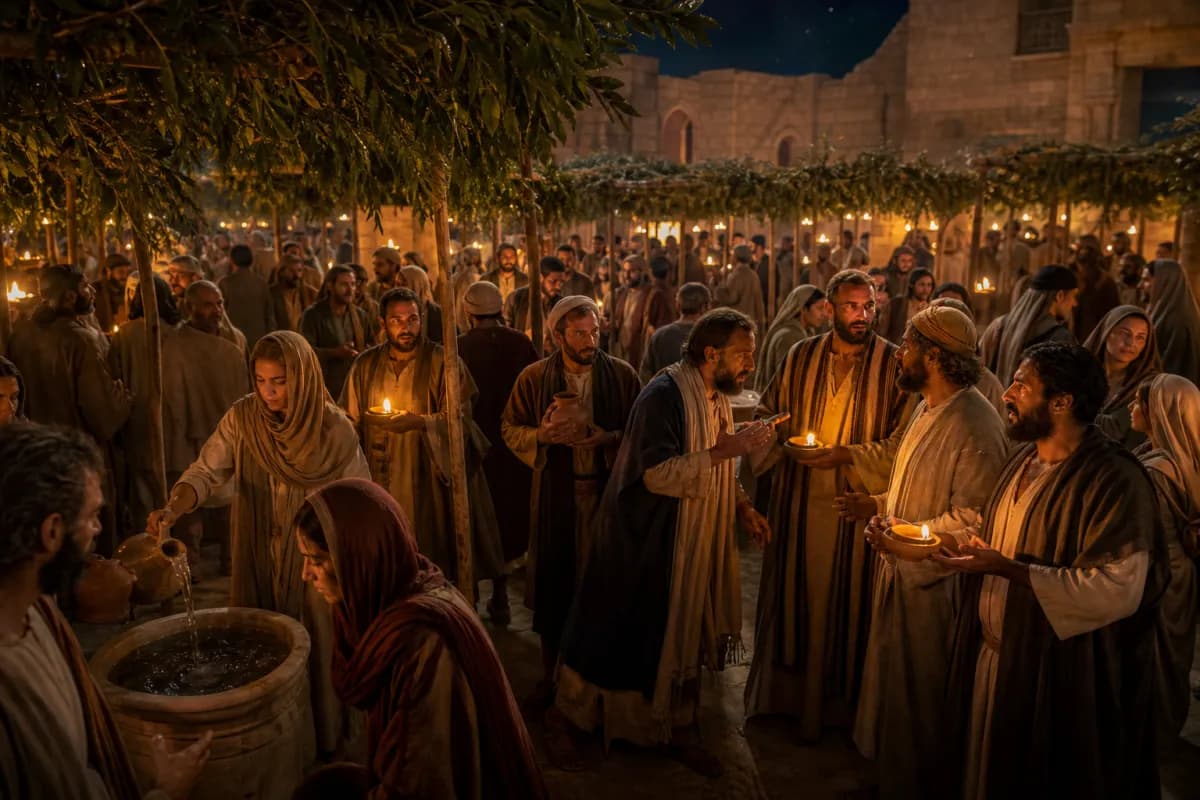
John 7–8 places Jesus at the Feast of Booths, where public argument about His origin and authority grows sharper. He invites the thirsty to come to Him for living water, declares Himself the light of the world, heals no one to win the debate, and exposes the difference between seeking God’s glory and defending human status. His final “I am” claim makes the conflict with His opponents decisive.
- In this study
- 112 verses · 5 movements
John 7
7:1After these things, Jesus was walking in Galilee, for he wouldn’t walk in Judea, because the Jews sought to kill him.
7:2Now the feast of the Jews, the Feast of Booths, was at hand.
7:3His brothers therefore said to him, “Depart from here and go into Judea, that your disciples also may see your works which you do.
7:4For no one does anything in secret while he seeks to be known openly. If you do these things, reveal yourself to the world.”
7:5For even his brothers didn’t believe in him.
7:6Jesus therefore said to them, “My time has not yet come, but your time is always ready.
7:7The world can’t hate you, but it hates me, because I testify about it, that its works are evil.
7:8You go up to the feast. I am not yet going up to this feast, because my time is not yet fulfilled.”
7:9Having said these things to them, he stayed in Galilee.
7:10But when his brothers had gone up to the feast, then he also went up, not publicly, but as it were in secret.
7:11The Jews therefore sought him at the feast, and said, “Where is he?”
7:12There was much murmuring among the multitudes concerning him. Some said, “He is a good man.” Others said, “Not so, but he leads the multitude astray.”
7:13Yet no one spoke openly of him for fear of the Jews.
7:14But when it was now the middle of the feast, Jesus went up into the temple and taught.
7:15The Jews therefore marveled, saying, “How does this man know letters, having never been educated?”
7:16Jesus therefore answered them, “My teaching is not mine, but his who sent me.
7:17If anyone desires to do his will, he will know about the teaching, whether it is from God or if I am speaking from myself.
7:18He who speaks from himself seeks his own glory, but he who seeks the glory of him who sent him is true, and no unrighteousness is in him.
7:19Didn’t Moses give you the law, and yet none of you keeps the law? Why do you seek to kill me?”
7:20The multitude answered, “You have a demon! Who seeks to kill you?”
7:21Jesus answered them, “I did one work and you all marvel because of it.
7:22Moses has given you circumcision (not that it is of Moses, but of the fathers), and on the Sabbath you circumcise a boy.
7:23If a boy receives circumcision on the Sabbath, that the law of Moses may not be broken, are you angry with me because I made a man completely healthy on the Sabbath?
7:24Don’t judge according to appearance, but judge righteous judgment.”
7:25Therefore some of them of Jerusalem said, “Isn’t this he whom they seek to kill?
7:26Behold, he speaks openly, and they say nothing to him. Can it be that the rulers indeed know that this is truly the Christ?
7:27However, we know where this man comes from, but when the Christ comes, no one will know where he comes from.”
7:28Jesus therefore cried out in the temple, teaching and saying, “You both know me, and know where I am from. I have not come of myself, but he who sent me is true, whom you don’t know.
7:29I know him, because I am from him, and he sent me.”
7:30They sought therefore to take him; but no one laid a hand on him, because his hour had not yet come.
7:31But of the multitude, many believed in him. They said, “When the Christ comes, he won’t do more signs than those which this man has done, will he?”
7:32The Pharisees heard the multitude murmuring these things concerning him, and the chief priests and the Pharisees sent officers to arrest him.
7:33Then Jesus said, “I will be with you a little while longer, then I go to him who sent me.
7:34You will seek me and won’t find me. You can’t come where I am.”
7:35The Jews therefore said among themselves, “Where will this man go that we won’t find him? Will he go to the Dispersion among the Greeks and teach the Greeks?
7:36What is this word that he said, ‘You will seek me, and won’t find me;’ and ‘Where I am, you can’t come’ ?”
7:37Now on the last and greatest day of the feast, Jesus stood and cried out, “If anyone is thirsty, let him come to me and drink!
7:38He who believes in me, as the Scripture has said, from within him will flow rivers of living water.”
7:39But he said this about the Spirit, which those believing in him were to receive. For the Holy Spirit was not yet given, because Jesus wasn’t yet glorified.
7:40Many of the multitude therefore, when they heard these words, said, “This is truly the prophet.”
7:41Others said, “This is the Christ.” But some said, “What, does the Christ come out of Galilee?
7:42Hasn’t the Scripture said that the Christ comes of the offspring of David, and from Bethlehem, the village where David was?”
7:43So a division arose in the multitude because of him.
7:44Some of them would have arrested him, but no one laid hands on him.
7:45The officers therefore came to the chief priests and Pharisees; and they said to them, “Why didn’t you bring him?”
7:46The officers answered, “No man ever spoke like this man!”
7:47The Pharisees therefore answered them, “You aren’t also led astray, are you?
7:48Have any of the rulers or any of the Pharisees believed in him?
7:49But this multitude that doesn’t know the law is cursed.”
7:50Nicodemus (he who came to him by night, being one of them) said to them,
7:51“Does our law judge a man unless it first hears from him personally and knows what he does?”
7:52They answered him, “Are you also from Galilee? Search and see that no prophet has arisen out of Galilee.”
7:53Everyone went to his own house,
John 8
8:1but Jesus went to the Mount of Olives.
8:2Now very early in the morning, he came again into the temple, and all the people came to him. He sat down and taught them.
8:3The scribes and the Pharisees brought a woman taken in adultery. Having set her in the middle,
8:4they told him, “Teacher, we found this woman in adultery, in the very act.
8:5Now in our law, Moses commanded us to stone such women. What then do you say about her?”
8:6They said this testing him, that they might have something to accuse him of. But Jesus stooped down and wrote on the ground with his finger.
8:7But when they continued asking him, he looked up and said to them, “He who is without sin among you, let him throw the first stone at her.”
8:8Again he stooped down and wrote on the ground with his finger.
8:9They, when they heard it, being convicted by their conscience, went out one by one, beginning from the oldest, even to the last. Jesus was left alone with the woman where she was, in the middle.
8:10Jesus, standing up, saw her and said, “Woman, where are your accusers? Did no one condemn you?”
8:11She said, “No one, Lord.” Jesus said, “Neither do I condemn you. Go your way. From now on, sin no more.”
8:12Again, therefore, Jesus spoke to them, saying, “I am the light of the world. He who follows me will not walk in the darkness, but will have the light of life.”
8:13The Pharisees therefore said to him, “You testify about yourself. Your testimony is not valid.”
8:14Jesus answered them, “Even if I testify about myself, my testimony is true, for I know where I came from, and where I am going; but you don’t know where I came from, or where I am going.
8:15You judge according to the flesh. I judge no one.
8:16Even if I do judge, my judgment is true, for I am not alone, but I am with the Father who sent me.
8:17It’s also written in your law that the testimony of two people is valid.
8:18I am one who testifies about myself, and the Father who sent me testifies about me.”
8:19They said therefore to him, “Where is your Father?” Jesus answered, “You know neither me nor my Father. If you knew me, you would know my Father also.”
8:20Jesus spoke these words in the treasury, as he taught in the temple. Yet no one arrested him, because his hour had not yet come.
8:21Jesus said therefore again to them, “I am going away, and you will seek me, and you will die in your sins. Where I go, you can’t come.”
8:22The Jews therefore said, “Will he kill himself, because he says, ‘Where I am going, you can’t come’ ?”
8:23He said to them, “You are from beneath. I am from above. You are of this world. I am not of this world.
8:24I said therefore to you that you will die in your sins; for unless you believe that I am he, you will die in your sins.”
8:25They said therefore to him, “Who are you?” Jesus said to them, “Just what I have been saying to you from the beginning.
8:26I have many things to speak and to judge concerning you. However, he who sent me is true; and the things which I heard from him, these I say to the world.”
8:27They didn’t understand that he spoke to them about the Father.
8:28Jesus therefore said to them, “When you have lifted up the Son of Man, then you will know that I am he, and I do nothing of myself, but as my Father taught me, I say these things.
8:29He who sent me is with me. The Father hasn’t left me alone, for I always do the things that are pleasing to him.”
8:30As he spoke these things, many believed in him.
8:31Jesus therefore said to those Jews who had believed him, “If you remain in my word, then you are truly my disciples.
8:32You will know the truth, and the truth will make you free.”
8:33They answered him, “We are Abraham’s offspring, and have never been in bondage to anyone. How do you say, ‘You will be made free’ ?”
8:34Jesus answered them, “Most certainly I tell you, everyone who commits sin is the bondservant of sin.
8:35A bondservant doesn’t live in the house forever. A son remains forever.
8:36If therefore the Son makes you free, you will be free indeed.
8:37I know that you are Abraham’s offspring, yet you seek to kill me, because my word finds no place in you.
8:38I say the things which I have seen with my Father; and you also do the things which you have seen with your father.”
8:39They answered him, “Our father is Abraham.” Jesus said to them, “If you were Abraham’s children, you would do the works of Abraham.
8:40But now you seek to kill me, a man who has told you the truth which I heard from God. Abraham didn’t do this.
8:41You do the works of your father.” They said to him, “We were not born of sexual immorality. We have one Father, God.”
8:42Therefore Jesus said to them, “If God were your father, you would love me, for I came out and have come from God. For I haven’t come of myself, but he sent me.
8:43Why don’t you understand my speech? Because you can’t hear my word.
8:44You are of your father the devil, and you want to do the desires of your father. He was a murderer from the beginning, and doesn’t stand in the truth, because there is no truth in him. When he speaks a lie, he speaks on his own; for he is a liar, and the father of lies.
8:45But because I tell the truth, you don’t believe me.
8:46Which of you convicts me of sin? If I tell the truth, why do you not believe me?
8:47He who is of God hears the words of God. For this cause you don’t hear, because you are not of God.”
8:48Then the Jews answered him, “Don’t we say well that you are a Samaritan, and have a demon?”
8:49Jesus answered, “I don’t have a demon, but I honor my Father and you dishonor me.
8:50But I don’t seek my own glory. There is one who seeks and judges.
8:51Most certainly, I tell you, if a person keeps my word, he will never see death.”
8:52Then the Jews said to him, “Now we know that you have a demon. Abraham died, as did the prophets; and you say, ‘If a man keeps my word, he will never taste of death.’
8:53Are you greater than our father Abraham, who died? The prophets died. Who do you make yourself out to be?”
8:54Jesus answered, “If I glorify myself, my glory is nothing. It is my Father who glorifies me, of whom you say that he is our God.
8:55You have not known him, but I know him. If I said, ‘I don’t know him,’ I would be like you, a liar. But I know him and keep his word.
8:56Your father Abraham rejoiced to see my day. He saw it and was glad.”
8:57The Jews therefore said to him, “You are not yet fifty years old! Have you seen Abraham?”
8:58Jesus said to them, “Most certainly, I tell you, before Abraham came into existence, I AM. ”
8:59Therefore they took up stones to throw at him, but Jesus hid himself and went out of the temple, having gone through the middle of them, and so passed by.
CONTEXTUAL OVERVIEW
John 7 opens with Jesus’ brothers urging Him to go publicly to Judea, while Jesus says His time has not yet come. At the feast, crowds and leaders debate whether He is good, deceptive, Messiah, or merely known too well to fit their expectations. The conflict is not an abstract disagreement about religion; it concerns whether Jesus is sent by the Father and whether His words will be received on God’s terms.
Water and light dominate the festival setting. On the last day of the feast Jesus calls the thirsty to come to Him and promises rivers of living water for believers; John identifies this as a promise about the Spirit. In chapter 8 Jesus says, “I am the light of the world.” These claims confront the crowd’s physical festival memories with the person who alone can give the Spirit’s life and lead people out of darkness.
HISTORICAL AND LITERARY CONTEXT
The Feast of Booths commemorated Israel’s wilderness life and was one of Jerusalem’s major pilgrimage festivals. John’s narrative uses its setting to frame Jesus’ teaching about God’s provision, presence, and light. Jesus does not say the feast itself is worthless; He declares that its hope reaches fulfillment in Him, the one sent by the Father.
The textual placement of 7:53–8:11 is debated because many early Greek manuscripts do not include the story of the woman accused of adultery at this location, and some place it elsewhere. The church has long received the account as a powerful picture of Jesus’ mercy and call to holiness, but the immediate flow from 7:52 to 8:12 is especially clear in the earliest manuscript tradition. John 8:12–59 therefore supplies the central light-and-testimony dispute for this study.
Did you know?
A golden jug carried water from the Pool of Siloam to the temple altar during the Feast of Booths, according to the later account preserved in Mishnah Sukkah 4:9.
Why it matters: This festival custom gives a vivid setting for Jesus’ invitation in John 7:37–39: the thirsty are to come to Him for the life of the Spirit.
SECTION-BY-SECTION ANALYSIS
- John 7:1–24 · John 7:33Jesus acts according to the Father’s timing and exposes judgments that use religious rules while refusing the mercy those rules serve.
- John 7:25–52 · John 7:39At Booths Jesus identifies Himself as the source of Spirit-given living water, even as official and popular responses divide around His words.
- John 8:12–59 · John 8:12Jesus, the light of the world, calls people to abide in His word and reveals that true freedom comes from the Son rather than ancestry or argument.
CHRIST IN THIS PASSAGE
Jesus’ claim to give living water is fulfilled explicitly by the Spirit given to believers after He is glorified. His saving mission therefore reaches beyond a festival moment: through His death, resurrection, and exaltation, He gives the Spirit who brings God’s life into His people. The invitation is personal and urgent—come to Me and drink—not a vague appeal to religious feeling.
As the light of the world, Jesus reveals the Father and exposes the darkness that refuses Him. His claim before Abraham is not merely that He existed earlier in history; within the escalating dispute it identifies Him with the eternal “I am” language of God’s self-revelation. The response of attempted stoning shows that His opponents understand the weight of the claim. Only the Son can free slaves of sin, because only He brings people into the Father’s house.
REFLECTION
John 7 warns against deciding who Jesus is by familiarity, public opinion, or a demand that He act on our timetable. Ask where you are judging by appearance: perhaps you reject a hard word because it disrupts your plans, or you use a rule to avoid the mercy God requires. Let Jesus’ question about seeking God’s glory search your motives.
John 8 asks whether you will remain in Jesus’ word. Freedom is not the ability to define yourself without limits; it is release from the sin that masters and deceives. Come to Christ with the specific pattern that has become slavery, receive His light without concealment, and take one next step of obedience with confidence that the Son truly makes His people free.
Original Greek Word Study
John 8:12
φῶς
phos · G5457
Usually translated: light
Phos means light. Jesus calls Himself the light of the world, promising that those who follow Him will no longer walk in darkness but receive the light of life.
Follow the Scripture trail
Living Water and Light in a Divided Feast in the larger story
The connection: At Israel’s wilderness festival, Jesus identifies Himself as the giver of the Spirit’s living water and the light that dispels darkness. Through His glorification in death and resurrection, the eternal Son brings slaves of sin into the Father’s house as free children.
Respond to the passage
Bring one hidden or defended sin into Jesus’ light rather than protecting it with excuses or religious appearance. Ask for the Spirit’s living water, stay with one command of Christ that you have avoided, and thank Him that His freedom is rooted in His saving work.
- How does the Feast of Booths sharpen Jesus’ words about water and light?
- Why does Jesus connect recognizing His teaching with seeking the Father’s glory?
- What kind of freedom does Jesus promise to those who abide in His word?
Prayer
Lord Jesus, light of the world, bring my hidden darkness into Your mercy. Give me the living water of Your Spirit, free me from the sins that master me, and teach me to remain in Your word. Amen.