Passage Study
The Shepherd Gives Sight and Lays Down His Life
John 9:1–10:42
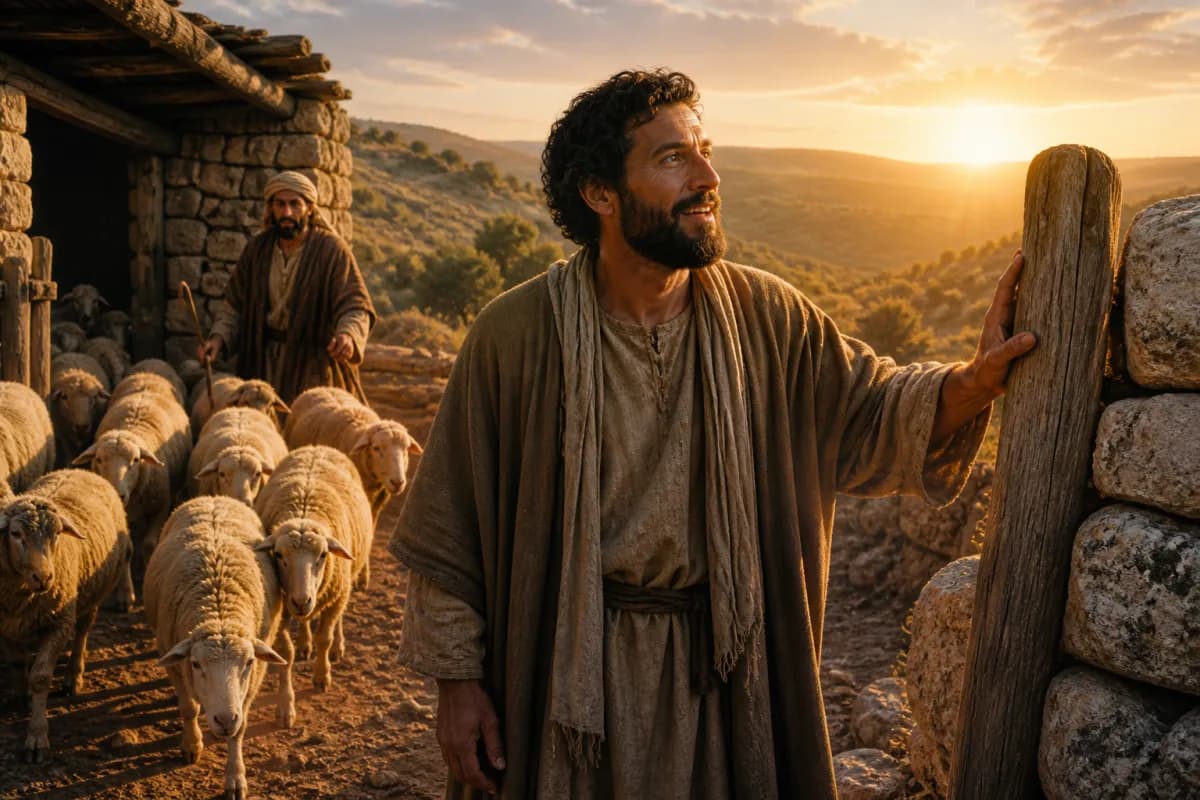
John 9–10 joins the healing of a man blind from birth to Jesus’ revelation as the good shepherd. The healed man gains physical sight and increasingly confesses Jesus, while religious investigators who claim to see reject the sign. Jesus then contrasts the thief with the shepherd who knows His sheep, gives them abundant life, lays down His life for them, takes it up again, and gathers other sheep into one flock.
- In this study
- 83 verses · 5 movements
John 9
9:1As he passed by, he saw a man blind from birth.
9:2His disciples asked him, “Rabbi, who sinned, this man or his parents, that he was born blind?”
9:3Jesus answered, “This man didn’t sin, nor did his parents, but that the works of God might be revealed in him.
9:4I must work the works of him who sent me while it is day. The night is coming, when no one can work.
9:5While I am in the world, I am the light of the world.”
9:6When he had said this, he spat on the ground, made mud with the saliva, anointed the blind man’s eyes with the mud,
9:7and said to him, “Go, wash in the pool of Siloam” (which means “Sent”). So he went away, washed, and came back seeing.
9:8Therefore the neighbors and those who saw that he was blind before said, “Isn’t this he who sat and begged?”
9:9Others were saying, “It is he.” Still others were saying, “He looks like him.” He said, “I am he.”
9:10They therefore were asking him, “How were your eyes opened?”
9:11He answered, “A man called Jesus made mud, anointed my eyes, and said to me, ‘Go to the pool of Siloam and wash.’ So I went away and washed, and I received sight.”
9:12Then they asked him, “Where is he?” He said, “I don’t know.”
9:13They brought him who had been blind to the Pharisees.
9:14It was a Sabbath when Jesus made the mud and opened his eyes.
9:15Again therefore the Pharisees also asked him how he received his sight. He said to them, “He put mud on my eyes, I washed, and I see.”
9:16Some therefore of the Pharisees said, “This man is not from God, because he doesn’t keep the Sabbath.” Others said, “How can a man who is a sinner do such signs?” So there was division among them.
9:17Therefore they asked the blind man again, “What do you say about him, because he opened your eyes?” He said, “He is a prophet.”
9:18The Jews therefore didn’t believe concerning him, that he had been blind and had received his sight, until they called the parents of him who had received his sight,
9:19and asked them, “Is this your son, whom you say was born blind? How then does he now see?”
9:20His parents answered them, “We know that this is our son, and that he was born blind;
9:21but how he now sees, we don’t know; or who opened his eyes, we don’t know. He is of age. Ask him. He will speak for himself.”
9:22His parents said these things because they feared the Jews; for the Jews had already agreed that if any man would confess him as Christ, he would be put out of the synagogue.
9:23Therefore his parents said, “He is of age. Ask him.”
9:24So they called the man who was blind a second time, and said to him, “Give glory to God. We know that this man is a sinner.”
9:25He therefore answered, “I don’t know if he is a sinner. One thing I do know: that though I was blind, now I see.”
9:26They said to him again, “What did he do to you? How did he open your eyes?”
9:27He answered them, “I told you already, and you didn’t listen. Why do you want to hear it again? You don’t also want to become his disciples, do you?”
9:28They insulted him and said, “You are his disciple, but we are disciples of Moses.
9:29We know that God has spoken to Moses. But as for this man, we don’t know where he comes from.”
9:30The man answered them, “How amazing! You don’t know where he comes from, yet he opened my eyes.
9:31We know that God doesn’t listen to sinners, but if anyone is a worshiper of God and does his will, he listens to him.
9:32Since the world began it has never been heard of that anyone opened the eyes of someone born blind.
9:33If this man were not from God, he could do nothing.”
9:34They answered him, “You were altogether born in sins, and do you teach us?” Then they threw him out.
9:35Jesus heard that they had thrown him out, and finding him, he said, “Do you believe in the Son of God?”
9:36He answered, “Who is he, Lord, that I may believe in him?”
9:37Jesus said to him, “You have both seen him, and it is he who speaks with you.”
9:38He said, “Lord, I believe!” and he worshiped him.
9:39Jesus said, “I came into this world for judgment, that those who don’t see may see; and that those who see may become blind.”
9:40Those of the Pharisees who were with him heard these things, and said to him, “Are we also blind?”
9:41Jesus said to them, “If you were blind, you would have no sin; but now you say, ‘We see.’ Therefore your sin remains.
John 10
10:1“Most certainly, I tell you, one who doesn’t enter by the door into the sheep fold, but climbs up some other way, is a thief and a robber.
10:2But one who enters in by the door is the shepherd of the sheep.
10:3The gatekeeper opens the gate for him, and the sheep listen to his voice. He calls his own sheep by name and leads them out.
10:4Whenever he brings out his own sheep, he goes before them; and the sheep follow him, for they know his voice.
10:5They will by no means follow a stranger, but will flee from him; for they don’t know the voice of strangers.”
10:6Jesus spoke this parable to them, but they didn’t understand what he was telling them.
10:7Jesus therefore said to them again, “Most certainly, I tell you, I am the sheep’s door.
10:8All who came before me are thieves and robbers, but the sheep didn’t listen to them.
10:9I am the door. If anyone enters in by me, he will be saved, and will go in and go out and will find pasture.
10:10The thief only comes to steal, kill, and destroy. I came that they may have life, and may have it abundantly.
10:11“I am the good shepherd. The good shepherd lays down his life for the sheep.
10:12He who is a hired hand, and not a shepherd, who doesn’t own the sheep, sees the wolf coming, leaves the sheep, and flees. The wolf snatches the sheep and scatters them.
10:13The hired hand flees because he is a hired hand and doesn’t care for the sheep.
10:14I am the good shepherd. I know my own, and I’m known by my own;
10:15even as the Father knows me, and I know the Father. I lay down my life for the sheep.
10:16I have other sheep which are not of this fold. I must bring them also, and they will hear my voice. They will become one flock with one shepherd.
10:17Therefore the Father loves me, because I lay down my life, that I may take it again.
10:18No one takes it away from me, but I lay it down by myself. I have power to lay it down, and I have power to take it again. I received this commandment from my Father.”
10:19Therefore a division arose again among the Jews because of these words.
10:20Many of them said, “He has a demon and is insane! Why do you listen to him?”
10:21Others said, “These are not the sayings of one possessed by a demon. It isn’t possible for a demon to open the eyes of the blind, is it?”
10:22It was the Feast of the Dedication at Jerusalem.
10:23It was winter, and Jesus was walking in the temple, in Solomon’s porch.
10:24The Jews therefore came around him and said to him, “How long will you hold us in suspense? If you are the Christ, tell us plainly.”
10:25Jesus answered them, “I told you, and you don’t believe. The works that I do in my Father’s name, these testify about me.
10:26But you don’t believe, because you are not of my sheep, as I told you.
10:27My sheep hear my voice, and I know them, and they follow me.
10:28I give eternal life to them. They will never perish, and no one will snatch them out of my hand.
10:29My Father who has given them to me is greater than all. No one is able to snatch them out of my Father’s hand.
10:30I and the Father are one.”
10:31Therefore the Jews took up stones again to stone him.
10:32Jesus answered them, “I have shown you many good works from my Father. For which of those works do you stone me?”
10:33The Jews answered him, “We don’t stone you for a good work, but for blasphemy, because you, being a man, make yourself God.”
10:34Jesus answered them, “Isn’t it written in your law, ‘I said, you are gods’?
10:35If he called them gods, to whom the word of God came (and the Scripture can’t be broken),
10:36do you say of him whom the Father sanctified and sent into the world, ‘You blaspheme,’ because I said, ‘I am the Son of God’?
10:37If I don’t do the works of my Father, don’t believe me.
10:38But if I do them, though you don’t believe me, believe the works, that you may know and believe that the Father is in me, and I in the Father.”
10:39They sought again to seize him, and he went out of their hand.
10:40He went away again beyond the Jordan into the place where John was baptizing at first, and he stayed there.
10:41Many came to him. They said, “John indeed did no sign, but everything that John said about this man is true.”
10:42Many believed in him there.
CONTEXTUAL OVERVIEW
John 9 begins with the disciples asking whose sin caused a man’s blindness. Jesus refuses the simple blame assignment and acts to reveal God’s works. The man washes in the Pool of Siloam and returns seeing, but the healing starts an investigation that presses every witness to decide what the sign means. The man moves from calling Jesus “the man,” to “a prophet,” to one from God, and finally worships Him as Lord.
The shepherd discourse follows this expulsion scene. Jesus does not offer a sentimental pastoral image detached from the conflict. The leaders’ treatment of the healed man supplies the contrast: they question, threaten, and cast out, while Jesus seeks the man, speaks to him, and receives his worship. The good shepherd’s care is costly because He lays down His life for the sheep.
HISTORICAL AND LITERARY CONTEXT
Blindness in the ancient world could bring economic vulnerability and social marginalization, which explains why neighbors dispute the man’s identity and his parents fear being put out of the synagogue. John records their fear without making their caution admirable. The authorities’ threat turns the examination into a test of public allegiance to Jesus.
Shepherd language carries Israel’s scriptural memory of kings and leaders. Ezekiel condemns shepherds who feed themselves rather than the flock and promises that the Lord will seek His sheep and set up a Davidic shepherd over them. John 10 echoes this background, while Jesus’ reference to laying down and taking up His life moves beyond a leadership metaphor to His voluntary, death-and-resurrection mission.
SECTION-BY-SECTION ANALYSIS
- John 9:1–12 · John 10:41Jesus gives sight to the man born blind, refusing a blame-centered explanation of suffering and displaying God’s work in a concrete act of mercy.
- John 9:13–41 · John 10:40The healed man’s growing confession contrasts with leaders whose certainty about their own sight makes them reject the One who opened his eyes.
- John 10:1–42 · John 10:11Jesus is the good shepherd who knows, protects, dies for, and gathers His sheep, then takes up His life in obedience to the Father.
CHRIST IN THIS PASSAGE
Jesus’ healing of the man born blind is a sign of His identity as the light of the world, but the chapter refuses to reduce it to an illustration. A particular man receives sight, public pressure follows, and Jesus seeks him after he is expelled. The man’s worship is the proper response to the Son of Man who brings sight to those who know they need Him and exposes those who trust their own vision.
Jesus explains His saving mission directly in the shepherd discourse: He lays down His life for the sheep and takes it up again. This is stronger than the general statement that good leaders take risks. His death is voluntary, obedient to the Father, and given for the sheep; His resurrection is included in His authority to take His life up again. The promise to gather other sheep shows that His death creates one flock from beyond the immediate fold of Israel.
REFLECTION
The man born blind gives a clear pattern for honest faith. He does not claim to know every theological answer under interrogation; he says what has happened: “I was blind and now I see.” Where has fear of people made you mute about what Christ has done, or where has your need to explain every painful event made you overlook the mercy Christ is doing now?
Hear the shepherd’s promise personally but not privately. Jesus knows His sheep, holds them securely, and gathers them into one flock. Bring the threat, accusation, or uncertainty that makes you feel exposed to Him. Then listen for His voice in His word and practice belonging to His flock through worship, truthfulness, and care for another vulnerable person.
Original Greek Word Study
John 10:11
ποιμήν
poimen · G4166
Usually translated: shepherd
Poimen means shepherd. Jesus is the good shepherd who knows His sheep and lays down His life for them, contrasting His care with leaders who use rather than protect the flock.
Follow the Scripture trail
The Shepherd Gives Sight and Lays Down His Life in the larger story
The connection: Jesus gives sight to the man religious authorities cast out and reveals Himself as the promised shepherd who seeks His sheep. By laying down His life and taking it up again, He saves, secures, and gathers one people from Israel and the nations under His care.
Respond to the passage
Bring to Jesus the area where fear, shame, or self-confidence has kept you from seeing clearly. Thank Him that He laid down His life for His sheep. Listen to His word in one concrete decision this week and offer shepherd-like care to someone who has been overlooked or pushed aside.
- How does the healed man’s understanding of Jesus deepen through John 9?
- Why does John place the shepherd discourse after the man’s expulsion?
- What does Jesus mean when He says He lays down His life and takes it up again?
Prayer
Good Shepherd, thank You for seeking me when I was blind and for laying down Your life for Your sheep. Guard me from proud self-confidence, help me recognize Your voice, and make me care for those who are easily overlooked. Amen.