Passage Study
The Search for Wisdom beneath the Earth
Job 28:1–28:28
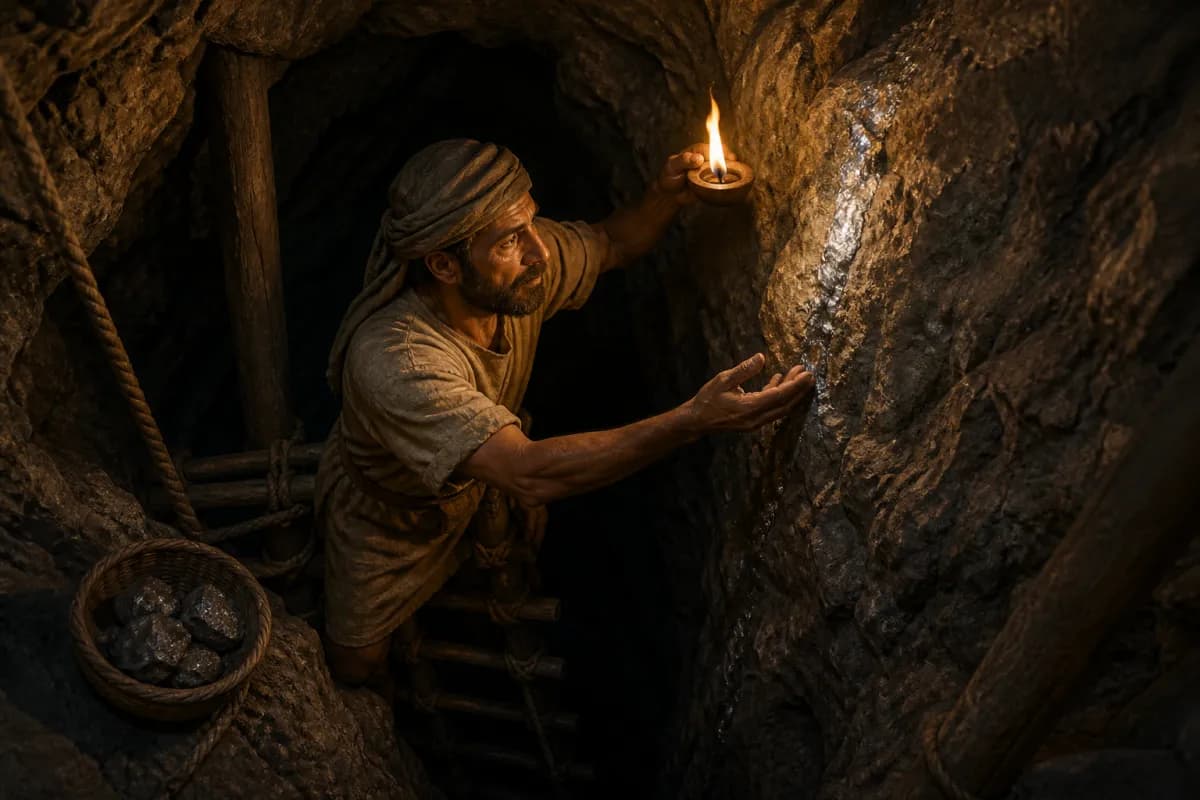
Job 28:1–28 follows human miners into dark shafts where they find silver, gold, and precious stones, then asks where wisdom can be found. No creature, sea, wealth, or human effort can purchase it; God alone knows its way, and He names the fear of the Lord and turning from evil as wisdom. The poem points to Jesus, in whom God’s saving wisdom is made known and who calls people from self-reliance into reverent life before God.
- In this study
- 28 verses · 5 movements
Job 28
28:1“Surely there is a mine for silver, and a place for gold which they refine.
28:2Iron is taken out of the earth, and copper is smelted out of the ore.
28:3Man sets an end to darkness, and searches out, to the furthest bound, the stones of obscurity and of thick darkness.
28:4He breaks open a shaft away from where people live. They are forgotten by the foot. They hang far from men, they swing back and forth.
28:5As for the earth, out of it comes bread. Underneath it is turned up as it were by fire.
28:6Sapphires come from its rocks. It has dust of gold.
28:7That path no bird of prey knows, neither has the falcon’s eye seen it.
28:8The proud animals have not trodden it, nor has the fierce lion passed by there.
28:9He puts his hand on the flinty rock, and he overturns the mountains by the roots.
28:10He cuts out channels among the rocks. His eye sees every precious thing.
28:11He binds the streams that they don’t trickle. The thing that is hidden he brings out to light.
28:12“But where will wisdom be found? Where is the place of understanding?
28:13Man doesn’t know its price, and it isn’t found in the land of the living.
28:14The deep says, ‘It isn’t in me.’ The sea says, ‘It isn’t with me.’
28:15It can’t be gotten for gold, neither will silver be weighed for its price.
28:16It can’t be valued with the gold of Ophir, with the precious onyx, or the sapphire.
28:17Gold and glass can’t equal it, neither will it be exchanged for jewels of fine gold.
28:18No mention will be made of coral or of crystal. Yes, the price of wisdom is above rubies.
28:19The topaz of Ethiopia will not equal it. It won’t be valued with pure gold.
28:20Where then does wisdom come from? Where is the place of understanding?
28:21Seeing it is hidden from the eyes of all living, and kept close from the birds of the sky.
28:22Destruction and Death say, ‘We have heard a rumor of it with our ears.’
28:23“God understands its way, and he knows its place.
28:24For he looks to the ends of the earth, and sees under the whole sky.
28:25He establishes the force of the wind. Yes, he measures out the waters by measure.
28:26When he made a decree for the rain, and a way for the lightning of the thunder,
28:27then he saw it, and declared it. He established it, yes, and searched it out.
28:28To man he said, ‘Behold, the fear of the Lord, that is wisdom. To depart from evil is understanding.’”
CONTEXTUAL OVERVIEW
Job 28 interrupts the argument with a self-contained wisdom poem. Its opening marvels at human ingenuity: people tunnel into darkness, divert streams, and uncover what birds of prey and wild animals do not see. The poem respects skill, labor, and discovery. Its question is sharper: if humans can reach hidden ore, why can they not reach wisdom?
The answer does not demean material goods; it puts them in their place. Gold from Ophir, onyx, sapphire, coral, crystal, and pearls cannot purchase wisdom. The poem moves from the depths of the earth to the limits of death itself, then directs attention to the God who sees the whole created order.
HISTORICAL AND LITERARY CONTEXT
The mining imagery fits the ancient world’s familiarity with extracting metals and precious stones, though the poem does not require readers to identify a particular mine or technology. Its movement is literary and theological: humans penetrate places inaccessible to animals, yet their greatest achievement does not solve the question of how to live rightly before God.
The chapter stands after Job’s protest and before his final defense. It does not suddenly give Job the reason for his suffering. Instead, it reframes the whole dispute. Neither Job nor his friends possesses the divine vantage point required to explain every event. Wisdom begins with reverence, not with confidence that one has decoded providence.
SECTION-BY-SECTION ANALYSIS
- The mine · Job 28:1Human beings can uncover hidden treasures through strenuous skill, yet discovery cannot by itself answer how to live before God.
- No price · Job 28:18The poem names costly goods only to say that wisdom cannot be bought, inherited, or traded for.
- Fear the Lord · Job 28:28Reverent awe before God and a turn from evil form the practical wisdom available to creatures who do not see as God sees.
CHRIST IN THIS PASSAGE
Job 28 does not directly name the Messiah, but its claim that God alone knows wisdom prepares the way for the New Testament’s announcement that Christ is God’s wisdom for His people. Jesus does not give believers secret knowledge that makes suffering transparent. In Him, God makes His saving purpose known through a crucified and risen Savior who overturns worldly measures of power and success.
Christ also embodies the obedient fear of the Lord. He lives in perfect trust and turns decisively from evil, then gives Himself for those whose wisdom has become self-reliance. His mission calls people to receive God’s wisdom by faith and to walk in the repentance and holy love that the poem’s final line describes.
REFLECTION
A culture rich in information can still be poor in wisdom. Job 28 invites you to value learning and skill without asking them to bear the weight of ultimate control. Some losses remain unexplained; some decisions remain complex. The fear of the Lord is not ignorance but the freedom to live faithfully before the God who sees what we cannot.
Jesus meets the anxious search for mastery with Himself. Ask Him to show you where you are trying to buy, achieve, or outthink the wisdom only God can give. Then take the next obedient step—turn from a known evil, seek wise counsel, and trust the Father with what remains hidden.
Original Hebrew Word Study
Job 28:28
יִרְאָה
yirah · H3374
Usually translated: fear, reverence, or awe
Yirah means reverent awe. Job’s wisdom poem ends where human searching must end: true wisdom begins in reverence for the Lord and turns away from evil.
Follow the Scripture trail
The Search for Wisdom beneath the Earth in the larger story
The connection: Job’s wisdom poem declares that only God sees the whole order of reality and that human life begins with reverent trust. Jesus makes God’s saving wisdom known through His cross and resurrection, forming people who turn from evil and walk humbly before God.
Respond to the passage
Bring to Jesus the place where you are demanding complete control before you will obey. Ask for reverent wisdom, then choose one concrete turn away from evil and one humble step of trust in the God who sees what you cannot.
- Why does the poem begin by honoring human mining skill before declaring that wisdom cannot be found that way?
- What do the references to wealth and the deep teach about the limits of money and information?
- How does Christ as God’s wisdom reshape the way Christians pursue knowledge, work, and obedience?
Prayer
God of all wisdom, forgive my attempts to control what only You can see. Thank You for Jesus, Your wisdom and my Redeemer. Give me reverence, a turning from evil, and patient trust for the path before me. Amen.