Passage Study
Job’s Oath of Integrity before the God Who Sees
Job 29:1–31:40
Job 29–31 brings Job’s last defense to its peak. He remembers former honor and his care for the vulnerable, grieves his present humiliation, and swears a detailed oath that rejects lust, deceit, exploitation, greed, revenge, and concealed sin. His defense does not make him sinless; it refuses the friends’ invented charges and places his whole life before God’s just scrutiny. The passage points to Jesus, who alone is wholly righteous and brings repentant sinners into truthful fellowship with God.
- In this study
- 96 verses · 5 movements
Job 29
29:1Job again took up his parable, and said,
29:2“Oh that I were as in the months of old, as in the days when God watched over me;
29:3when his lamp shone on my head, and by his light I walked through darkness,
29:4as I was in my prime, when the friendship of God was in my tent,
29:5when the Almighty was yet with me, and my children were around me,
29:6when my steps were washed with butter, and the rock poured out streams of oil for me,
29:7when I went out to the city gate, when I prepared my seat in the street.
29:8The young men saw me and hid themselves. The aged rose up and stood.
29:9The princes refrained from talking, and laid their hand on their mouth.
29:10The voice of the nobles was hushed, and their tongue stuck to the roof of their mouth.
29:11For when the ear heard me, then it blessed me, and when the eye saw me, it commended me,
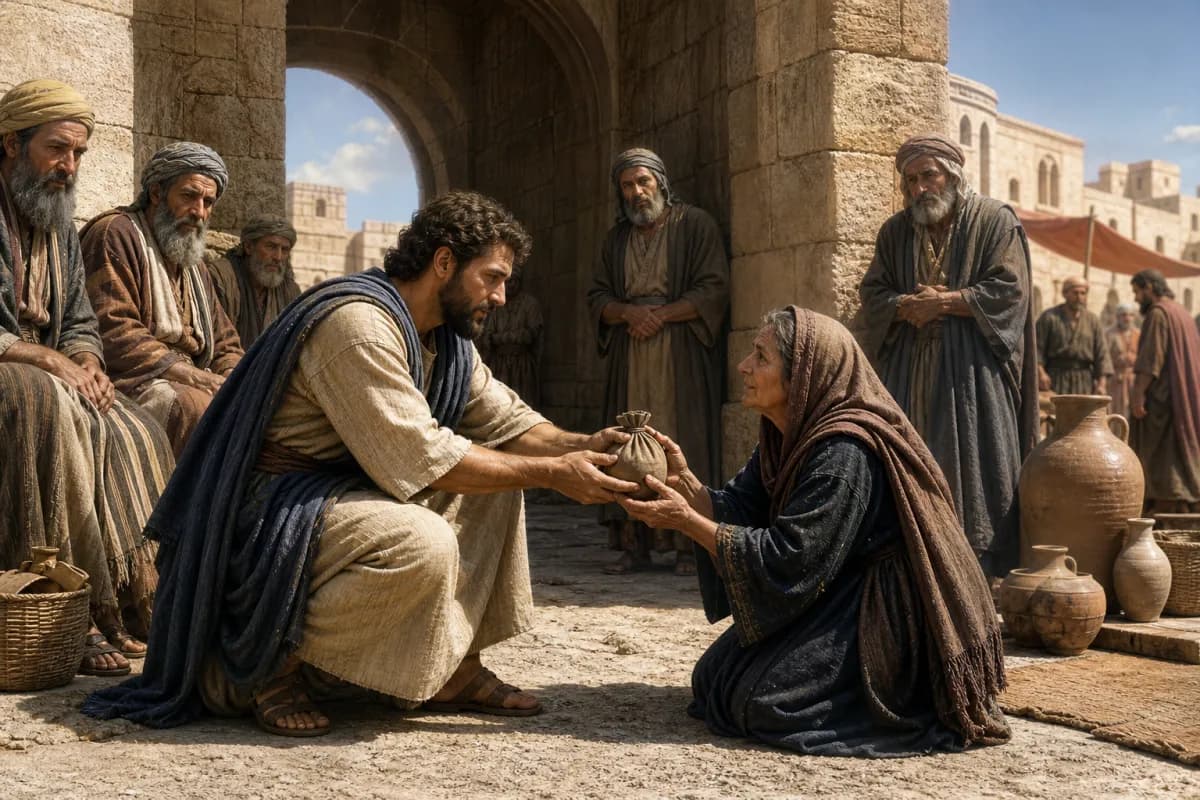
29:12because I delivered the poor who cried, and the fatherless also, who had no one to help him,
29:13the blessing of him who was ready to perish came on me, and I caused the widow’s heart to sing for joy.
29:14I put on righteousness, and it clothed me. My justice was as a robe and a diadem.
29:15I was eyes to the blind, and feet to the lame.
29:16I was a father to the needy. I researched the cause of him whom I didn’t know.
29:17I broke the jaws of the unrighteous and plucked the prey out of his teeth.
29:18Then I said, ‘I will die in my own house, I will count my days as the sand.
29:19My root is spread out to the waters. The dew lies all night on my branch.
29:20My glory is fresh in me. My bow is renewed in my hand.’
29:21“Men listened to me, waited, and kept silence for my counsel.
29:22After my words they didn’t speak again. My speech fell on them.
29:23They waited for me as for the rain. Their mouths drank as with the spring rain.
29:24I smiled on them when they had no confidence. They didn’t reject the light of my face.
29:25I chose out their way, and sat as chief. I lived as a king in the army, as one who comforts the mourners.
Job 30
30:1“But now those who are younger than I have me in derision, whose fathers I considered unworthy to put with my sheep dogs.
30:2Of what use is the strength of their hands to me, men in whom ripe age has perished?
30:3They are gaunt from lack and famine. They gnaw the dry ground, in the gloom of waste and desolation.
30:4They pluck salt herbs by the bushes. The roots of the broom tree are their food.
30:5They are driven out from among men. They cry after them as after a thief,
30:6so that they live in frightful valleys, and in holes of the earth and of the rocks.
30:7They bray among the bushes. They are gathered together under the nettles.
30:8They are children of fools, yes, children of wicked men. They were flogged out of the land.
30:9“Now I have become their song. Yes, I am a byword to them.
30:10They abhor me, they stand aloof from me, and don’t hesitate to spit in my face.
30:11For he has untied his cord, and afflicted me; and they have thrown off restraint before me.
30:12On my right hand rise the rabble. They thrust aside my feet. They cast their ways of destruction up against me.
30:13They mar my path. They promote my destruction without anyone’s help.
30:14As through a wide breach they come. They roll themselves in amid the ruin.
30:15Terrors have turned on me. They chase my honor as the wind. My welfare has passed away as a cloud.
30:16“Now my soul is poured out within me. Days of affliction have taken hold of me.
30:17In the night season my bones are pierced in me, and the pains that gnaw me take no rest.
30:18My garment is disfigured by great force. It binds me about as the collar of my tunic.
30:19He has cast me into the mire. I have become like dust and ashes.
30:20I cry to you, and you do not answer me. I stand up, and you gaze at me.
30:21You have turned to be cruel to me. With the might of your hand you persecute me.
30:22You lift me up to the wind, and drive me with it. You dissolve me in the storm.
30:23For I know that you will bring me to death, to the house appointed for all living.
30:24“However doesn’t one stretch out a hand in his fall? Or in his calamity therefore cry for help?
30:25Didn’t I weep for him who was in trouble? Wasn’t my soul grieved for the needy?
30:26When I looked for good, then evil came. When I waited for light, darkness came.
30:27My heart is troubled, and doesn’t rest. Days of affliction have come on me.
30:28I go mourning without the sun. I stand up in the assembly, and cry for help.
30:29I am a brother to jackals, and a companion to ostriches.
30:30My skin grows black and peels from me. My bones are burned with heat.
30:31Therefore my harp has turned to mourning, and my pipe into the voice of those who weep.
Job 31
31:1“I made a covenant with my eyes; how then should I look lustfully at a young woman?
31:2For what is the portion from God above, and the heritage from the Almighty on high?
31:3Is it not calamity to the unrighteous, and disaster to the workers of iniquity?
31:4Doesn’t he see my ways, and count all my steps?
31:5“If I have walked with falsehood, and my foot has hurried to deceit
31:6(let me be weighed in an even balance, that God may know my integrity);
31:7if my step has turned out of the way, if my heart walked after my eyes, if any defilement has stuck to my hands,
31:8then let me sow, and let another eat. Yes, let the produce of my field be rooted out.
31:9“If my heart has been enticed to a woman, and I have laid wait at my neighbor’s door,
31:10then let my wife grind for another, and let others sleep with her.
31:11For that would be a heinous crime. Yes, it would be an iniquity to be punished by the judges,
31:12for it is a fire that consumes to destruction, and would root out all my increase.
31:13“If I have despised the cause of my male servant or of my female servant, when they contended with me,
31:14what then will I do when God rises up? When he visits, what will I answer him?
31:15Didn’t he who made me in the womb make him? Didn’t one fashion us in the womb?
31:16“If I have withheld the poor from their desire, or have caused the eyes of the widow to fail,
31:17or have eaten my morsel alone, and the fatherless has not eaten of it
31:18(no, from my youth he grew up with me as with a father, I have guided her from my mother’s womb);
31:19if I have seen any perish for want of clothing, or that the needy had no covering;
31:20if his heart hasn’t blessed me, if he hasn’t been warmed with my sheep’s fleece;
31:21if I have lifted up my hand against the fatherless, because I saw my help in the gate;
31:22then let my shoulder fall from the shoulder blade, and my arm be broken from the bone.
31:23For calamity from God is a terror to me. Because of his majesty, I can do nothing.
31:24“If I have made gold my hope, and have said to the fine gold, ‘You are my confidence;’
31:25If I have rejoiced because my wealth was great, and because my hand had gotten much;
31:26if I have seen the sun when it shined, or the moon moving in splendor,
31:27and my heart has been secretly enticed, and my hand threw a kiss from my mouth;
31:28this also would be an iniquity to be punished by the judges, for I would have denied the God who is above.
31:29“If I have rejoiced at the destruction of him who hated me, or lifted up myself when evil found him
31:30(I have certainly not allowed my mouth to sin by asking his life with a curse);
31:31if the men of my tent have not said, ‘Who can find one who has not been filled with his meat?’
31:32(the foreigner has not camped in the street, but I have opened my doors to the traveler);
31:33if like Adam I have covered my transgressions, by hiding my iniquity in my heart,
31:34because I feared the great multitude, and the contempt of families terrified me, so that I kept silence, and didn’t go out of the door—
31:35oh that I had one to hear me! Behold, here is my signature! Let the Almighty answer me! Let the accuser write my indictment!
31:36Surely I would carry it on my shoulder, and I would bind it to me as a crown.
31:37I would declare to him the number of my steps. I would go near to him like a prince.
31:38If my land cries out against me, and its furrows weep together;
31:39if I have eaten its fruits without money, or have caused its owners to lose their life,
31:40let briers grow instead of wheat, and stinkweed instead of barley.” The words of Job are ended.
CONTEXTUAL OVERVIEW
Job’s final speech is not a nostalgic attempt to recover status. In chapter 29, he recalls a life marked by God’s favor and by concrete responsibility: he delivered the poor who cried, cared for the orphan and widow, confronted oppressors, and treated the blind and lame as neighbors rather than inconveniences. These memories answer the portrait of a cruel exploiter that Eliphaz has invented.
Chapters 30–31 make the contrast painful. Young men now mock Job, his body is wasting, and he calls to God without receiving the hearing he longs for. In that darkness, Job does not offer a vague claim to be a good person. He names the places where integrity must be tested—sexual desire, business speech, treatment of servants, money, enemies, strangers, and hidden wrongdoing—and asks for a true verdict.
HISTORICAL AND LITERARY CONTEXT
Job 29–31 is wisdom poetry shaped as a formal self-defense. The repeated pattern, “if I have … then let …,” is an oath of clearance: Job invokes consequences if the accusations are true. The passage does not portray him as claiming perfection or purchasing God’s favor through moral achievement. It shows a man refusing to confess sins he has not committed merely to satisfy a theological argument.
The speech also makes justice social and visible. Job’s integrity includes how he used power over servants, whether he shared food with the hungry, whether he let wealth become his confidence, and whether he rejoiced at an enemy’s downfall. The friends have treated suffering as evidence; Job calls God to examine the actual fruits of his life.
SECTION-BY-SECTION ANALYSIS
- The gate and the poor · Job 29:7Job’s remembered honor is tied to advocacy for the vulnerable, not to private prestige or wealth.
- A covenant with my eyes · Job 31:1Job treats inward desire as morally serious before it grows into exploitative action.
- Let the Almighty answer me · Job 31:35The oath reaches its climax in Job’s desire for God’s truthful judgment rather than an easy acquittal from his companions.
CHRIST IN THIS PASSAGE
Job’s oath reveals the kind of integrity God rightly desires, but Job is not the sinless Savior. His need to stand before God underlines the human problem that no self-defense can finally solve. Jesus alone lives without deceit or exploitation, loves the poor without self-interest, and obeys the Father perfectly. His righteousness is not merely an example; through His saving death, He reconciles guilty people who cannot present a spotless record of their own.
There is also a strong thematic echo in Job’s care for the powerless. Jesus announces good news to the poor and identifies Himself with those in need. His mission forms a people whose repentance has practical shape: truth in the hidden places, justice in work and money, mercy toward those with little social protection, and love that does not delight in an enemy’s fall.
REFLECTION
Job 31 gives searching questions for a conscience without licensing self-salvation. Where have your eyes, words, money, authority, or private resentments moved away from love of God and neighbor? Bring specific sin into the light before Jesus, who forgives and changes His people. Where an accusation is false, do not manufacture guilt to make conflict end more quickly.
This passage also asks what your neighbors experience from your faith. Job remembers food shared, servants heard, strangers welcomed, and the vulnerable defended. Ask Christ to make the integrity you confess visible in one costly act of fairness, generosity, or protection this week.
Original Hebrew Word Study
Job 31:6
תֻּמָּה
tummah · H8538
Usually translated: integrity or blamelessness
Tummah means integrity or wholeness. Job asks to be weighed fairly, insisting that his life has not been the hidden fraud his friends imagine.
Follow the Scripture trail
Job’s Oath of Integrity before the God Who Sees in the larger story
The connection: Job’s oath exposes both the goodness of a life ordered toward God and neighbor and the need for a final Judge who truly knows the heart. Jesus alone is fully righteous; by His cross He brings sinners into God’s presence and makes integrity the fruit of grace rather than a defense of self.
Respond to the passage
Ask Jesus to search one hidden area of your life—desire, speech, money, power, resentment, or secrecy. Confess what is true, reject what is false, and take one concrete step to serve a person who has less power or security than you.
- Why does Job remember his care for the poor and vulnerable when answering the friends’ accusations?
- What is the difference between Job’s oath of integrity and a claim that he has no need for mercy?
- How does Jesus’ perfect righteousness change the way Christians practice honest self-examination?
Prayer
Lord Jesus, You see the hidden parts of my life and You welcome truthful confession. Forgive my sin, guard my eyes and speech, and make Your mercy visible in the way I use power and care for people in need. Amen.