Passage Study
Job’s First Lament and the Failure of Easy Answers
Job 3:1–14:22
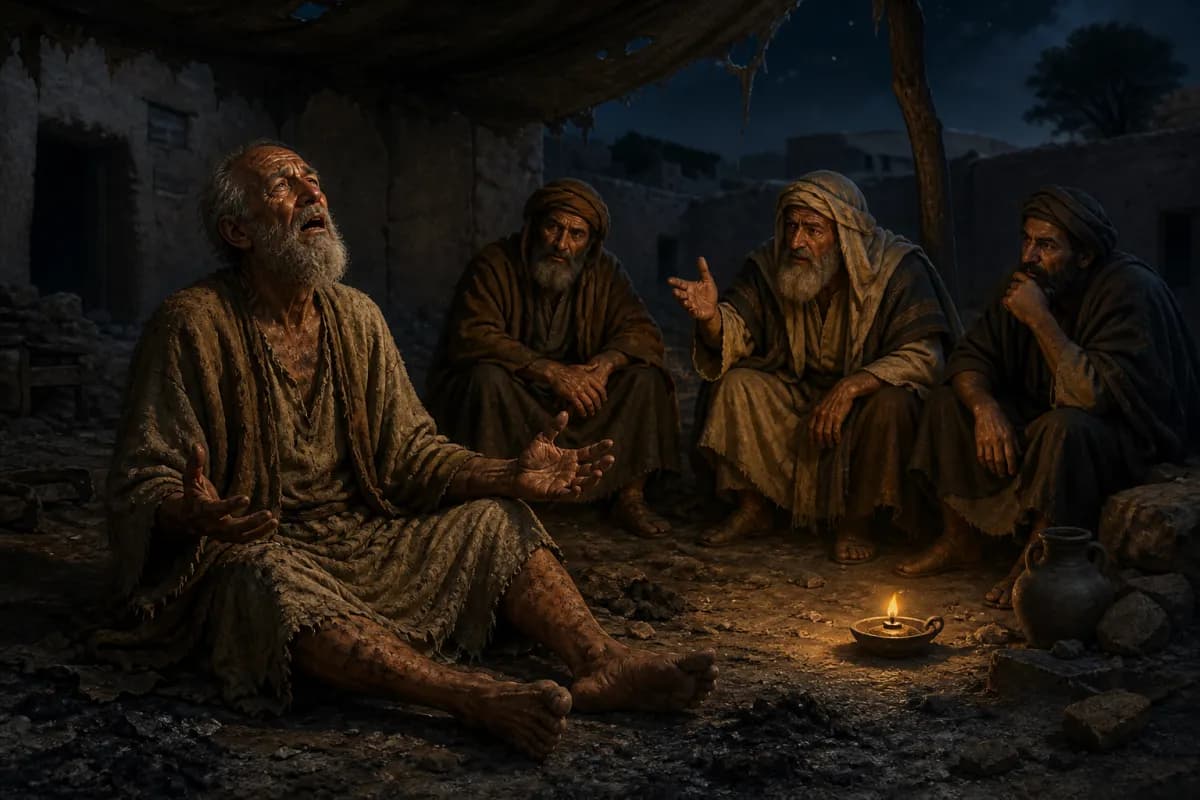
Job 3:1–14:22 begins the long argument over suffering. Job curses the day of his birth and asks why a person in agony is kept alive; Eliphaz, Bildad, and Zophar defend a moral order in which suffering exposes guilt; and Job insists that their explanations do not fit his life. The passage teaches believers to lament truthfully and points to Jesus, who receives the afflicted without turning pain into proof of personal condemnation.
- In this study
- 299 verses · 5 movements
Job 3
3:1After this Job opened his mouth, and cursed the day of his birth.
3:2Job answered:
3:3“Let the day perish in which I was born, the night which said, ‘There is a boy conceived.’
3:4Let that day be darkness. Don’t let God from above seek for it, neither let the light shine on it.
3:5Let darkness and the shadow of death claim it for their own. Let a cloud dwell on it. Let all that makes the day black terrify it.
3:6As for that night, let thick darkness seize on it. Let it not rejoice among the days of the year. Let it not come into the number of the months.
3:7Behold, let that night be barren. Let no joyful voice come therein.
3:8Let them curse it who curse the day, who are ready to rouse up leviathan.
3:9Let the stars of its twilight be dark. Let it look for light, but have none, neither let it see the eyelids of the morning,
3:10because it didn’t shut up the doors of my mother’s womb, nor did it hide trouble from my eyes.
3:11“Why didn’t I die from the womb? Why didn’t I give up the spirit when my mother bore me?
3:12Why did the knees receive me? Or why the breast, that I should nurse?
3:13For now I should have lain down and been quiet. I should have slept, then I would have been at rest,
3:14with kings and counselors of the earth, who built up waste places for themselves;
3:15or with princes who had gold, who filled their houses with silver;
3:16or as a hidden untimely birth I had not been, as infants who never saw light.
3:17There the wicked cease from troubling. There the weary are at rest.
3:18There the prisoners are at ease together. They don’t hear the voice of the taskmaster.
3:19The small and the great are there. The servant is free from his master.
3:20“Why is light given to him who is in misery, life to the bitter in soul,
3:21who long for death, but it doesn’t come; and dig for it more than for hidden treasures,
3:22who rejoice exceedingly, and are glad, when they can find the grave?
3:23Why is light given to a man whose way is hidden, whom God has hedged in?
3:24For my sighing comes before I eat. My groanings are poured out like water.
3:25For the thing which I fear comes on me, that which I am afraid of comes to me.
3:26I am not at ease, neither am I quiet, neither do I have rest; but trouble comes.”
Job 4
4:1Then Eliphaz the Temanite answered,
4:2“If someone ventures to talk with you, will you be grieved? But who can withhold himself from speaking?
4:3Behold, you have instructed many, you have strengthened the weak hands.
4:4Your words have supported him who was falling, you have made the feeble knees firm.
4:5But now it has come to you, and you faint. It touches you, and you are troubled.
4:6Isn’t your piety your confidence? Isn’t the integrity of your ways your hope?
4:7“Remember, now, who ever perished, being innocent? Or where were the upright cut off?
4:8According to what I have seen, those who plow iniquity and sow trouble, reap the same.
4:9By the breath of God they perish. By the blast of his anger are they consumed.
4:10The roaring of the lion, and the voice of the fierce lion, the teeth of the young lions, are broken.
4:11The old lion perishes for lack of prey. The cubs of the lioness are scattered abroad.
4:12“Now a thing was secretly brought to me. My ear received a whisper of it.
4:13In thoughts from the visions of the night, when deep sleep falls on men,
4:14fear came on me, and trembling, which made all my bones shake.
4:15Then a spirit passed before my face. The hair of my flesh stood up.
4:16It stood still, but I couldn’t discern its appearance. A form was before my eyes. Silence, then I heard a voice, saying,
4:17‘Shall mortal man be more just than God? Shall a man be more pure than his Maker?
4:18Behold, he puts no trust in his servants. He charges his angels with error.
4:19How much more those who dwell in houses of clay, whose foundation is in the dust, who are crushed before the moth!
4:20Between morning and evening they are destroyed. They perish forever without any regarding it.
4:21Isn’t their tent cord plucked up within them? They die, and that without wisdom.’
Job 5
5:1“Call now; is there any who will answer you? To which of the holy ones will you turn?
5:2For resentment kills the foolish man, and jealousy kills the simple.
5:3I have seen the foolish taking root, but suddenly I cursed his habitation.
5:4His children are far from safety. They are crushed in the gate. Neither is there any to deliver them,
5:5whose harvest the hungry eat up, and take it even out of the thorns. The snare gapes for their substance.
5:6For affliction doesn’t come out of the dust, neither does trouble spring out of the ground;
5:7but man is born to trouble, as the sparks fly upward.
5:8“But as for me, I would seek God. I would commit my cause to God,
5:9who does great things that can’t be fathomed, marvelous things without number;
5:10who gives rain on the earth, and sends waters on the fields;
5:11so that he sets up on high those who are low, those who mourn are exalted to safety.
5:12He frustrates the plans of the crafty, so that their hands can’t perform their enterprise.
5:13He takes the wise in their own craftiness; the counsel of the cunning is carried headlong.
5:14They meet with darkness in the day time, and grope at noonday as in the night.
5:15But he saves from the sword of their mouth, even the needy from the hand of the mighty.
5:16So the poor has hope, and injustice shuts her mouth.
5:17“Behold, happy is the man whom God corrects. Therefore do not despise the chastening of the Almighty.
5:18For he wounds and binds up. He injures and his hands make whole.
5:19He will deliver you in six troubles; yes, in seven no evil will touch you.
5:20In famine he will redeem you from death; in war, from the power of the sword.
5:21You will be hidden from the scourge of the tongue, neither will you be afraid of destruction when it comes.
5:22You will laugh at destruction and famine, neither will you be afraid of the animals of the earth.
5:23For you will be allied with the stones of the field. The animals of the field will be at peace with you.
5:24You will know that your tent is in peace. You will visit your fold, and will miss nothing.
5:25You will know also that your offspring will be great, your offspring as the grass of the earth.
5:26You will come to your grave in a full age, like a shock of grain comes in its season.
5:27Behold, we have researched it. It is so. Hear it, and know it for your good.”
Job 6
6:1Then Job answered,
6:2“Oh that my anguish were weighed, and all my calamity laid in the balances!
6:3For now it would be heavier than the sand of the seas, therefore my words have been rash.
6:4For the arrows of the Almighty are within me. My spirit drinks up their poison. The terrors of God set themselves in array against me.
6:5Does the wild donkey bray when he has grass? Or does the ox low over his fodder?
6:6Can that which has no flavor be eaten without salt? Or is there any taste in the white of an egg?
6:7My soul refuses to touch them. They are as loathsome food to me.
6:8“Oh that I might have my request, that God would grant the thing that I long for,
6:9even that it would please God to crush me; that he would let loose his hand, and cut me off!
6:10Let it still be my consolation, yes, let me exult in pain that doesn’t spare, that I have not denied the words of the Holy One.
6:11What is my strength, that I should wait? What is my end, that I should be patient?
6:12Is my strength the strength of stones? Or is my flesh of bronze?
6:13Isn’t it that I have no help in me, that wisdom is driven away from me?
6:14“To him who is ready to faint, kindness should be shown from his friend; even to him who forsakes the fear of the Almighty.
6:15My brothers have dealt deceitfully as a brook, as the channel of brooks that pass away;
6:16which are black by reason of the ice, in which the snow hides itself.
6:17In the dry season, they vanish. When it is hot, they are consumed out of their place.
6:18The caravans that travel beside them turn away. They go up into the waste, and perish.
6:19The caravans of Tema looked. The companies of Sheba waited for them.
6:20They were distressed because they were confident. They came there, and were confounded.
6:21For now you are nothing. You see a terror, and are afraid.
6:22Did I ever say, ‘Give to me’? or, ‘Offer a present for me from your substance’?
6:23or, ‘Deliver me from the adversary’s hand’? or, ‘Redeem me from the hand of the oppressors’?
6:24“Teach me, and I will hold my peace. Cause me to understand my error.
6:25How forcible are words of uprightness! But your reproof, what does it reprove?
6:26Do you intend to reprove words, since the speeches of one who is desperate are as wind?
6:27Yes, you would even cast lots for the fatherless, and make merchandise of your friend.
6:28Now therefore be pleased to look at me, for surely I will not lie to your face.
6:29Please return. Let there be no injustice. Yes, return again. My cause is righteous.
6:30Is there injustice on my tongue? Can’t my taste discern mischievous things?
Job 7
7:1“Isn’t a man forced to labor on earth? Aren’t his days like the days of a hired hand?
7:2As a servant who earnestly desires the shadow, as a hireling who looks for his wages,
7:3so I am made to possess months of misery, wearisome nights are appointed to me.
7:4When I lie down, I say, ‘When will I arise, and the night be gone?’ I toss and turn until the dawning of the day.
7:5My flesh is clothed with worms and clods of dust. My skin closes up, and breaks out afresh.
7:6My days are swifter than a weaver’s shuttle, and are spent without hope.
7:7Oh remember that my life is a breath. My eye will no more see good.
7:8The eye of him who sees me will see me no more. Your eyes will be on me, but I will not be.
7:9As the cloud is consumed and vanishes away, so he who goes down to Sheol will come up no more.
7:10He will return no more to his house, neither will his place know him any more.
7:11“Therefore I will not keep silent. I will speak in the anguish of my spirit. I will complain in the bitterness of my soul.
7:12Am I a sea, or a sea monster, that you put a guard over me?
7:13When I say, ‘My bed will comfort me. My couch will ease my complaint,’
7:14then you scare me with dreams and terrify me through visions,
7:15so that my soul chooses strangling, death rather than my bones.
7:16I loathe my life. I don’t want to live forever. Leave me alone, for my days are but a breath.
7:17What is man, that you should magnify him, that you should set your mind on him,
7:18that you should visit him every morning, and test him every moment?
7:19How long will you not look away from me, nor leave me alone until I swallow down my spittle?
7:20If I have sinned, what do I do to you, you watcher of men? Why have you set me as a mark for you, so that I am a burden to myself?
7:21Why do you not pardon my disobedience, and take away my iniquity? For now will I lie down in the dust. You will seek me diligently, but I will not be.”
Job 8
8:1Then Bildad the Shuhite answered,
8:2“How long will you speak these things? Shall the words of your mouth be a mighty wind?
8:3Does God pervert justice? Or does the Almighty pervert righteousness?
8:4If your children have sinned against him, he has delivered them into the hand of their disobedience.
8:5If you want to seek God diligently, make your supplication to the Almighty.
8:6If you were pure and upright, surely now he would awaken for you, and make the habitation of your righteousness prosperous.
8:7Though your beginning was small, yet your latter end would greatly increase.
8:8“Please inquire of past generations. Find out about the learning of their fathers.
8:9(For we are but of yesterday, and know nothing, because our days on earth are a shadow.)
8:10Shall they not teach you, tell you, and utter words out of their heart?
8:11“Can the papyrus grow up without mire? Can the rushes grow without water?
8:12While it is yet in its greenness, not cut down, it withers before any other reed.
8:13So are the paths of all who forget God. The hope of the godless man will perish,
8:14whose confidence will break apart, whose trust is a spider’s web.
8:15He will lean on his house, but it will not stand. He will cling to it, but it will not endure.
8:16He is green before the sun. His shoots go out along his garden.
8:17His roots are wrapped around the rock pile. He sees the place of stones.
8:18If he is destroyed from his place, then it will deny him, saying, ‘I have not seen you.’
8:19Behold, this is the joy of his way. Out of the earth, others will spring.
8:20“Behold, God will not cast away a blameless man, neither will he uphold the evildoers.
8:21He will still fill your mouth with laughter, your lips with shouting.
8:22Those who hate you will be clothed with shame. The tent of the wicked will be no more.”
Job 9
9:1Then Job answered,
9:2“Truly I know that it is so, but how can man be just with God?
9:3If he is pleased to contend with him, he can’t answer him one time in a thousand.
9:4God is wise in heart, and mighty in strength. Who has hardened himself against him and prospered?
9:5He removes the mountains, and they don’t know it, when he overturns them in his anger.
9:6He shakes the earth out of its place. Its pillars tremble.
9:7He commands the sun and it doesn’t rise, and seals up the stars.
9:8He alone stretches out the heavens, and treads on the waves of the sea.
9:9He makes the Bear, Orion, and the Pleiades, and the rooms of the south.
9:10He does great things past finding out; yes, marvelous things without number.
9:11Behold, he goes by me, and I don’t see him. He passes on also, but I don’t perceive him.
9:12Behold, he snatches away. Who can hinder him? Who will ask him, ‘What are you doing?’
9:13“God will not withdraw his anger. The helpers of Rahab stoop under him.
9:14How much less will I answer him, and choose my words to argue with him?
9:15Though I were righteous, yet I wouldn’t answer him. I would make supplication to my judge.
9:16If I had called, and he had answered me, yet I wouldn’t believe that he listened to my voice.
9:17For he breaks me with a storm, and multiplies my wounds without cause.
9:18He will not allow me to catch my breath, but fills me with bitterness.
9:19If it is a matter of strength, behold, he is mighty! If of justice, ‘Who,’ says he, ‘will summon me?’
9:20Though I am righteous, my own mouth will condemn me. Though I am blameless, it will prove me perverse.
9:21I am blameless. I don’t respect myself. I despise my life.
9:22“It is all the same. Therefore I say he destroys the blameless and the wicked.
9:23If the scourge kills suddenly, he will mock at the trial of the innocent.
9:24The earth is given into the hand of the wicked. He covers the faces of its judges. If not he, then who is it?
9:25“Now my days are swifter than a runner. They flee away. They see no good.
9:26They have passed away as the swift ships, as the eagle that swoops on the prey.
9:27If I say, ‘I will forget my complaint, I will put off my sad face, and cheer up,’
9:28I am afraid of all my sorrows. I know that you will not hold me innocent.
9:29I will be condemned. Why then do I labor in vain?
9:30If I wash myself with snow, and cleanse my hands with lye,
9:31yet you will plunge me in the ditch. My own clothes will abhor me.
9:32For he is not a man, as I am, that I should answer him, that we should come together in judgment.
9:33There is no umpire between us, that might lay his hand on us both.
9:34Let him take his rod away from me. Let his terror not make me afraid;
9:35then I would speak, and not fear him, for I am not so in myself.
Job 10
10:1“My soul is weary of my life. I will give free course to my complaint. I will speak in the bitterness of my soul.
10:2I will tell God, ‘Do not condemn me. Show me why you contend with me.
10:3Is it good to you that you should oppress, that you should despise the work of your hands, and smile on the counsel of the wicked?
10:4Do you have eyes of flesh? Or do you see as man sees?
10:5Are your days as the days of mortals, or your years as man’s years,
10:6that you inquire after my iniquity, and search after my sin?
10:7Although you know that I am not wicked, there is no one who can deliver out of your hand.
10:8“‘Your hands have framed me and fashioned me altogether, yet you destroy me.
10:9Remember, I beg you, that you have fashioned me as clay. Will you bring me into dust again?
10:10Haven’t you poured me out like milk, and curdled me like cheese?
10:11You have clothed me with skin and flesh, and knit me together with bones and sinews.
10:12You have granted me life and loving kindness. Your visitation has preserved my spirit.
10:13Yet you hid these things in your heart. I know that this is with you:
10:14if I sin, then you mark me. You will not acquit me from my iniquity.
10:15If I am wicked, woe to me. If I am righteous, I still will not lift up my head, being filled with disgrace, and conscious of my affliction.
10:16If my head is held high, you hunt me like a lion. Again you show yourself powerful to me.
10:17You renew your witnesses against me, and increase your indignation on me. Changes and warfare are with me.
10:18“‘Why, then, have you brought me out of the womb? I wish I had given up the spirit, and no eye had seen me.
10:19I should have been as though I had not been. I should have been carried from the womb to the grave.
10:20Aren’t my days few? Stop! Leave me alone, that I may find a little comfort,
10:21before I go where I will not return from, to the land of darkness and of the shadow of death;
10:22the land dark as midnight, of the shadow of death, without any order, where the light is as midnight.’”
Job 11
11:1Then Zophar, the Naamathite, answered,
11:2“Shouldn’t the multitude of words be answered? Should a man full of talk be justified?
11:3Should your boastings make men hold their peace? When you mock, will no man make you ashamed?
11:4For you say, ‘My doctrine is pure. I am clean in your eyes.’
11:5But oh that God would speak, and open his lips against you,
11:6that he would show you the secrets of wisdom! For true wisdom has two sides. Know therefore that God exacts of you less than your iniquity deserves.
11:7“Can you fathom the mystery of God? Or can you probe the limits of the Almighty?
11:8They are high as heaven. What can you do? They are deeper than Sheol. What can you know?
11:9Its measure is longer than the earth, and broader than the sea.
11:10If he passes by, or confines, or convenes a court, then who can oppose him?
11:11For he knows false men. He sees iniquity also, even though he doesn’t consider it.
11:12An empty-headed man becomes wise when a man is born as a wild donkey’s colt.
11:13“If you set your heart aright, stretch out your hands toward him.
11:14If iniquity is in your hand, put it far away. Don’t let unrighteousness dwell in your tents.
11:15Surely then you will lift up your face without spot. Yes, you will be steadfast, and will not fear,
11:16for you will forget your misery. You will remember it like waters that have passed away.
11:17Life will be clearer than the noonday. Though there is darkness, it will be as the morning.
11:18You will be secure, because there is hope. Yes, you will search, and will take your rest in safety.
11:19Also you will lie down, and no one will make you afraid. Yes, many will court your favor.
11:20But the eyes of the wicked will fail. They will have no way to flee. Their hope will be the giving up of the spirit.”
Job 12
12:1Then Job answered,
12:2“No doubt, but you are the people, and wisdom will die with you.
12:3But I have understanding as well as you; I am not inferior to you. Yes, who doesn’t know such things as these?
12:4I am like one who is a joke to his neighbor, I, who called on God, and he answered. The just, the blameless man is a joke.
12:5In the thought of him who is at ease there is contempt for misfortune. It is ready for them whose foot slips.
12:6The tents of robbers prosper. Those who provoke God are secure, who carry their god in their hands.
12:7“But ask the animals now, and they will teach you; the birds of the sky, and they will tell you.
12:8Or speak to the earth, and it will teach you. The fish of the sea will declare to you.
12:9Who doesn’t know that in all these, the LORD’s hand has done this,
12:10in whose hand is the life of every living thing, and the breath of all mankind?
12:11Doesn’t the ear try words, even as the palate tastes its food?
12:12With aged men is wisdom, in length of days understanding.
12:13“With God is wisdom and might. He has counsel and understanding.
12:14Behold, he breaks down, and it can’t be built again. He imprisons a man, and there can be no release.
12:15Behold, he withholds the waters, and they dry up. Again, he sends them out, and they overturn the earth.
12:16With him is strength and wisdom. The deceived and the deceiver are his.
12:17He leads counselors away stripped. He makes judges fools.
12:18He loosens the bond of kings. He binds their waist with a belt.
12:19He leads priests away stripped, and overthrows the mighty.
12:20He removes the speech of those who are trusted, and takes away the understanding of the elders.
12:21He pours contempt on princes, and loosens the belt of the strong.
12:22He uncovers deep things out of darkness, and brings out to light the shadow of death.
12:23He increases the nations, and he destroys them. He enlarges the nations, and he leads them captive.
12:24He takes away understanding from the chiefs of the people of the earth, and causes them to wander in a wilderness where there is no way.
12:25They grope in the dark without light. He makes them stagger like a drunken man.
Job 13
13:1“Behold, my eye has seen all this. My ear has heard and understood it.
13:2What you know, I know also. I am not inferior to you.
13:3“Surely I would speak to the Almighty. I desire to reason with God.
13:4But you are forgers of lies. You are all physicians of no value.
13:5Oh that you would be completely silent! Then you would be wise.
13:6Hear now my reasoning. Listen to the pleadings of my lips.
13:7Will you speak unrighteously for God, and talk deceitfully for him?
13:8Will you show partiality to him? Will you contend for God?
13:9Is it good that he should search you out? Or as one deceives a man, will you deceive him?
13:10He will surely reprove you if you secretly show partiality.
13:11Won’t his majesty make you afraid and his dread fall on you?
13:12Your memorable sayings are proverbs of ashes. Your defenses are defenses of clay.
13:13“Be silent! Leave me alone, that I may speak. Let come on me what will.
13:14Why should I take my flesh in my teeth, and put my life in my hand?
13:15Behold, he will kill me. I have no hope. Nevertheless, I will maintain my ways before him.
13:16This also will be my salvation, that a godless man will not come before him.
13:17Listen carefully to my speech. Let my declaration be in your ears.
13:18See now, I have set my cause in order. I know that I am righteous.
13:19Who is he who will contend with me? For then I would hold my peace and give up the spirit.
13:20“Only don’t do two things to me, then I will not hide myself from your face:
13:21withdraw your hand far from me, and don’t let your terror make me afraid.
13:22Then call, and I will answer, or let me speak, and you answer me.
13:23How many are my iniquities and sins? Make me know my disobedience and my sin.
13:24Why do you hide your face, and consider me your enemy?
13:25Will you harass a driven leaf? Will you pursue the dry stubble?
13:26For you write bitter things against me, and make me inherit the iniquities of my youth.
13:27You also put my feet in the stocks, and mark all my paths. You set a bound to the soles of my feet,
13:28though I am decaying like a rotten thing, like a garment that is moth-eaten.
Job 14
14:1“Man, who is born of a woman, is of few days, and full of trouble.
14:2He grows up like a flower, and is cut down. He also flees like a shadow, and doesn’t continue.
14:3Do you open your eyes on such a one, and bring me into judgment with you?
14:4Who can bring a clean thing out of an unclean? Not one.
14:5Seeing his days are determined, the number of his months is with you, and you have appointed his bounds that he can’t pass.
14:6Look away from him, that he may rest, until he accomplishes, as a hireling, his day.
14:7“For there is hope for a tree if it is cut down, that it will sprout again, that the tender branch of it will not cease.
14:8Though its root grows old in the earth, and its stock dies in the ground,
14:9yet through the scent of water it will bud, and sprout boughs like a plant.
14:10But man dies, and is laid low. Yes, man gives up the spirit, and where is he?
14:11As the waters fail from the sea, and the river wastes and dries up,
14:12so man lies down and doesn’t rise. Until the heavens are no more, they will not awake, nor be roused out of their sleep.
14:13“Oh that you would hide me in Sheol, that you would keep me secret until your wrath is past, that you would appoint me a set time and remember me!
14:14If a man dies, will he live again? I would wait all the days of my warfare, until my release should come.
14:15You would call, and I would answer you. You would have a desire for the work of your hands.
14:16But now you count my steps. Don’t you watch over my sin?
14:17My disobedience is sealed up in a bag. You fasten up my iniquity.
14:18“But the mountain falling comes to nothing. The rock is removed out of its place.
14:19The waters wear the stones. The torrents of it wash away the dust of the earth. So you destroy the hope of man.
14:20You forever prevail against him, and he departs. You change his face, and send him away.
14:21His sons come to honor, and he doesn’t know it. They are brought low, but he doesn’t perceive it of them.
14:22But his flesh on him has pain, and his soul within him mourns.”
CONTEXTUAL OVERVIEW
After seven days of silence, Job does not curse God; he curses the day he was born. His poem reaches for darkness to swallow the day that began a life now crushed by grief. The language is severe, but it is directed toward God in the hearing of friends. Biblical faith makes room for a sufferer to say that life feels unbearable without treating that cry as rebellion by definition.
The first speeches introduce the argument that will dominate the book. Eliphaz remembers that the innocent do not perish, Bildad calls Job to seek God, and Zophar assumes Job’s words deserve even more punishment. Each speaker says some true things about God’s justice, but each uses those truths as if they settle Job’s particular case.
HISTORICAL AND LITERARY CONTEXT
The speeches are Hebrew wisdom poetry, rich in images of darkness, hunting, storms, roots, and collapsing tents. They are not detached lectures. Job and his friends share a world in which God is just, sin has consequences, and wisdom matters. Their dispute concerns whether those convictions permit them to infer secret guilt from Job’s suffering.
The prologue has already told the reader that Job is not being punished for hidden wickedness. Job’s friends do not know that information, but the book still exposes their confidence as dangerous. Their inherited sayings become cruel when they are applied without listening to the actual sufferer before them.
SECTION-BY-SECTION ANALYSIS
- The cursed day · Job 3:1Job’s wish that his birth had never happened names despair honestly while stopping short of cursing the Giver of life.
- The friends’ formula · Job 8:3The friends rightly affirm God’s justice but wrongly make suffering a reliable diagnostic of a particular person’s secret guilt.
- The arbiter · Job 7:8Job’s longing for someone who could lay a hand on both God and humanity exposes the need for a mediator he does not yet see.
CHRIST IN THIS PASSAGE
Job’s request for an arbiter is a genuine need within the poem, not a direct prediction in which Job knows the name of Jesus. The New Testament answers the need with Jesus Christ, fully God and fully human, who gives Himself as the one mediator between God and humanity. He brings sinners to God without dismissing the cries of the wounded.
Jesus also corrects the friends’ assumption that visible suffering reveals personal guilt. When His disciples connect a man’s blindness to sin, Jesus refuses the simple equation. Christ’s saving mission addresses real sin through His cross, but He does not authorize the church to explain another person’s agony by inventing secret causes.
REFLECTION
This first cycle teaches Christians to listen for the difference between a lament and unbelief. A person who says, “I do not understand why I am alive,” may be reaching for God with more honesty than a person who repeats correct phrases without compassion. Job’s questions should make the church a safer place for grief, depression, and exhausted faith.
Bring your unanswerable questions to Jesus, the mediator Job longed for. When you speak to someone in pain, avoid turning a true doctrine into a private verdict. Ask what has happened, offer prayer and practical help, and let Christ’s mercy shape the patience you give.
Original Hebrew Word Study
Job 4:17
צַדִּיק
tsaddiq · H6662
Usually translated: righteous or just
Tsaddiq means righteous or just. Eliphaz asks whether a mortal can be righteous before God, but his true observation becomes a false comfort when used to explain Job’s suffering too quickly.
Follow the Scripture trail
Job’s First Lament and the Failure of Easy Answers in the larger story
The connection: Job’s lament and his longing for an arbiter reveal that moral formulas cannot carry a suffering person into God’s presence. Jesus is the mediator Job needs, whose cross deals with sin and whose compassion receives the afflicted without false accusation.
Respond to the passage
Tell Jesus the part of your pain you are tempted to hide behind religious language. Before offering an explanation to a suffering person, ask a question that helps you hear their story and offer one act of practical care.
- Why is Job’s curse of his birth-day different from cursing God?
- Which true beliefs do the friends misuse when they speak to Job?
- How does Job’s longing for an arbiter help readers understand what Jesus provides?
Prayer
Merciful Father, receive my questions and grief without letting despair become my master. Thank You for Jesus, the mediator who brings me near. Make me a patient and truthful friend to people whose pain I cannot explain. Amen.