Passage Study
Courage under the Word of God
Joshua 1:1–1:18
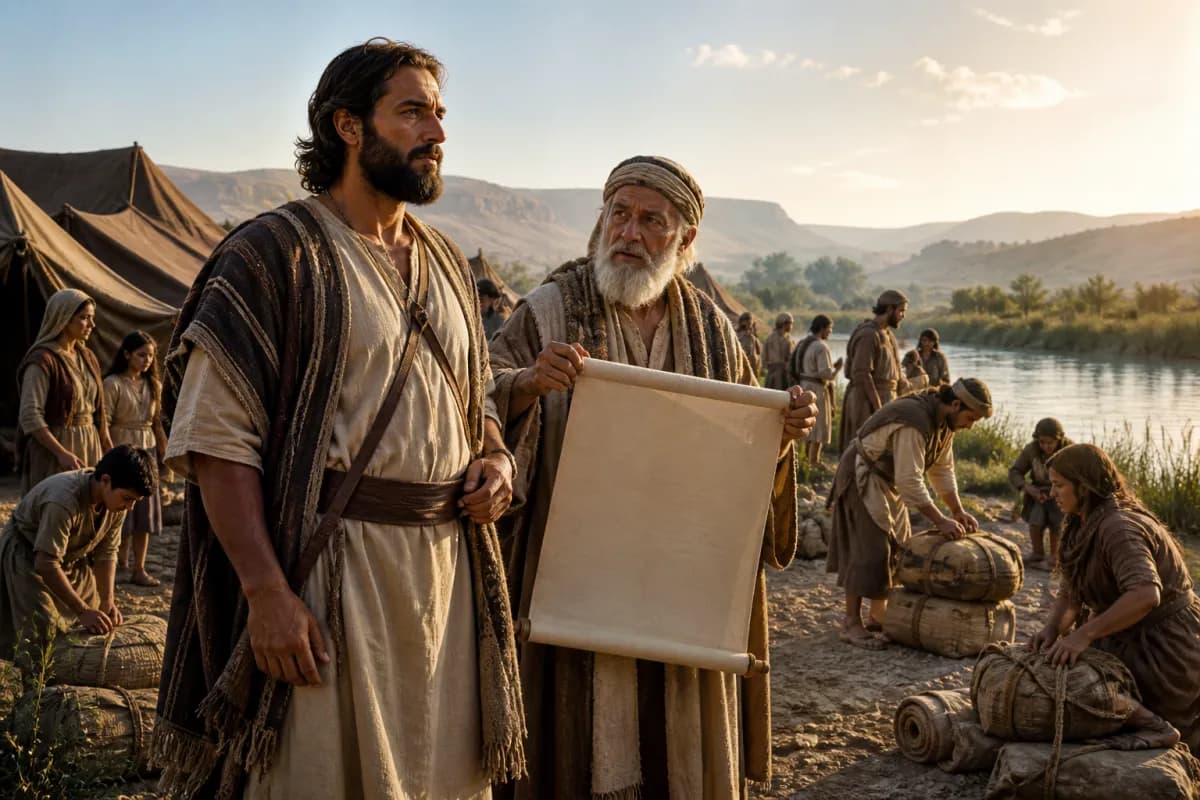
Joshua 1 begins after Moses’ death with the Lord commissioning Joshua to lead Israel across the Jordan, promising His presence, and commanding courageous obedience to the written law. The passage does not make courage a technique for personal success; it anchors courage in God’s promise and presence. It directs readers to Jesus, who leads His people into God’s lasting rest and sends them on His saving mission without abandoning them.
- In this study
- 18 verses · 5 movements
Joshua 1
1:1Now after the death of Moses the servant of the LORD, the LORD spoke to Joshua the son of Nun, Moses’ servant, saying,
1:2“Moses my servant is dead. Now therefore arise, go across this Jordan, you and all these people, to the land which I am giving to them, even to the children of Israel.
1:3I have given you every place that the sole of your foot will tread on, as I told Moses.
1:4From the wilderness and this Lebanon even to the great river, the river Euphrates, all the land of the Hittites, and to the great sea toward the going down of the sun, shall be your border.
1:5No man will be able to stand before you all the days of your life. As I was with Moses, so I will be with you. I will not fail you nor forsake you.
1:6“Be strong and courageous; for you shall cause this people to inherit the land which I swore to their fathers to give them.
1:7Only be strong and very courageous. Be careful to observe to do according to all the law which Moses my servant commanded you. Don’t turn from it to the right hand or to the left, that you may have good success wherever you go.
1:8This book of the law shall not depart from your mouth, but you shall meditate on it day and night, that you may observe to do according to all that is written in it; for then you shall make your way prosperous, and then you shall have good success.
1:9Haven’t I commanded you? Be strong and courageous. Don’t be afraid. Don’t be dismayed, for the LORD your God is with you wherever you go.”
1:10Then Joshua commanded the officers of the people, saying,
1:11“Pass through the middle of the camp, and command the people, saying, ‘Prepare food; for within three days you are to pass over this Jordan, to go in to possess the land which the LORD your God gives you to possess.’”
1:12Joshua spoke to the Reubenites, and to the Gadites, and to the half-tribe of Manasseh, saying,
1:13“Remember the word which Moses the servant of the LORD commanded you, saying, ‘The LORD your God gives you rest, and will give you this land.
1:14Your wives, your little ones, and your livestock shall live in the land which Moses gave you beyond the Jordan; but you shall pass over before your brothers armed, all the mighty men of valor, and shall help them
1:15until the LORD has given your brothers rest, as he has given you, and they have also possessed the land which the LORD your God gives them. Then you shall return to the land of your possession and possess it, which Moses the servant of the LORD gave you beyond the Jordan toward the sunrise.’”
1:16They answered Joshua, saying, “All that you have commanded us we will do, and wherever you send us we will go.
1:17Just as we listened to Moses in all things, so will we listen to you. Only may the LORD your God be with you, as he was with Moses.
1:18Whoever rebels against your commandment, and doesn’t listen to your words in all that you command him shall himself be put to death. Only be strong and courageous.”
CONTEXTUAL OVERVIEW
Joshua opens with a death and a command. Moses, the servant of the Lord, has died; now Joshua must lead a grieving people through the Jordan into a land they have not yet possessed. The Lord does not minimize the loss, but He immediately locates Israel’s future in His own promise: every place the sole of their foot treads has been given under the covenant made to Moses.
Three times Joshua is told to be strong and courageous. The repetition is not permission for self-confidence. Joshua faces fortified peoples, a vast task, and the shadow of Moses’ leadership, yet the ground of courage is that the Lord will be with him as He was with Moses and will not fail or forsake him.
HISTORICAL AND LITERARY CONTEXT
Joshua continues the Pentateuch’s story after Deuteronomy’s final commission. The land language reaches back to God’s promises to Abraham and to the boundaries named through Moses. It belongs to Israel’s specific covenant vocation and should not be turned into a blank promise that every believer will obtain whatever territory or goal they desire.
The command to meditate on the law day and night is addressed to Israel’s leader, but it is given for the good of the whole people. “Meditate” carries the sense of speaking or pondering God’s instruction continually. Joshua’s success depends on careful obedience, not on military force, charisma, or imitation of neighboring kings.
SECTION-BY-SECTION ANALYSIS
- I will be with you · Joshua 1:13Joshua’s authority and courage rest on the Lord’s pledged presence rather than his resemblance to Moses.
- Do not turn from it · Joshua 1:8The written law directs leadership, resisting the temptation to treat urgent circumstances as an excuse for compromise.
- Until the Lord gives rest · Joshua 1:15The eastern tribes must not enjoy their inheritance while fellow Israelites remain exposed and unsettled.
CHRIST IN THIS PASSAGE
Joshua’s name is the Hebrew form related to Jesus’ name, but the chapter does not make Joshua a one-to-one symbol of Christ in every action. Its strongest connection is the shared need for a leader who brings God’s people into promised rest. Hebrews argues that Joshua’s land rest was real but not final; Jesus provides the deeper rest of reconciliation with God through His finished saving work.
Jesus also repeats the presence promise for His mission. After rising from the dead, He sends disciples to make disciples of all nations and assures them that He is with them always. Christian courage is therefore not conquest language redirected toward personal ambition; it is faithful obedience, costly service, and gospel witness under the Lord who stays with His people.
REFLECTION
Many people quote “be strong and courageous” when facing a large decision while leaving out the chapter’s center: do not turn from God’s word. Biblical courage is not the ability to feel certain. It is the willingness to obey when fear is present because God has spoken and promised His presence.
Bring the next daunting assignment to Jesus. Instead of asking first how to control the outcome, ask what His word requires and who needs your faithful help. Then take the next clear step, trusting that His presence is more reliable than your sense of readiness.
Original Hebrew Word Study
Joshua 1:6
חָזַק
chazaq · H2388
Usually translated: be strong
Chazaq means to be strong. Joshua’s courage rests on the Lord’s presence and on careful obedience to the written law, not on self-confidence.
Follow the Scripture trail
Courage under the Word of God in the larger story
The connection: Joshua receives a real commission to lead Israel into its promised inheritance, but the lasting rest of God’s people remains ahead. Jesus fulfills that deeper hope by saving sinners, remaining with His church, and sending it into the nations under His authority.
Respond to the passage
Name the responsibility that makes you feel unready. Bring it to Jesus, open His word before acting, and take one courageous step that serves others rather than pursuing self-protection or personal acclaim.
- Why does the Lord connect Joshua’s courage so closely to obedience to the written law?
- What does the duty of the eastern tribes teach about receiving blessing while others still need help?
- How does Hebrews help Christians distinguish Joshua’s land rest from the deeper rest Jesus gives?
Prayer
Lord Jesus, You lead me into the rest I cannot earn and You remain with me in every calling. Make me strong and courageous through Your word, free me from self-reliance, and use my obedience to serve others and bear witness to Your grace. Amen.