Passage Study
The Lord Gives Victory over the Northern Coalition
Joshua 11:1–11:23
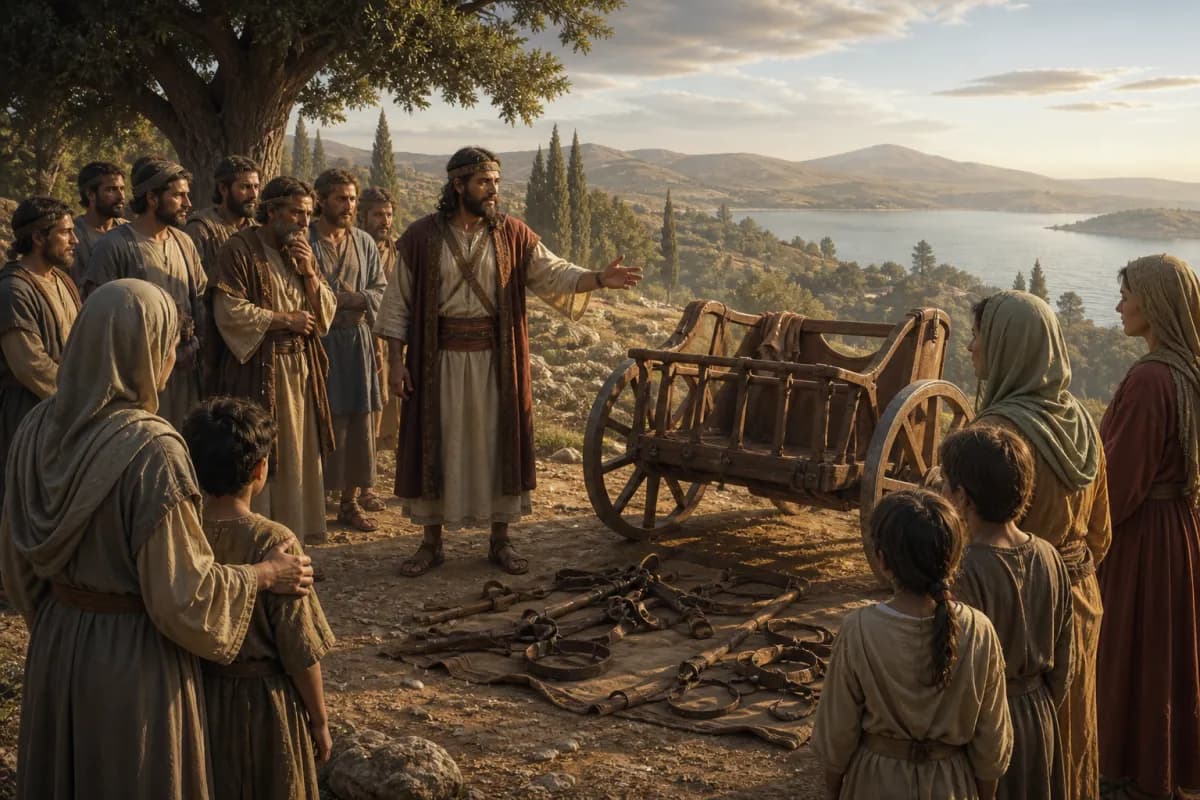
Joshua 11 brings the northern kings together in a force described as numerous as sand by the sea, with many horses and chariots. The Lord tells Joshua not to fear, commands a response that prevents Israel from relying on captured military power, and gives the coalition into Israel’s hand. The chapter closes by saying Joshua took the land according to the Lord’s command to Moses. It points toward Jesus, whose kingdom defeats evil without trusting the weapons of earthly power.
- In this study
- 23 verses · 5 movements
Joshua 11
11:1When Jabin king of Hazor heard of it, he sent to Jobab king of Madon, to the king of Shimron, to the king of Achshaph,
11:2and to the kings who were on the north, in the hill country, in the Arabah south of Chinneroth, in the lowland, and in the heights of Dor on the west,
11:3to the Canaanite on the east and on the west, the Amorite, the Hittite, the Perizzite, the Jebusite in the hill country, and the Hivite under Hermon in the land of Mizpah.
11:4They went out, they and all their armies with them, many people, even as the sand that is on the seashore in multitude, with very many horses and chariots.
11:5All these kings met together; and they came and encamped together at the waters of Merom, to fight with Israel.
11:6The LORD said to Joshua, “Don’t be afraid because of them; for tomorrow at this time, I will deliver them up all slain before Israel. You shall hamstring their horses and burn their chariots with fire.”
11:7So Joshua came suddenly, with all the warriors, against them by the waters of Merom, and attacked them.
11:8The LORD delivered them into the hand of Israel, and they struck them, and chased them to great Sidon, and to Misrephoth Maim, and to the valley of Mizpah eastward. They struck them until they left them no one remaining.
11:9Joshua did to them as the LORD told him. He hamstrung their horses and burned their chariots with fire.
11:10Joshua turned back at that time, and took Hazor, and struck its king with the sword; for Hazor used to be the head of all those kingdoms.
11:11They struck all the souls who were in it with the edge of the sword, utterly destroying them. There was no one left who breathed. He burned Hazor with fire.
11:12Joshua captured all the cities of those kings, with their kings, and he struck them with the edge of the sword, and utterly destroyed them, as Moses the servant of the LORD commanded.
11:13But as for the cities that stood on their mounds, Israel burned none of them, except Hazor only. Joshua burned that.
11:14The children of Israel took all the plunder of these cities, with the livestock, as plunder for themselves; but every man they struck with the edge of the sword, until they had destroyed them. They didn’t leave any who breathed.
11:15As the LORD commanded Moses his servant, so Moses commanded Joshua. Joshua did so. He left nothing undone of all that the LORD commanded Moses.
11:16So Joshua captured all that land, the hill country, all the South, all the land of Goshen, the lowland, the Arabah, the hill country of Israel, and the lowland of the same,
11:17from Mount Halak, that goes up to Seir, even to Baal Gad in the valley of Lebanon under Mount Hermon. He took all their kings, struck them, and put them to death.
11:18Joshua made war a long time with all those kings.
11:19There was not a city that made peace with the children of Israel, except the Hivites, the inhabitants of Gibeon. They took all in battle.
11:20For it was of the LORD to harden their hearts, to come against Israel in battle, that he might utterly destroy them, that they might have no favor, but that he might destroy them, as the LORD commanded Moses.
11:21Joshua came at that time, and cut off the Anakim from the hill country, from Hebron, from Debir, from Anab, and from all the hill country of Judah, and from all the hill country of Israel. Joshua utterly destroyed them with their cities.
11:22There were none of the Anakim left in the land of the children of Israel. Only in Gaza, in Gath, and in Ashdod, did some remain.
11:23So Joshua took the whole land, according to all that the LORD spoke to Moses; and Joshua gave it for an inheritance to Israel according to their divisions by their tribes. Then the land had rest from war.
CONTEXTUAL OVERVIEW
After the southern victories, Joshua 11 raises the scale of opposition. Jabin of Hazor gathers rulers from the north, hill country, Arabah, lowlands, and coastlands. Their army is described in deliberately overwhelming terms, complete with horses and chariots—resources Israel would naturally be tempted to fear or seize for future advantage.
The Lord answers with the same command He has given Joshua before: do not fear. He also orders Joshua to hamstring the horses and burn the chariots. Israel is not to build its identity or security by absorbing the military technology of its enemies; the land is received under the Lord’s command.
HISTORICAL AND LITERARY CONTEXT
Hazor is presented as the head of these kingdoms, making its burning especially significant within the narrative. Joshua 11 summarizes campaigns in the language of complete victory and then notes that the land had rest from war. Its theological focus is the fulfillment of commands given through Moses, not an invitation to generalize its military actions to later nations.
The statement that the Lord hardened certain Canaanite hearts belongs within the Bible’s larger pattern of divine judgment after persistent opposition. It should create humility rather than speculation about hidden decrees concerning particular modern peoples. The text clearly holds human hostility and God’s righteous purpose together without offering a detached theory of every judgment.
SECTION-BY-SECTION ANALYSIS
- As numerous as sand · Joshua 11:4The enemy’s size intensifies the force of the Lord’s command not to fear.
- Hamstring their horses · Joshua 11:6Israel must refuse to make enemy military power the foundation of its future security.
- According to the command · Joshua 11:23Joshua’s success is measured by obedience to the word given through Moses.
CHRIST IN THIS PASSAGE
Joshua 11’s wars belong to a unique stage of Israel’s covenant history; Jesus does not commission His church to conquer territory by force. The chapter’s lasting theological witness is that God’s purpose is not defeated by an apparently overwhelming enemy and that His people must not make worldly strength their savior.
Jesus reigns with authority over every hostile power, yet His victory comes through the cross and resurrection. He refuses the path of coercive earthly rule and sends His people to serve, suffer faithfully, and announce His kingdom. The final rest Joshua reaches in the land remains incomplete; Christ gives the deeper rest of reconciliation and final renewal.
REFLECTION
Horses and chariots have modern equivalents: connections, money, influence, technologies, and political leverage that can quietly become the source of our confidence. These things may be useful, but Joshua 11 warns against letting them define what we believe can save us or advance God’s purposes.
Bring your largest threat and strongest resource to Jesus. Ask Him to free you from fear and from the hunger to control outcomes. Serve His kingdom by the means He gives—truth, prayer, generosity, courage, and love—while trusting His reign beyond what you can manage.
Original Hebrew Word Study
Joshua 11:6
חָזַק
chazaq · H2388
Usually translated: be strong
Chazaq means to strengthen. The Lord tells Joshua not to fear the northern coalition because their size cannot overturn His promised victory.
Follow the Scripture trail
The Lord Gives Victory over the Northern Coalition in the larger story
The connection: Joshua’s victory over the northern coalition shows that God’s promise does not depend on superior weapons. Jesus overcomes the powers through His cross and resurrection, giving His people a kingdom that does not rest on coercion or worldly force.
Respond to the passage
Name the resource you are most tempted to treat as indispensable. Thank Jesus for every good provision, but consciously place your confidence in His reign and choose one kingdom-shaped act of truth or service this week.
- Why does the Lord command Joshua to destroy horses and chariots instead of keep them?
- What does the chapter mean by measuring Joshua’s work against Moses’ command?
- How does Jesus’ victory correct the desire to advance God’s purposes through worldly power?
Prayer
Lord Jesus, You reign over every power that frightens me. Deliver me from trust in visible strength, make me faithful to Your word, and teach me to serve Your kingdom by the way of Your cross. Amen.