Passage Study
Caleb Receives Hebron by Following the Lord Fully
Joshua 14:1–14:15
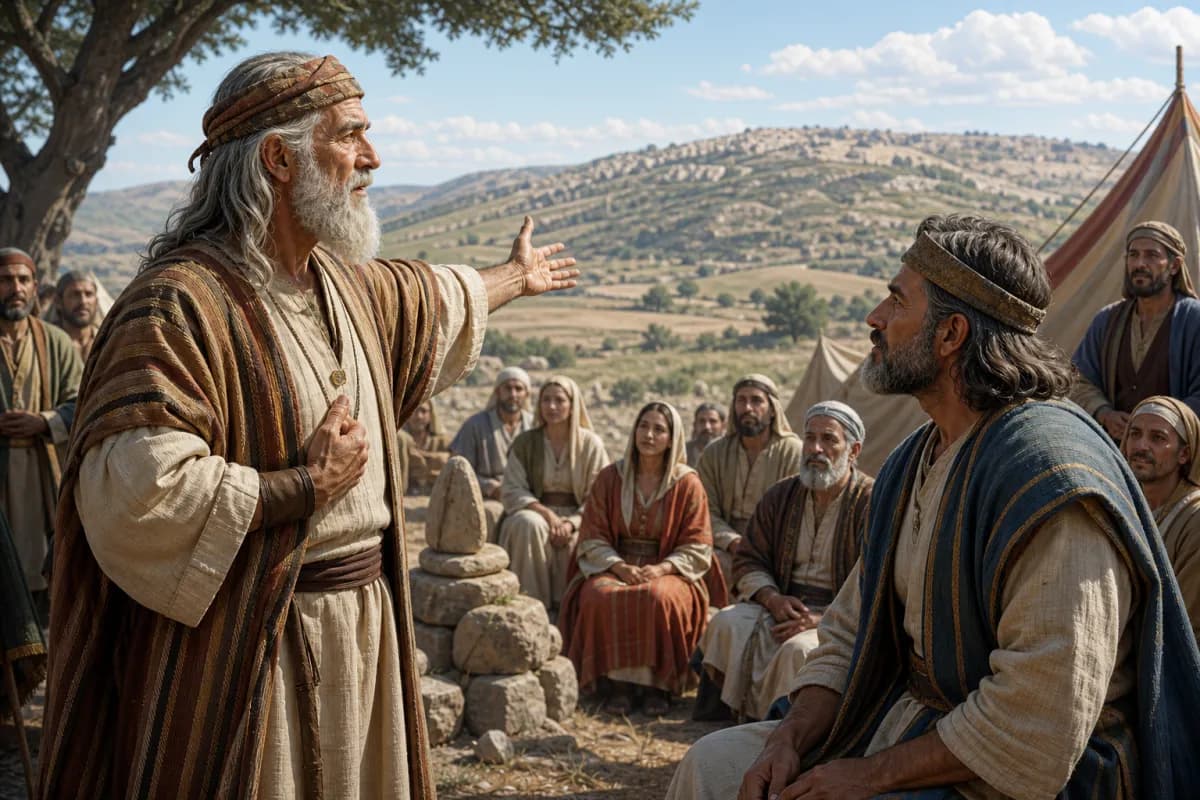
Joshua 14 records Caleb’s appeal at Gilgal for the hill country promised to him forty-five years earlier. Though eighty-five, Caleb asks for Hebron, where Anakim still live, because the Lord has kept him alive and will be with him. His inheritance honors long obedience to God’s promise and directs readers to the lasting inheritance secured by Jesus Christ.
- In this study
- 15 verses · 5 movements
Joshua 14
14:1These are the inheritances which the children of Israel took in the land of Canaan, which Eleazar the priest, Joshua the son of Nun, and the heads of the fathers’ houses of the tribes of the children of Israel, distributed to them,
14:2by the lot of their inheritance, as the LORD commanded by Moses, for the nine tribes, and for the half-tribe.
14:3For Moses had given the inheritance of the two tribes and the half-tribe beyond the Jordan; but to the Levites he gave no inheritance among them.
14:4For the children of Joseph were two tribes, Manasseh and Ephraim. They gave no portion to the Levites in the land, except cities to dwell in, with their pasture lands for their livestock and for their property.
14:5The children of Israel did as the LORD commanded Moses, and they divided the land.
14:6Then the children of Judah came near to Joshua in Gilgal. Caleb the son of Jephunneh the Kenizzite said to him, “You know the thing that the LORD spoke to Moses the man of God concerning me and concerning you in Kadesh Barnea.
14:7I was forty years old when Moses the servant of the LORD sent me from Kadesh Barnea to spy out the land. I brought him word again as it was in my heart.
14:8Nevertheless, my brothers who went up with me made the heart of the people melt; but I wholly followed the LORD my God.
14:9Moses swore on that day, saying, ‘Surely the land where you walked shall be an inheritance to you and to your children forever, because you have wholly followed the LORD my God.’
14:10“Now, behold, the LORD has kept me alive, as he spoke, these forty-five years, from the time that the LORD spoke this word to Moses, while Israel walked in the wilderness. Now, behold, I am eighty-five years old, today.
14:11As yet I am as strong today as I was in the day that Moses sent me. As my strength was then, even so is my strength now for war, to go out and to come in.
14:12Now therefore give me this hill country, of which the LORD spoke in that day; for you heard in that day how the Anakim were there, and great and fortified cities. It may be that the LORD will be with me, and I shall drive them out, as the LORD said.”
14:13Joshua blessed him; and he gave Hebron to Caleb the son of Jephunneh for an inheritance.
14:14Therefore Hebron became the inheritance of Caleb the son of Jephunneh the Kenizzite to this day, because he followed the LORD, the God of Israel wholeheartedly.
14:15Now the name of Hebron before was Kiriath Arba, after the greatest man among the Anakim. Then the land had rest from war.
CONTEXTUAL OVERVIEW
Joshua 14 moves from national conquest to the distribution of a promised inheritance. Before Judah’s boundaries are listed, Caleb comes to Joshua at Gilgal with a personal claim rooted in the Lord’s word through Moses. He does not demand a quiet reward for past service; he asks for the contested hill country of Hebron, where the descendants of Anak remain.
Caleb repeatedly says that he “followed the Lord my God fully.” The phrase does not present him as sinless or self-made. It identifies the decisive difference at Kadesh-barnea: when the other spies spread fear, Caleb trusted the God who had promised the land. Forty-five years later, he treats that promise as still living.
HISTORICAL AND LITERARY CONTEXT
Caleb’s memory reaches back to Numbers 13–14, when Israel stood near the land and refused to enter because of the giants and fortified cities. Moses promised Caleb a particular inheritance because he had followed the Lord wholeheartedly. Joshua 14 shows that the wilderness generation’s unbelief did not cancel God’s word to the faithful witness.
Hebron had deep ancestral associations: Abraham lived there, and the burial place of Abraham’s family was nearby. Yet the chapter does not turn Caleb’s allotment into a private claim for modern readers. It belongs to Israel’s covenant settlement, while the chapter’s enduring witness is God’s faithfulness across years of waiting.
SECTION-BY-SECTION ANALYSIS
- Forty-five years · Joshua 14:10Caleb measures his life by the long interval between God’s spoken promise and its visible fulfillment.
- Give me this hill country · Joshua 14:12His request faces the remaining Anakim rather than seeking an easier portion.
- Followed the Lord fully · Joshua 14:8Caleb’s distinguishing mark is covenant loyalty when fear made obedience costly.
CHRIST IN THIS PASSAGE
Caleb’s inheritance is a strong promise-and-fulfillment pattern, not a guarantee that Christ gives every believer a desired earthly territory. Hebrews says the patriarchs looked beyond a land possession to a better country, and Jesus gives His people an inheritance that cannot perish. Caleb’s patient trust helps readers see that God’s promises are kept on God’s timetable.
Jesus Himself obeyed the Father without turning back from the harder path. Through His death and resurrection, He brings believers into the family of God and promises the final inheritance of His kingdom. Caleb’s courage is therefore best received as a witness to faithful dependence, not as a formula for conquest.
REFLECTION
Caleb does not let age, delay, or the presence of giants rewrite what the Lord has said. His example is especially searching when years of disappointment have made obedience seem less urgent. Faith remembers God’s promise without pretending that the remaining work is easy.
Bring to Jesus the place where delay has cooled your trust. Ask Him for Caleb’s settled confidence—not confidence in your strength, but readiness to obey because the risen Lord keeps His word and will complete His saving purpose.
Original Hebrew Word Study
Joshua 14:8
מָלֵא
male · H4390
Usually translated: to fill or follow fully
Male means to fill. Caleb says he followed the Lord fully, describing a wholehearted faith that endured from the spies’ report into old age.
Follow the Scripture trail
Caleb Receives Hebron by Following the Lord Fully in the larger story
The connection: Caleb receives the concrete inheritance God promised after years of waiting. His trust anticipates the greater inheritance Jesus secures for His people through His saving death and resurrection.
Respond to the passage
Name the promise of God you have allowed delay or difficulty to eclipse. Ask Jesus to make you faithful in the next demanding act of obedience rather than resigned to fear.
- Why does Caleb ask for Hebron rather than a safer allotment?
- How does his memory of Kadesh shape his confidence forty-five years later?
- What keeps Caleb’s inheritance from becoming a promise of personal success for Christians?
Prayer
Lord Jesus, You are faithful through every season of waiting. Keep me from shrinking back when obedience is costly, and fix my hope on the inheritance Your resurrection has secured. Amen.