Passage Study
Judah’s Inheritance and the Household of Faith
Joshua 15:1–15:63
Joshua 15 gives Judah’s large allotment through boundary descriptions, city lists, Caleb’s conquest of Debir, Achsah’s request for springs, and the notice that Jerusalem’s Jebusites remain. The detailed inheritance makes the Lord’s promise concrete for real clans, while Achsah’s wise request and the unfinished settlement keep the chapter from triumphalism. Judah’s line ultimately leads to David and to Jesus, the promised King.
- In this study
- 63 verses · 5 movements
Joshua 15
15:1The lot for the tribe of the children of Judah according to their families was to the border of Edom, even to the wilderness of Zin southward, at the uttermost part of the south.
15:2Their south border was from the uttermost part of the Salt Sea, from the bay that looks southward;
15:3and it went out southward of the ascent of Akrabbim, and passed along to Zin, and went up by the south of Kadesh Barnea, and passed along by Hezron, went up to Addar, and turned toward Karka;
15:4and it passed along to Azmon, went out at the brook of Egypt; and the border ended at the sea. This shall be your south border.
15:5The east border was the Salt Sea, even to the end of the Jordan. The border of the north quarter was from the bay of the sea at the end of the Jordan.
15:6The border went up to Beth Hoglah, and passed along by the north of Beth Arabah; and the border went up to the stone of Bohan the son of Reuben.
15:7The border went up to Debir from the valley of Achor, and so northward, looking toward Gilgal, that faces the ascent of Adummim, which is on the south side of the river. The border passed along to the waters of En Shemesh, and ended at En Rogel.
15:8The border went up by the valley of the son of Hinnom to the side of the Jebusite (also called Jerusalem) southward; and the border went up to the top of the mountain that lies before the valley of Hinnom westward, which is at the farthest part of the valley of Rephaim northward.
15:9The border extended from the top of the mountain to the spring of the waters of Nephtoah, and went out to the cities of Mount Ephron; and the border extended to Baalah (also called Kiriath Jearim);
15:10and the border turned about from Baalah westward to Mount Seir, and passed along to the side of Mount Jearim (also called Chesalon) on the north, and went down to Beth Shemesh, and passed along by Timnah;
15:11and the border went out to the side of Ekron northward; and the border extended to Shikkeron, and passed along to Mount Baalah, and went out at Jabneel; and the goings out of the border were at the sea.
15:12The west border was to the shore of the great sea. This is the border of the children of Judah according to their families.
15:13He gave to Caleb the son of Jephunneh a portion among the children of Judah, according to the commandment of the LORD to Joshua, even Kiriath Arba, named after the father of Anak (also called Hebron).
15:14Caleb drove out the three sons of Anak: Sheshai, and Ahiman, and Talmai, the children of Anak.
15:15He went up against the inhabitants of Debir: now the name of Debir before was Kiriath Sepher.
15:16Caleb said, “He who strikes Kiriath Sepher, and takes it, to him I will give Achsah my daughter as wife.”
15:17Othniel the son of Kenaz, the brother of Caleb, took it: and he gave him Achsah his daughter as wife.
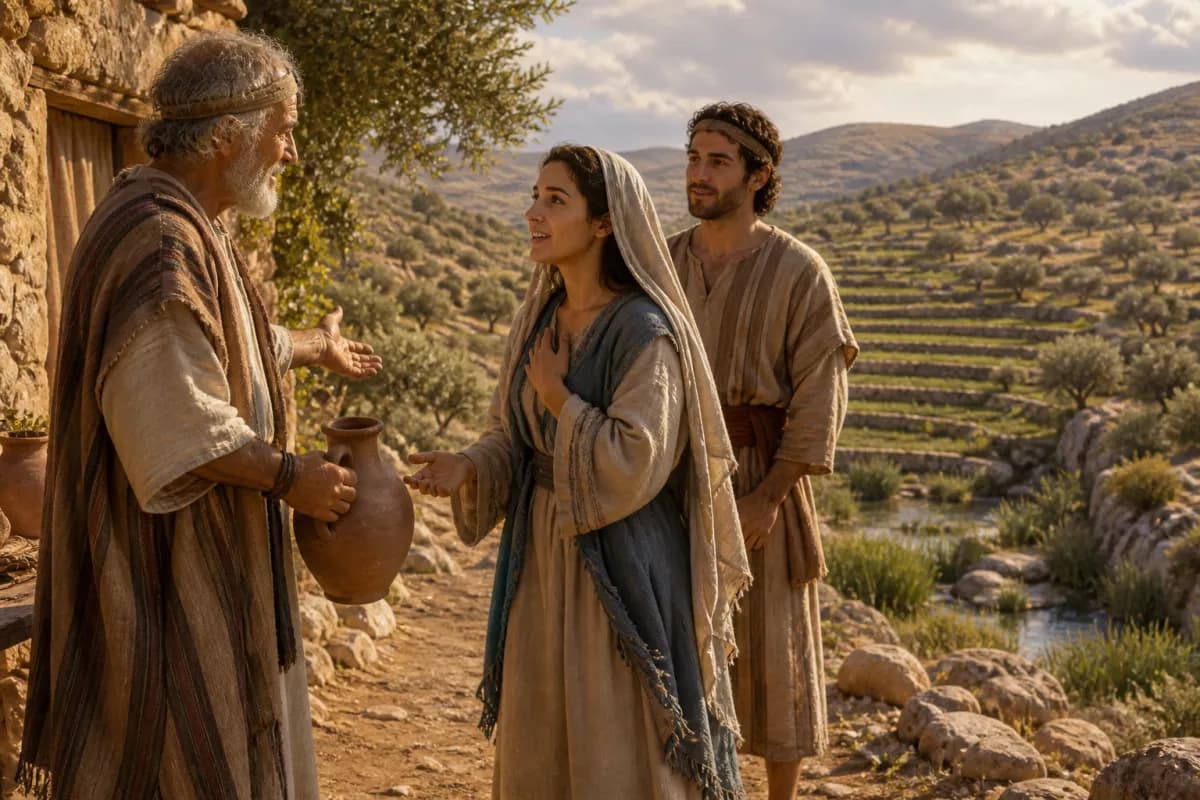
15:18When she came, she had him ask her father for a field. She got off her donkey, and Caleb said, “What do you want?”
15:19She said, “Give me a blessing. Because you have set me in the land of the South, give me also springs of water.” So he gave her the upper springs and the lower springs.
15:20This is the inheritance of the tribe of the children of Judah according to their families.
15:21The farthest cities of the tribe of the children of Judah toward the border of Edom in the South were Kabzeel, Eder, Jagur,
15:22Kinah, Dimonah, Adadah,
15:23Kedesh, Hazor, Ithnan,
15:24Ziph, Telem, Bealoth,
15:25Hazor Hadattah, Kerioth Hezron (also called Hazor),
15:26Amam, Shema, Moladah,
15:27Hazar Gaddah, Heshmon, Beth Pelet,
15:28Hazar Shual, Beersheba, Biziothiah,
15:29Baalah, Iim, Ezem,
15:30Eltolad, Chesil, Hormah,
15:31Ziklag, Madmannah, Sansannah,
15:32Lebaoth, Shilhim, Ain, and Rimmon. All the cities are twenty-nine, with their villages.
15:33In the lowland, Eshtaol, Zorah, Ashnah,
15:34Zanoah, En Gannim, Tappuah, Enam,
15:35Jarmuth, Adullam, Socoh, Azekah,
15:36Shaaraim, Adithaim and Gederah (or Gederothaim); fourteen cities with their villages.
15:37Zenan, Hadashah, Migdal Gad,
15:38Dilean, Mizpah, Joktheel,
15:39Lachish, Bozkath, Eglon,
15:40Cabbon, Lahmam, Chitlish,
15:41Gederoth, Beth Dagon, Naamah, and Makkedah; sixteen cities with their villages.
15:42Libnah, Ether, Ashan,
15:43Iphtah, Ashnah, Nezib,
15:44Keilah, Achzib, and Mareshah; nine cities with their villages.
15:45Ekron, with its towns and its villages;
15:46from Ekron even to the sea, all that were by the side of Ashdod, with their villages.
15:47Ashdod, its towns and its villages; Gaza, its towns and its villages; to the brook of Egypt, and the great sea with its coastline.
15:48In the hill country, Shamir, Jattir, Socoh,
15:49Dannah, Kiriath Sannah (which is Debir),
15:50Anab, Eshtemoh, Anim,
15:51Goshen, Holon, and Giloh; eleven cities with their villages.
15:52Arab, Dumah, Eshan,
15:53Janim, Beth Tappuah, Aphekah,
15:54Humtah, Kiriath Arba (also called Hebron), and Zior; nine cities with their villages.
15:55Maon, Carmel, Ziph, Jutah,
15:56Jezreel, Jokdeam, Zanoah,
15:57Kain, Gibeah, and Timnah; ten cities with their villages.
15:58Halhul, Beth Zur, Gedor,
15:59Maarath, Beth Anoth, and Eltekon; six cities with their villages.
15:60Kiriath Baal (also called Kiriath Jearim), and Rabbah; two cities with their villages.
15:61In the wilderness, Beth Arabah, Middin, Secacah,
15:62Nibshan, the City of Salt, and En Gedi; six cities with their villages.
15:63As for the Jebusites, the inhabitants of Jerusalem, the children of Judah couldn’t drive them out; but the Jebusites live with the children of Judah at Jerusalem to this day.
CONTEXTUAL OVERVIEW
Joshua 15 is dominated by names, ridges, valleys, towns, and boundaries. This is not filler after the drama of Jericho; it is the legal and communal form of God’s promise taking shape among Judah’s families. The land is assigned, described, and inhabited as a gift rather than as an undefined slogan about blessing.
Within the list, the narrative pauses twice for people. Caleb drives out the Anakim from Hebron and challenges anyone to take Debir; Othniel succeeds, and Achsah asks her father for springs because her southern land needs water. Those scenes give the inheritance a human scale: faith receives a gift and responsibly seeks what is needed to live in it.
HISTORICAL AND LITERARY CONTEXT
Judah receives the first tribal allotment west of the Jordan, stretching from the wilderness of Zin toward Jerusalem and the Mediterranean. Boundary lists reflect the practical importance of shared land, towns, grazing areas, and kinship. Their precision helps prevent the promise from becoming an abstraction detached from households and neighbors.
The final notice that Judah could not dispossess the Jebusites in Jerusalem qualifies the chapter’s settlement language. Joshua presents real progress alongside incomplete possession. Later narratives will return to Jerusalem, but Joshua 15 does not let readers mistake an allotted inheritance for a finished history.
SECTION-BY-SECTION ANALYSIS
- Boundaries and towns · Joshua 15:45Judah’s inheritance is made concrete through recognizable places and communities.
- The upper and lower springs · Joshua 15:19Achsah asks for water that enables the land she receives to become fruitful.
- Jebusites in Jerusalem · Joshua 15:63The final verse records an unfinished aspect of Judah’s settlement rather than claiming complete victory.
CHRIST IN THIS PASSAGE
Judah’s allotment carries a strong canonical connection because God later establishes David’s royal line in Judah, and the New Testament identifies Jesus as the promised son of David. Joshua 15 does not predict Jesus in every boundary or town name. It locates the tribe through which God’s kingship promise will advance.
The chapter also corrects a merely territorial reading of blessing. Jesus is the King who gathers people from every nation into God’s kingdom; His inheritance is not defended by tribal force. Through His saving work, those once outside the covenant become fellow heirs in Him.
REFLECTION
Achsah’s request gives ordinary dignity to asking for what is needed to steward a gift well. Faith does not despise practical needs or assume that receiving land removes the need for water. It brings real limitations openly before the giver.
Ask Jesus to make you grateful for the responsibilities entrusted to you and honest about what is necessary to serve well. Refuse both entitlement and despair; seek His kingdom with the confidence that the true King provides what His people need for faithful obedience.
Original Hebrew Word Study
Joshua 15:1
נַחֲלָה
nachalah · H5159
Usually translated: inheritance
Nachalah is an inheritance. Judah’s detailed borders make the promised land concrete, a gift allotted by the Lord to real families and tribes.
Follow the Scripture trail
Judah’s Inheritance and the Household of Faith in the larger story
The connection: Judah’s concrete inheritance becomes the setting for the royal line of David, from which Jesus comes as the promised King. His saving mission opens God’s inheritance to people from every nation.
Respond to the passage
Thank Jesus for the particular responsibilities He has given you. Bring Him the practical “springs” you lack, and use what He supplies for faithful service rather than private status.
- Why does Joshua preserve long boundary and city lists?
- What does Achsah’s request reveal about receiving an inheritance wisely?
- How does the Jebusite notice prevent a simplistic reading of Judah’s settlement?
Prayer
King Jesus, thank You for bringing outsiders into Your kingdom. Give me gratitude for what You entrust to me, wisdom to ask for what I need, and faithfulness in unfinished places. Amen.