Passage Study
Manasseh’s Inheritance, Daughters, and Clearing the Hill Country
Joshua 17:1–17:18
Joshua 17 assigns territory to Manasseh, gives the daughters of Zelophehad their promised inheritance, and records Joseph’s complaint that one portion is insufficient. Joshua answers by directing Joseph’s large people to clear the forested hill country and face the Canaanites’ iron chariots. The chapter joins God’s just provision to courageous responsibility and points to Christ, who makes believers heirs in God’s family.
- In this study
- 18 verses · 5 movements
Joshua 17
17:1This was the lot for the tribe of Manasseh, for he was the firstborn of Joseph. As for Machir the firstborn of Manasseh, the father of Gilead, because he was a man of war, therefore he had Gilead and Bashan.
17:2So this was for the rest of the children of Manasseh according to their families: for the children of Abiezer, for the children of Helek, for the children of Asriel, for the children of Shechem, for the children of Hepher, and for the children of Shemida. These were the male children of Manasseh the son of Joseph according to their families.
17:3But Zelophehad, the son of Hepher, the son of Gilead, the son of Machir, the son of Manasseh, had no sons, but daughters. These are the names of his daughters: Mahlah, Noah, Hoglah, Milcah, and Tirzah.
17:4They came to Eleazar the priest, and to Joshua the son of Nun, and to the princes, saying, “The LORD commanded Moses to give us an inheritance among our brothers.” Therefore according to the commandment of the LORD he gave them an inheritance among the brothers of their father.
17:5Ten parts fell to Manasseh, in addition to the land of Gilead and Bashan, which is beyond the Jordan;
17:6because the daughters of Manasseh had an inheritance among his sons. The land of Gilead belonged to the rest of the sons of Manasseh.
17:7The border of Manasseh was from Asher to Michmethath, which is before Shechem. The border went along to the right hand, to the inhabitants of En Tappuah.
17:8The land of Tappuah belonged to Manasseh; but Tappuah on the border of Manasseh belonged to the children of Ephraim.
17:9The border went down to the brook of Kanah, southward of the brook. These cities belonged to Ephraim among the cities of Manasseh. The border of Manasseh was on the north side of the brook, and ended at the sea.
17:10Southward it was Ephraim’s, and northward it was Manasseh’s, and the sea was his border. They reached to Asher on the north, and to Issachar on the east.
17:11Manasseh had three heights in Issachar, in Asher Beth Shean and its towns, and Ibleam and its towns, and the inhabitants of Dor and its towns, and the inhabitants of Endor and its towns, and the inhabitants of Taanach and its towns, and the inhabitants of Megiddo and its towns.
17:12Yet the children of Manasseh couldn’t drive out the inhabitants of those cities; but the Canaanites would dwell in that land.
17:13When the children of Israel had grown strong, they put the Canaanites to forced labor, and didn’t utterly drive them out.
17:14The children of Joseph spoke to Joshua, saying, “Why have you given me just one lot and one part for an inheritance, since we are a numerous people, because the LORD has blessed us so far?”
17:15Joshua said to them, “If you are a numerous people, go up to the forest, and clear land for yourself there in the land of the Perizzites and of the Rephaim, since the hill country of Ephraim is too narrow for you.”
17:16The children of Joseph said, “The hill country is not enough for us. All the Canaanites who dwell in the land of the valley have chariots of iron, both those who are in Beth Shean and its towns, and those who are in the valley of Jezreel.”
17:17Joshua spoke to the house of Joseph, that is, to Ephraim and to Manasseh, saying, “You are a numerous people, and have great power. You shall not have one lot only;
17:18but the hill country shall be yours. Although it is a forest, you shall cut it down, and it’s farthest extent shall be yours; for you shall drive out the Canaanites, though they have chariots of iron, and though they are strong.”
CONTEXTUAL OVERVIEW
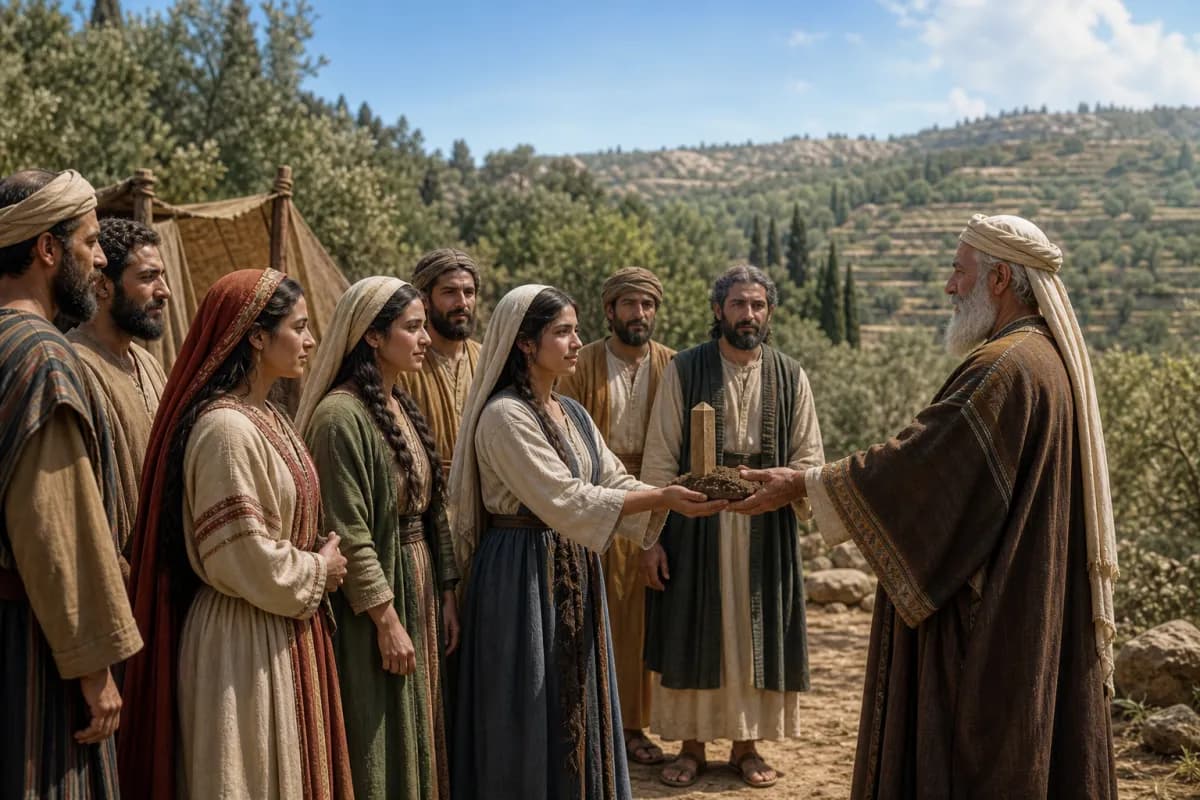
Joshua 17 continues Joseph’s inheritance by detailing Manasseh, including clans east and west of the Jordan. At its center stand Mahlah, Noah, Hoglah, Milcah, and Tirzah, the daughters of Zelophehad. They come before the leaders and receive the inheritance the Lord had commanded through Moses, so their father’s name is not erased because he had no son.
The chapter ends with a different family concern: Joseph’s descendants say that one lot is not enough for their numerous people. Joshua does not deny their size. He tells them that if they are numerous and strong, they should clear the forest and take the hill country, including territory where Canaanites have iron chariots.
HISTORICAL AND LITERARY CONTEXT
The daughters’ inheritance applies a ruling already given in Numbers 27 and protects a household’s place within the tribal land. This is not a modern abstract theory of property; it is a specific covenant provision that displays the Lord’s attention to women whose family line might otherwise lose its allotment.
The Joseph tribes’ complaint echoes the difficulty of settling forested and contested regions. Joshua’s response refuses both fatalism and entitlement. Their population becomes an argument for responsibility: they are to act on the gift they have received rather than only demanding another gift.
SECTION-BY-SECTION ANALYSIS
- The daughters of Zelophehad · Joshua 17:3Their inheritance carries forward God’s command that their father’s household retain a place in the land.
- One lot is not enough · Joshua 17:17Joseph’s complaint voices real pressure but risks treating God’s gift as inadequate.
- Iron chariots · Joshua 17:16Joshua names the military obstacle without allowing it to cancel the task of possession.
CHRIST IN THIS PASSAGE
The daughters’ inclusion has a strong thematic connection to the gospel’s inheritance language. Jesus does not distribute the land of Canaan to the church, but through Him women and men alike receive adoption and a place among God’s heirs. The chapter’s concern that a name and household not disappear finds a deeper answer in the Savior who brings outsiders into God’s family.
Joshua’s charge to Joseph also resists passive spirituality. Christ’s saving grace does not make believers self-sufficient, and it does not leave them inert. He calls His people to receive His gifts with courageous obedience while trusting His power rather than their numbers or equipment.
REFLECTION
The daughters of Zelophehad show the value of bringing a just, Scripture-shaped appeal before God’s people. Joseph’s tribes show the temptation to complain about a hard assignment while overlooking the resources and calling already given. Both scenes invite honest speech, but they lead to different postures before God.
Come to Jesus with the place where you feel overlooked or insufficiently supplied. Receive your identity as an heir by grace, then ask what faithful clearing, courage, or service He is calling for in the portion already entrusted to you.
Original Hebrew Word Study
Joshua 17:4
נַחֲלָה
nachalah · H5159
Usually translated: inheritance
Nachalah is inheritance. The daughters of Zelophehad receive land among their father’s relatives, carrying forward God’s justice within the tribal allotments.
Follow the Scripture trail
Manasseh’s Inheritance, Daughters, and Clearing the Hill Country in the larger story
The connection: Manasseh’s daughters receive the inheritance God commanded, and Joseph’s tribes are summoned to live courageously in their gift. In Christ, God adopts believers as heirs and equips them for obedient service in His saving mission.
Respond to the passage
Bring a real need or sense of exclusion to Jesus without demanding your own terms. Then consider where He has already given you responsibility and take one courageous step of faithful stewardship.
- Why does the text give such attention to the daughters of Zelophehad?
- How does Joshua answer Joseph’s complaint without dismissing its difficulty?
- What does adoption in Christ add to the chapter’s concern for inheritance?
Prayer
Lord Jesus, thank You for making me an heir by grace. Teach me to bring my needs honestly to You, to honor the people You include, and to receive difficult responsibilities with courage from Your strength. Amen.