Passage Study
The Tabernacle at Shiloh and the Land Still to Be Received
Joshua 18:1–18:28
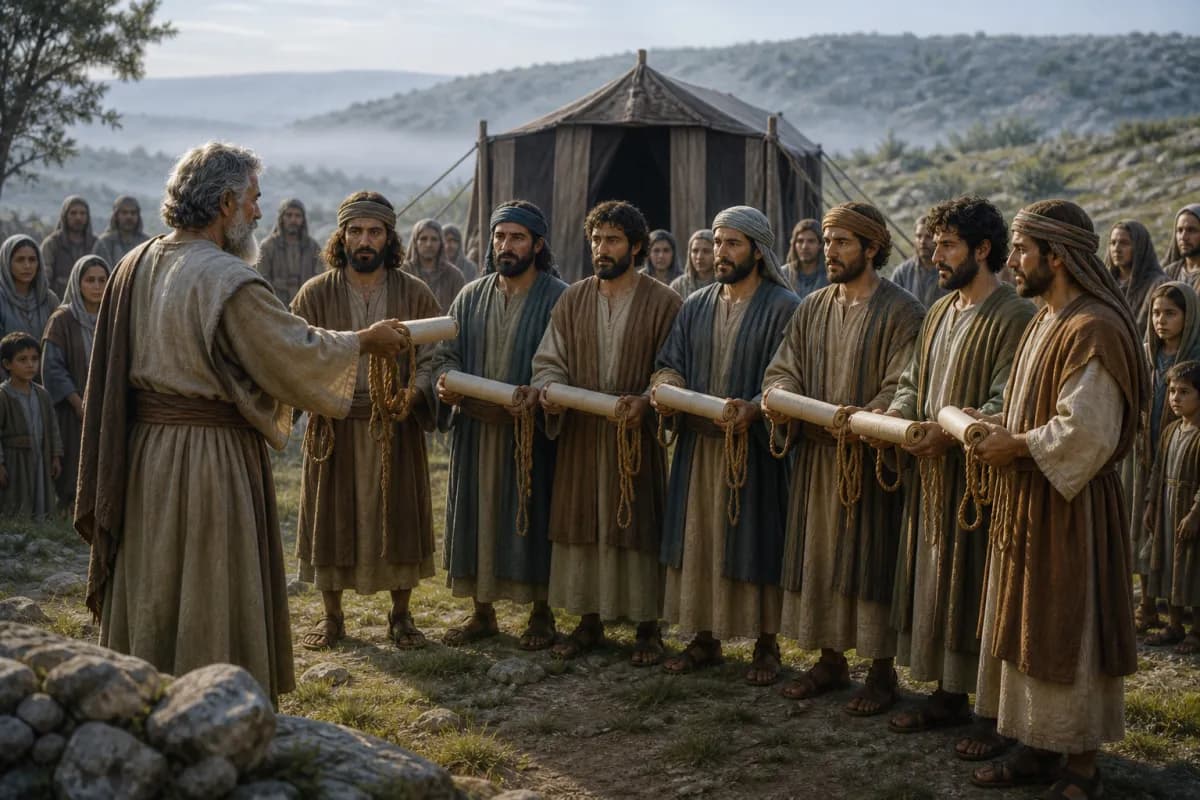
Joshua 18 gathers Israel at Shiloh, where the tabernacle is set up after the land has been subdued. Joshua confronts seven tribes for delaying possession, sends surveyors to describe the remaining territory, and casts lots before the Lord. Benjamin then receives its boundaries and cities. The chapter places God’s dwelling at the center of ordered inheritance and points to Jesus, who brings His people near to God.
- In this study
- 28 verses · 5 movements
Joshua 18
18:1The whole congregation of the children of Israel assembled themselves together at Shiloh, and set up the Tent of Meeting there. The land was subdued before them.
18:2Seven tribes remained among the children of Israel, which had not yet divided their inheritance.
18:3Joshua said to the children of Israel, “How long will you neglect to go in to possess the land, which the LORD, the God of your fathers, has given you?
18:4Appoint for yourselves three men from each tribe. I will send them, and they shall arise, walk through the land, and describe it according to their inheritance; then they shall come to me.
18:5They shall divide it into seven portions. Judah shall live in his borders on the south, and the house of Joseph shall live in their borders on the north.
18:6You shall survey the land into seven parts, and bring the description here to me; and I will cast lots for you here before the LORD our God.
18:7However, the Levites have no portion among you; for the priesthood of the LORD is their inheritance. Gad, Reuben, and the half-tribe of Manasseh have received their inheritance east of the Jordan, which Moses the servant of the LORD gave them.”
18:8The men arose and went. Joshua commanded those who went to survey the land, saying, “Go walk through the land, survey it, and come again to me. I will cast lots for you here before the LORD in Shiloh.”
18:9The men went and passed through the land, and surveyed it by cities into seven portions in a book. They came to Joshua to the camp at Shiloh.
18:10Joshua cast lots for them in Shiloh before the LORD. There Joshua divided the land to the children of Israel according to their divisions.
18:11The lot of the tribe of the children of Benjamin came up according to their families. The border of their lot went out between the children of Judah and the children of Joseph.
18:12Their border on the north quarter was from the Jordan. The border went up to the side of Jericho on the north, and went up through the hill country westward. It ended at the wilderness of Beth Aven.
18:13The border passed along from there to Luz, to the side of Luz (also called Bethel), southward. The border went down to Ataroth Addar, by the mountain that lies on the south of Beth Horon the lower.
18:14The border extended, and turned around on the west quarter southward, from the mountain that lies before Beth Horon southward; and ended at Kiriath Baal (also called Kiriath Jearim), a city of the children of Judah. This was the west quarter.
18:15The south quarter was from the farthest part of Kiriath Jearim. The border went out westward, and went out to the spring of the waters of Nephtoah.
18:16The border went down to the farthest part of the mountain that lies before the valley of the son of Hinnom, which is in the valley of Rephaim northward. It went down to the valley of Hinnom, to the side of the Jebusite southward, and went down to En Rogel.
18:17It extended northward, went out at En Shemesh, and went out to Geliloth, which is opposite the ascent of Adummim. It went down to the stone of Bohan the son of Reuben.
18:18It passed along to the side opposite the Arabah northward, and went down to the Arabah.
18:19The border passed along to the side of Beth Hoglah northward; and the border ended at the north bay of the Salt Sea, at the south end of the Jordan. This was the south border.
18:20The Jordan was its border on the east quarter. This was the inheritance of the children of Benjamin, by the borders around it, according to their families.
18:21Now the cities of the tribe of the children of Benjamin according to their families were Jericho, Beth Hoglah, Emek Keziz,
18:22Beth Arabah, Zemaraim, Bethel,
18:23Avvim, Parah, Ophrah,
18:24Chephar Ammoni, Ophni, and Geba; twelve cities with their villages.
18:25Gibeon, Ramah, Beeroth,
18:26Mizpeh, Chephirah, Mozah,
18:27Rekem, Irpeel, Taralah,
18:28Zelah, Eleph, the Jebusite (also called Jerusalem), Gibeath, and Kiriath; fourteen cities with their villages. This is the inheritance of the children of Benjamin according to their families.
CONTEXTUAL OVERVIEW
Joshua 18 begins with a decisive relocation: the whole congregation gathers at Shiloh, and the tent of meeting is set up there. The land is subdued before them, yet seven tribes have not received their inheritance. The placement of the tabernacle says that Israel’s settlement is not merely about farms and borders; the Lord’s dwelling remains the center of the people.
Joshua’s question is direct: “How long will you put off going in to take possession?” The issue is not that God has failed to provide. The remaining land must be surveyed, written down, and allotted by lot before the Lord, but the tribes must also act upon the gift they have been given.
HISTORICAL AND LITERARY CONTEXT
Shiloh becomes Israel’s principal sanctuary during much of the period before the monarchy. The tabernacle established there carries forward the wilderness tent of meeting, the appointed place where Israel gathered before the Lord. Joshua 18’s administrative work therefore occurs in worshipful proximity to God’s presence.
Casting lots in this setting does not mean random fortune-telling divorced from God’s rule. It is an Israelite means of ordering the distribution before the Lord, while the survey gives the lots a concrete description. The chapter joins divine sovereignty, communal process, and the tribes’ responsibility to inhabit their portions.
SECTION-BY-SECTION ANALYSIS
- The tent of meeting at Shiloh · Joshua 18:1Israel’s common worship stands at the center before the remaining portions are distributed.
- How long will you delay? · Joshua 18:3Joshua names the gap between receiving God’s promise and entering the work of possession.
- Lots before the Lord · Joshua 18:6The allotment is made under God’s rule rather than tribal competition.
CHRIST IN THIS PASSAGE
Shiloh’s tabernacle is a genuine sanctuary pattern that finds its fulfillment in Jesus, who “tabernacled” among His people and brings them into God’s presence. Joshua 18 does not identify its survey maps with a hidden outline of the gospel. Its clearest Christward line is that inheritance and identity are ordered around the God who chooses to dwell with His people.
Through His blood, Christ gives believers access to God rather than to a particular earthly sanctuary. He also gives a final inheritance that is received by grace yet calls for persevering faith. The church waits on Him and serves under His presence rather than trying to secure life by rivalry.
REFLECTION
The seven tribes show that delay can become a spiritual problem even after a gift has been placed before us. We may prefer the uncertainty of waiting to the vulnerable work of receiving a calling, reconciling with someone, or serving where Christ has already made the way clear.
Come before Jesus, not merely before a task list. Ask Him to reveal where delay has hardened into avoidance, and take the next obedient step with confidence that His presence—not your ability to predict every detail—is the center of your life.
Original Hebrew Word Study
Joshua 18:1
שָׁכַן
shakan · H7931
Usually translated: to dwell or settle
Shakan means to dwell. The tabernacle is set up at Shiloh before the remaining land is surveyed, keeping God’s dwelling central to Israel’s settlement.
Follow the Scripture trail
The Tabernacle at Shiloh and the Land Still to Be Received in the larger story
The connection: At Shiloh, Israel’s inheritance is ordered around the Lord’s dwelling. Jesus fulfills the deeper sanctuary hope by bringing sinners into God’s presence and securing their lasting inheritance through His saving work.
Respond to the passage
Ask Jesus where you have delayed a clear act of faithfulness. Begin with worship, then take one measurable step toward the responsibility His word has already placed before you.
- Why is the tabernacle set up before the remaining land is distributed?
- What does Joshua’s question reveal about the seven tribes?
- How does Jesus’ dwelling among us fulfill the sanctuary pattern without recreating Shiloh?
Prayer
Lord Jesus, You bring me near to God. Make Your presence central in my decisions, expose my avoidance, and give me courage to receive the responsibilities You place before me. Amen.