Passage Study
The Remaining Allotments and Joshua’s Humble Portion
Joshua 19:1–19:51
Joshua 19 records the allotments of Simeon, Zebulun, Issachar, Asher, Naphtali, Dan, and finally Joshua himself. The tribes receive towns and borders by lot before the Lord, and Joshua receives Timnath-serah only after the people have received their portions. The chapter displays God’s ordered care for every tribe and the servant leadership that finds its fulfillment in Jesus.
- In this study
- 51 verses · 5 movements
Joshua 19
19:1The second lot came out for Simeon, even for the tribe of the children of Simeon according to their families. Their inheritance was in the middle of the inheritance of the children of Judah.
19:2They had for their inheritance Beersheba (or Sheba), Moladah,
19:3Hazar Shual, Balah, Ezem,
19:4Eltolad, Bethul, Hormah,
19:5Ziklag, Beth Marcaboth, Hazar Susah,
19:6Beth Lebaoth, and Sharuhen; thirteen cities with their villages;
19:7Ain, Rimmon, Ether, and Ashan; four cities with their villages;
19:8and all the villages that were around these cities to Baalath Beer, Ramah of the South. This is the inheritance of the tribe of the children of Simeon according to their families.
19:9Out of the part of the children of Judah was the inheritance of the children of Simeon; for the portion of the children of Judah was too much for them. Therefore the children of Simeon had inheritance in the middle of their inheritance.
19:10The third lot came up for the children of Zebulun according to their families. The border of their inheritance was to Sarid.
19:11Their border went up westward, even to Maralah, and reached to Dabbesheth. It reached to the brook that is before Jokneam.
19:12It turned from Sarid eastward toward the sunrise to the border of Chisloth Tabor. It went out to Daberath, and went up to Japhia.
19:13From there it passed along eastward to Gath Hepher, to Ethkazin; and it went out at Rimmon which stretches to Neah.
19:14The border turned around it on the north to Hannathon; and it ended at the valley of Iphtah El;
19:15Kattath, Nahalal, Shimron, Idalah, and Bethlehem: twelve cities with their villages.
19:16This is the inheritance of the children of Zebulun according to their families, these cities with their villages.
19:17The fourth lot came out for Issachar, even for the children of Issachar according to their families.
19:18Their border was to Jezreel, Chesulloth, Shunem,
19:19Hapharaim, Shion, Anaharath,
19:20Rabbith, Kishion, Ebez,
19:21Remeth, Engannim, En Haddah, and Beth Pazzez.
19:22The border reached to Tabor, Shahazumah, and Beth Shemesh. Their border ended at the Jordan: sixteen cities with their villages.
19:23This is the inheritance of the tribe of the children of Issachar according to their families, the cities with their villages.
19:24The fifth lot came out for the tribe of the children of Asher according to their families.
19:25Their border was Helkath, Hali, Beten, Achshaph,
19:26Allammelech, Amad, Mishal. It reached to Carmel westward, and to Shihorlibnath.
19:27It turned toward the sunrise to Beth Dagon, and reached to Zebulun, and to the valley of Iphtah El northward to Beth Emek and Neiel. It went out to Cabul on the left hand,
19:28and Ebron, Rehob, Hammon, and Kanah, even to great Sidon.
19:29The border turned to Ramah, to the fortified city of Tyre; and the border turned to Hosah. It ended at the sea by the region of Achzib;
19:30Ummah also, and Aphek, and Rehob: twenty-two cities with their villages.
19:31This is the inheritance of the tribe of the children of Asher according to their families, these cities with their villages.
19:32The sixth lot came out for the children of Naphtali, even for the children of Naphtali according to their families.
19:33Their border was from Heleph, from the oak in Zaanannim, Adami-nekeb, and Jabneel, to Lakkum. It ended at the Jordan.
19:34The border turned westward to Aznoth Tabor, and went out from there to Hukkok. It reached to Zebulun on the south, and reached to Asher on the west, and to Judah at the Jordan toward the sunrise.
19:35The fortified cities were Ziddim, Zer, Hammath, Rakkath, Chinnereth,
19:36Adamah, Ramah, Hazor,
19:37Kedesh, Edrei, En Hazor,
19:38Iron, Migdal El, Horem, Beth Anath, and Beth Shemesh; nineteen cities with their villages.
19:39This is the inheritance of the tribe of the children of Naphtali according to their families, the cities with their villages.
19:40The seventh lot came out for the tribe of the children of Dan according to their families.
19:41The border of their inheritance was Zorah, Eshtaol, Irshemesh,
19:42Shaalabbin, Aijalon, Ithlah,
19:43Elon, Timnah, Ekron,
19:44Eltekeh, Gibbethon, Baalath,
19:45Jehud, Bene Berak, Gath Rimmon,
19:46Me Jarkon, and Rakkon, with the border opposite Joppa.
19:47The border of the children of Dan went out beyond them; for the children of Dan went up and fought against Leshem, and took it, and struck it with the edge of the sword, and possessed it, and lived therein, and called Leshem, Dan, after the name of Dan their forefather.
19:48This is the inheritance of the tribe of the children of Dan according to their families, these cities with their villages.
19:49So they finished distributing the land for inheritance by its borders. The children of Israel gave an inheritance to Joshua the son of Nun among them.
19:50According to the LORD’s commandment, they gave him the city which he asked, even Timnathserah in the hill country of Ephraim; and he built the city, and lived there.
19:51These are the inheritances, which Eleazar the priest, Joshua the son of Nun, and the heads of the fathers’ houses of the tribes of the children of Israel, distributed for inheritance by lot in Shiloh before the LORD, at the door of the Tent of Meeting. So they finished dividing the land.
CONTEXTUAL OVERVIEW
Joshua 19 completes the west-Jordan allotments through a sequence of tribal boundaries and city lists. Simeon receives towns within Judah’s large territory; the other tribes receive portions from the central valleys to northern regions and the coastal plain. The repeated formula that each inheritance comes by lot keeps the focus on God’s ordering rather than a contest among tribes.
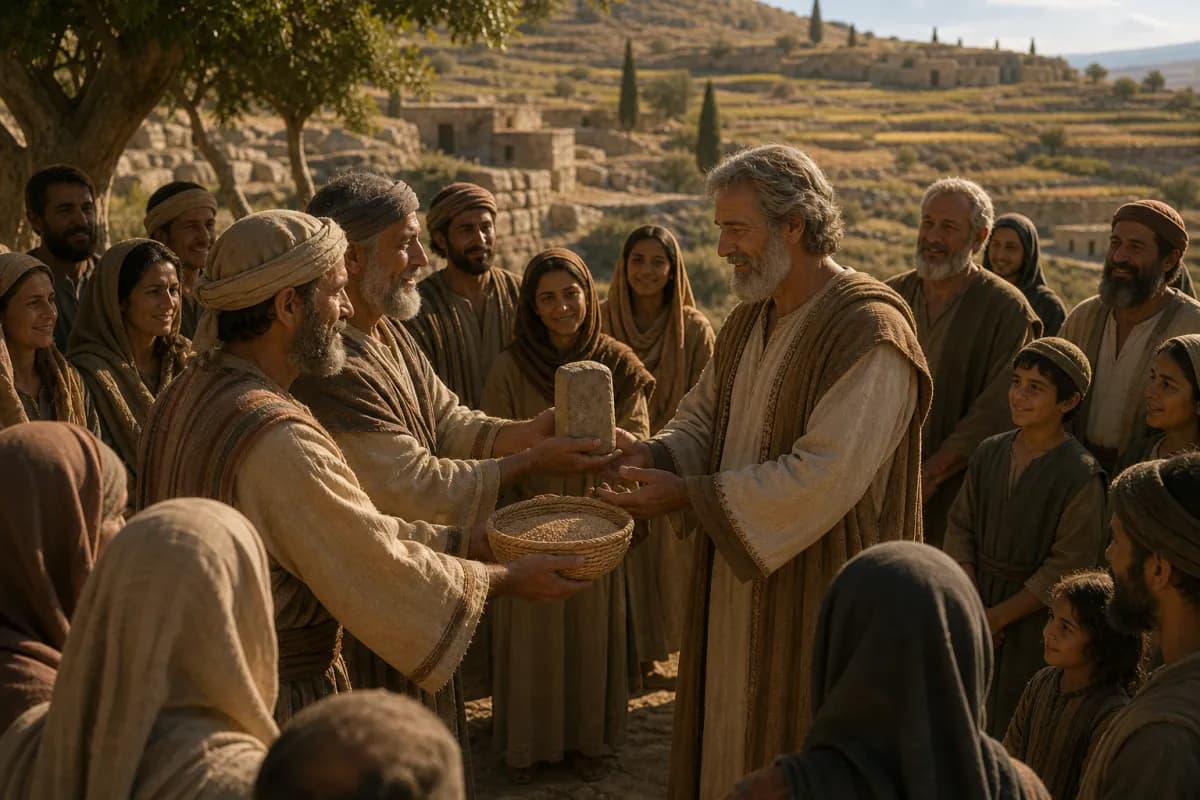
The final personal allotment belongs to Joshua. He asks for and receives Timnath-serah in Ephraim’s hill country only after the people finish receiving their inheritances. The timing quietly interprets his leadership: he has not used his authority to secure a first or grander possession.
HISTORICAL AND LITERARY CONTEXT
Several tribes receive territory that will feature prominently in later biblical history. Dan’s difficulty on the coastal edge is especially visible when its people take Leshem in the north, while Simeon’s towns within Judah anticipate its close relationship to the southern kingdom. The chapter’s purpose, however, is allotment under the covenant, not a complete account of later tribal fortunes.
Joshua’s portion completes the distribution at Shiloh before the tent of meeting. The leader who has supervised conquest and division receives a town after the people, embodying the duty already seen in Joshua 1: leaders are to seek the people’s rest rather than treat office as an entitlement.
SECTION-BY-SECTION ANALYSIS
- Simeon within Judah · Joshua 19:1The first allotment redistributes part of Judah’s large territory among another tribe.
- Dan captures Leshem · Joshua 19:47Dan responds to its constrained setting by taking and renaming a northern city.
- Joshua receives Timnath-serah · Joshua 19:49The leader’s portion comes after the people’s inheritance has been completed.
CHRIST IN THIS PASSAGE
Joshua’s late allotment forms a careful thematic echo of servant leadership. He is not Jesus, and Timnath-serah does not predict a detail of the gospel. Yet he receives after serving the people, while Jesus—the greater leader—gives Himself for His people and teaches that greatness is expressed in service.
The tribal allotments also anticipate the church’s unity in diversity. In Christ, believers receive differing gifts and callings from one Lord, not as grounds for envy or superiority. His saving mission forms one body from many peoples and gives every member a place of service.
REFLECTION
The long list of tribes resists the instinct to regard some people as incidental to God’s purpose. Simeon, Dan, Asher, and Naphtali are not interchangeable names; their portions matter in Israel’s common life. The chapter trains readers to see a people held together by God’s gift rather than by uniformity.
Consider whether you use responsibility to secure your own advantage before serving those entrusted to you. Ask Jesus for Joshua’s patience and for the humility of the One who gave His life to make a people for God.
Original Hebrew Word Study
Joshua 19:51
חָלַק
chalaq · H2505
Usually translated: to divide or apportion
Chalaq means to apportion. The land is divided by lot before the Lord, so each tribe’s place is received as an ordered gift rather than seized by strength.
Follow the Scripture trail
The Remaining Allotments and Joshua’s Humble Portion in the larger story
The connection: Joshua completes the tribes’ inheritances before receiving his own town, offering a limited echo of the servant leadership perfected in Jesus. Christ gives Himself to gather a diverse people into one redeemed body.
Respond to the passage
Thank Jesus for the particular place and gifts He has given you without comparing them to another’s. In one area of responsibility, choose service that puts another person’s good before your own recognition.
- What does the repeated distribution by lot emphasize?
- Why does Joshua receive his town at the end of the chapter?
- How does Jesus reshape leadership and belonging for His church?
Prayer
Lord Jesus, You came to serve and to give Your life. Free me from comparison and entitlement, help me honor the place of others in Your people, and make me a servant who seeks their good. Amen.