Passage Study
Cities of Refuge: Justice, Mercy, and a Place to Stand
Joshua 20:1–20:9
Joshua 20 establishes six cities of refuge for a person who kills another without intent. The accused may flee, state the case at the city gate, and remain protected from the avenger of blood until a hearing and, if necessary, until the high priest’s death. The passage guards both the value of life and due process, and it points carefully to Christ as the true refuge for guilty sinners.
- In this study
- 9 verses · 5 movements
Joshua 20
20:1The LORD spoke to Joshua, saying,
20:2“Speak to the children of Israel, saying, ‘Assign the cities of refuge, of which I spoke to you by Moses,
20:3that the man slayer who kills any person accidentally or unintentionally may flee there. They shall be to you for a refuge from the avenger of blood.
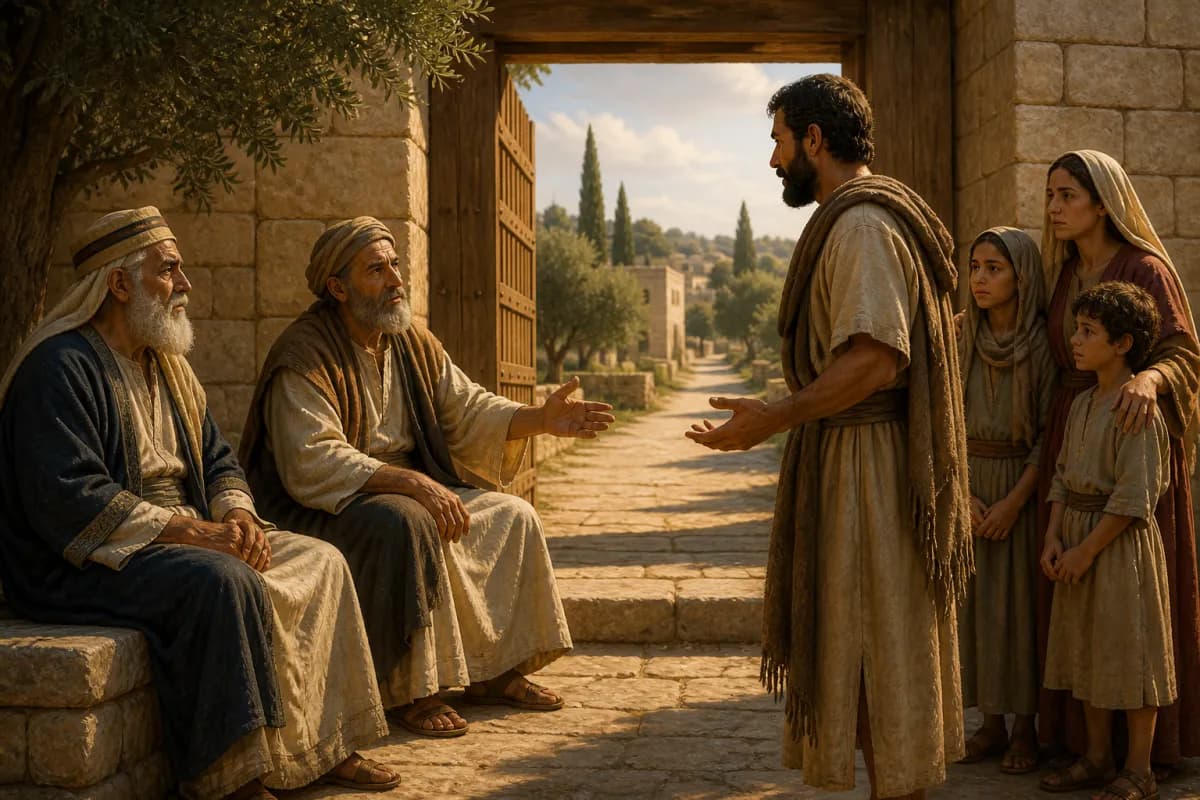
20:4He shall flee to one of those cities, and shall stand at the entrance of the gate of the city, and declare his case in the ears of the elders of that city. They shall take him into the city with them, and give him a place, that he may live among them.
20:5If the avenger of blood pursues him, then they shall not deliver up the man slayer into his hand; because he struck his neighbor unintentionally, and didn’t hate him before.
20:6He shall dwell in that city until he stands before the congregation for judgment, until the death of the high priest that shall be in those days. Then the man slayer shall return, and come to his own city, and to his own house, to the city he fled from.’”
20:7They set apart Kedesh in Galilee in the hill country of Naphtali, Shechem in the hill country of Ephraim, and Kiriath Arba (also called Hebron) in the hill country of Judah.
20:8Beyond the Jordan at Jericho eastward, they assigned Bezer in the wilderness in the plain out of the tribe of Reuben, Ramoth in Gilead out of the tribe of Gad, and Golan in Bashan out of the tribe of Manasseh.
20:9These were the appointed cities for all the children of Israel, and for the alien who lives among them, that whoever kills any person unintentionally might flee there, and not die by the hand of the avenger of blood, until he stands trial before the congregation.
CONTEXTUAL OVERVIEW
Joshua 20 interrupts the land lists with an institution designed for a crisis: a human life has been taken, but the killing was unintentional. The accused person flees to a designated city before the avenger of blood can retaliate. The city gate becomes a place for a stated case, protection, and later judgment rather than immediate revenge.
The chapter holds together truths that can be separated too easily. Life is valuable, so a death cannot be treated casually. Intent matters, so an accidental killer must not be treated as a murderer. The refuge city is neither an escape from justice nor a license for private vengeance.
HISTORICAL AND LITERARY CONTEXT
The cities implement commands given in Exodus, Numbers, and Deuteronomy for Israel’s covenant society. In a world without modern police systems, the nearest male relative could act as an avenger of blood to uphold a family’s claim after a killing. The refuge provisions place that response under communal legal restraint.
Three cities lie west of the Jordan and three east of it, making refuge accessible throughout Israel’s settled land. The high priest’s death marks the end of required residence for the protected person. The text does not fully explain why this death has that legal effect, so interpreters should avoid claiming a precise mechanism that the chapter does not state.
SECTION-BY-SECTION ANALYSIS
- Without intent · Joshua 20:1The law distinguishes accidental killing from an act done with prior hostility.
- At the city gate · Joshua 20:4The accused gives an account in a public legal setting rather than disappearing from judgment.
- Until the high priest dies · Joshua 20:6The protected person remains within the refuge arrangement until the chapter’s stated release point.
CHRIST IN THIS PASSAGE
The cities of refuge provide a strong but limited analogy to Christ. Hebrews calls believers to flee for refuge to lay hold of hope, and Jesus receives sinners who come to Him. Yet Joshua 20 concerns accidental killing and a legal process; it must not be used to deny personal guilt or imply that Christ merely shelters the innocent.
The gospel goes further: Christ bears the judgment deserved by truly guilty people and brings them to God through His priestly, once-for-all saving work. His mercy never erases justice; at the cross, God deals with sin righteously and offers forgiveness to those who trust His Son.
REFLECTION
This chapter teaches patience where anger demands a quick verdict. It honors grief without allowing grief to become the sole judge of another person’s responsibility. In families, churches, and public life, truth is better served when accusation, evidence, protection, and judgment are not collapsed into one immediate reaction.
Flee to Jesus with the sins you cannot repair by explanation or self-punishment. Because He is a merciful and righteous Savior, you can confess honestly, receive forgiveness, and learn to pursue justice without revenge.
Original Hebrew Word Study
Joshua 20:2
מִקְלָט
miqlat · H4733
Usually translated: refuge
Miqlat is a refuge. The cities protect a person accused of accidental killing until a just hearing can preserve both life and justice.
Follow the Scripture trail
Cities of Refuge: Justice, Mercy, and a Place to Stand in the larger story
The connection: Israel’s refuge cities preserve life and restrain vengeance within God’s justice. Jesus is the deeper refuge who bears sin’s judgment and brings guilty people safely to God through His saving priesthood.
Respond to the passage
Where anger has made you want a rapid verdict, ask Jesus for truthfulness and restraint. Where guilt has made you hide, come to Him openly and receive the mercy His cross has secured.
- Why does the accused person have to state the case at the city gate?
- How does Joshua 20 guard both the victim’s family and the accused?
- In what way is Christ a deeper refuge than the cities without making the analogy careless?
Prayer
Lord Jesus, righteous Judge and merciful refuge, teach me to honor life, resist revenge, and confess my sin without hiding. Hold me fast in the forgiveness You purchased at the cross. Amen.