Passage Study
A Witness Altar for One Lord and One People
Joshua 22:1–22:34
Joshua 22 sends the eastern tribes home after they have fought alongside Israel, but their large altar by the Jordan alarms the western tribes. A delegation confronts them before war begins, recalling past covenant breaches. The eastern tribes explain that the altar is not for sacrifice but a witness that they share the Lord’s worship. The chapter protects covenant unity and points to Christ, who makes one people from those once divided.
- In this study
- 34 verses · 5 movements
Joshua 22
22:1Then Joshua called the Reubenites, the Gadites, and the half-tribe of Manasseh,
22:2and said to them, “You have kept all that Moses the servant of the LORD commanded you, and have listened to my voice in all that I commanded you.
22:3You have not left your brothers these many days to this day, but have performed the duty of the commandment of the LORD your God.
22:4Now the LORD your God has given rest to your brothers, as he spoke to them. Therefore now return and go to your tents, to the land of your possession, which Moses the servant of the LORD gave you beyond the Jordan.
22:5Only take diligent heed to do the commandment and the law which Moses the servant of the LORD commanded you, to love the LORD your God, to walk in all his ways, to keep his commandments, to hold fast to him, and to serve him with all your heart and with all your soul.”
22:6So Joshua blessed them, and sent them away; and they went to their tents.
22:7Now to the one half-tribe of Manasseh Moses had given inheritance in Bashan; but Joshua gave to the other half among their brothers beyond the Jordan westward. Moreover when Joshua sent them away to their tents, he blessed them,
22:8and spoke to them, saying, “Return with much wealth to your tents, with very much livestock, with silver, with gold, with bronze, with iron, and with very much clothing. Divide the plunder of your enemies with your brothers.”
22:9The children of Reuben and the children of Gad and the half-tribe of Manasseh returned, and departed from the children of Israel out of Shiloh, which is in the land of Canaan, to go to the land of Gilead, to the land of their possession, which they owned, according to the commandment of the LORD by Moses.
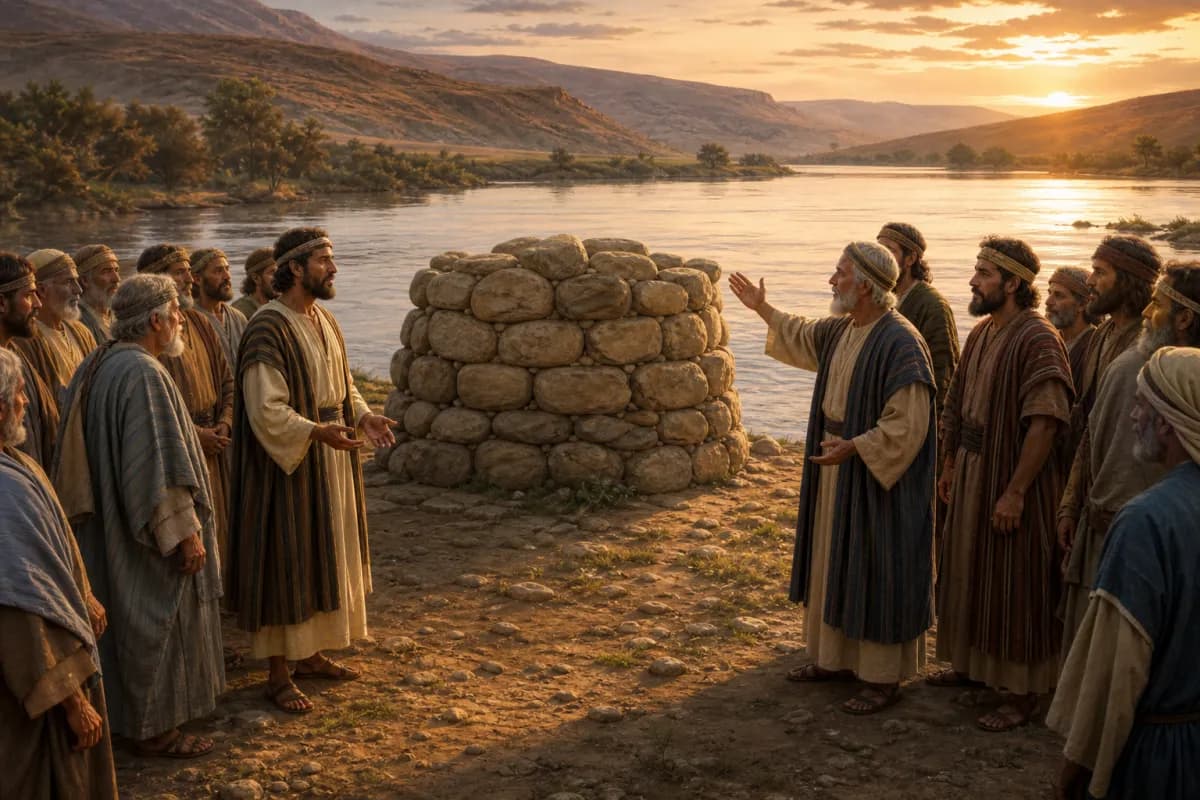
22:10When they came to the region near the Jordan, that is in the land of Canaan, the children of Reuben and the children of Gad and the half-tribe of Manasseh built an altar there by the Jordan, a great altar to look at.
22:11The children of Israel heard this, “Behold, the children of Reuben and the children of Gad and the half-tribe of Manasseh have built an altar along the border of the land of Canaan, in the region around the Jordan, on the side that belongs to the children of Israel.”
22:12When the children of Israel heard of it, the whole congregation of the children of Israel gathered themselves together at Shiloh, to go up against them to war.
22:13The children of Israel sent to the children of Reuben, and to the children of Gad, and to the half-tribe of Manasseh, into the land of Gilead, Phinehas the son of Eleazar the priest.
22:14With him were ten princes, one prince of a fathers’ house for each of the tribes of Israel; and they were each head of their fathers’ houses among the thousands of Israel.
22:15They came to the children of Reuben, and to the children of Gad, and to the half-tribe of Manasseh, to the land of Gilead, and they spoke with them, saying,
22:16“The whole congregation of the LORD says, ‘What trespass is this that you have committed against the God of Israel, to turn away today from following the LORD, in that you have built yourselves an altar, to rebel today against the LORD?
22:17Is the iniquity of Peor too little for us, from which we have not cleansed ourselves to this day, although there came a plague on the congregation of the LORD,
22:18that you must turn away today from following the LORD? It will be, since you rebel today against the LORD, that tomorrow he will be angry with the whole congregation of Israel.
22:19However, if the land of your possession is unclean, then pass over to the land of the possession of the LORD, in which the LORD’s tabernacle dwells, and take possession among us; but don’t rebel against the LORD, nor rebel against us, in building an altar other than the LORD our God’s altar.
22:20Didn’t Achan the son of Zerah commit a trespass in the devoted thing, and wrath fell on all the congregation of Israel? That man didn’t perish alone in his iniquity.’”
22:21Then the children of Reuben and the children of Gad and the half-tribe of Manasseh answered, and spoke to the heads of the thousands of Israel,
22:22“The Mighty One, God, the LORD, the Mighty One, God, the LORD, he knows; and Israel shall know: if it was in rebellion, or if in trespass against the LORD (don’t save us today),
22:23that we have built us an altar to turn away from following the LORD; or if to offer burnt offering or meal offering, or if to offer sacrifices of peace offerings, let the LORD himself require it.
22:24“If we have not out of concern done this, and for a reason, saying, ‘In time to come your children might speak to our children, saying, “What have you to do with the LORD, the God of Israel?
22:25For the LORD has made the Jordan a border between us and you, you children of Reuben and children of Gad. You have no portion in the LORD.”’ So your children might make our children cease from fearing the LORD.
22:26“Therefore we said, ‘Let’s now prepare to build ourselves an altar, not for burnt offering, nor for sacrifice;
22:27but it will be a witness between us and you, and between our generations after us, that we may perform the service of the LORD before him with our burnt offerings, with our sacrifices, and with our peace offerings;’ that your children may not tell our children in time to come, ‘You have no portion in the LORD.’
22:28“Therefore we said, ‘It shall be, when they tell us or our generations this in time to come, that we shall say, “Behold the pattern of the LORD’s altar, which our fathers made, not for burnt offering, nor for sacrifice; but it is a witness between us and you.”’
22:29“Far be it from us that we should rebel against the LORD, and turn away today from following the LORD, to build an altar for burnt offering, for meal offering, or for sacrifice, besides the LORD our God’s altar that is before his tabernacle!”
22:30When Phinehas the priest, and the princes of the congregation, even the heads of the thousands of Israel that were with him, heard the words that the children of Reuben and the children of Gad and the children of Manasseh spoke, it pleased them well.
22:31Phinehas the son of Eleazar the priest said to the children of Reuben, to the children of Gad, and to the children of Manasseh, “Today we know that the LORD is among us, because you have not committed this trespass against the LORD. Now you have delivered the children of Israel out of the LORD’s hand.”
22:32Phinehas the son of Eleazar the priest, and the princes, returned from the children of Reuben, and from the children of Gad, out of the land of Gilead, to the land of Canaan, to the children of Israel, and brought them word again.
22:33The thing pleased the children of Israel; and the children of Israel blessed God, and spoke no more of going up against them to war, to destroy the land in which the children of Reuben and the children of Gad lived.
22:34The children of Reuben and the children of Gad named the altar “A Witness Between Us that the LORD is God.”
CONTEXTUAL OVERVIEW
Joshua 22 begins with commendation. Reuben, Gad, and half of Manasseh have kept their promise to fight beside the western tribes before returning to their homes east of the Jordan. Joshua sends them away with an exhortation to love the Lord, walk in His ways, cling to Him, and serve Him with all their heart and soul.
The apparent unity is immediately tested when they build a large altar near the Jordan. The western tribes hear of it and gather at Shiloh to go to war, fearing a rival sacrificial center that would bring covenant judgment on all Israel. The chapter’s tension is not petty territorial suspicion; it concerns whether Israel will remain faithful to the Lord’s appointed worship.
HISTORICAL AND LITERARY CONTEXT
The Jordan forms a geographic boundary between the eastern tribes and the rest of Israel. Deuteronomy requires sacrifices to be offered at the place the Lord chooses, so an independent altar could signal rebellion. The western tribes remember Achan’s sin and the apostasy at Peor because both taught that one group’s breach can wound the whole covenant community.
Phinehas, who acted decisively against Peor’s rebellion, leads the delegation. His presence gives the meeting moral seriousness, but the delegation does not begin with attack. It asks, warns, offers to share western land if necessary, and listens to the eastern tribes’ detailed explanation.
SECTION-BY-SECTION ANALYSIS
- Cling to the Lord · Joshua 22:9Joshua’s farewell calls the eastern tribes to covenant loyalty as they live farther from Shiloh.
- The sin at Peor and Achan · Joshua 22:17The delegation remembers earlier breaches to explain why an apparent rival altar cannot be ignored.
- A witness between us · Joshua 22:28The altar’s stated purpose is memorial testimony, not a second site of sacrifice.
CHRIST IN THIS PASSAGE
Joshua 22 has a strong thematic connection to the unity Jesus creates. The eastern tribes insist that the Jordan does not sever them from the Lord or from their brothers. In Christ, Jews and Gentiles are reconciled into one household through His cross; their unity rests on His saving work, not on shared geography or a replica altar.
The chapter also shapes Christian conflict. It does not say every concern is harmless, and it does not say every alarming report warrants an immediate attack. Jesus calls His people to pursue truth, reconciliation, and peace while remaining serious about worship and holiness.
REFLECTION
The western tribes deserve credit for caring about covenant faithfulness, but their first report could have produced a disastrous war. The eastern tribes deserve credit for explaining their action with the Lord’s honor in view. Together they show that zeal for truth needs patient inquiry and that misunderstood actions need clear, humble speech.
When conflict arises in Christ’s church, resist both indifference and accusation. Ask enough questions to understand the issue, speak plainly about what is at stake, and seek the unity Jesus purchased rather than the satisfaction of winning a suspicion.
Original Hebrew Word Study
Joshua 22:27
עֵד
ed · H5707
Usually translated: witness
Ed is a witness. The altar is not a rival place of sacrifice but a witness that the eastern tribes share the same Lord and covenant worship.
Follow the Scripture trail
A Witness Altar for One Lord and One People in the larger story
The connection: The Jordan altar test threatens to fracture Israel’s shared worship, yet careful truth-seeking preserves fellowship. Jesus creates the deeper unity of one reconciled people through His cross and calls His church to guard that unity in truth and peace.
Respond to the passage
In a current conflict, ask Jesus to reveal where you have assumed motives before listening. Take one step toward a truthful conversation that honors holiness and seeks the unity He purchased.
- Why do the western tribes react so strongly to the altar?
- How do the eastern tribes explain its purpose?
- What does this chapter teach about addressing concerns in the church without rushing into accusation?
Prayer
Lord Jesus, You have made one people through Your cross. Give me zeal for truth without haste to condemn, humility to explain my actions, and courage to pursue peace that honors You. Amen.