Passage Study
The Lord Goes Before Israel through the Jordan
Joshua 3:1–3:17
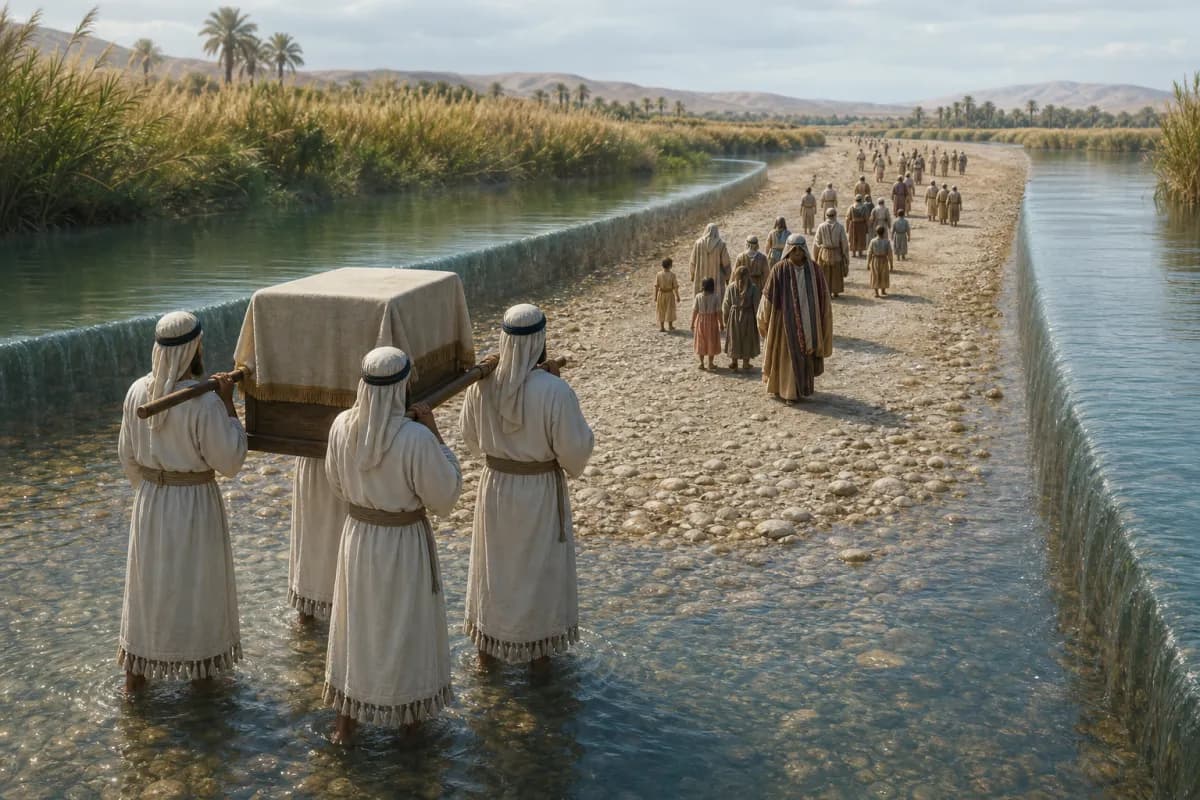
Joshua 3 makes Israel wait behind the ark while the priests enter the flooded Jordan. When their feet touch its edge, the water stops and the nation crosses on dry ground. The crossing reveals the Lord’s holy presence among His people and establishes Joshua before Israel. It recalls the exodus and points toward the God who brings His people through judgment and death into life through Jesus Christ.
- In this study
- 17 verses · 5 movements
Joshua 3
3:1Joshua got up early in the morning; and they moved from Shittim and came to the Jordan, he and all the children of Israel. They camped there before they crossed over.
3:2After three days, the officers went through the middle of the camp;
3:3and they commanded the people, saying, “When you see the ark of the LORD your God’s covenant, and the Levitical priests bearing it, then leave your place and follow it.
3:4Yet there shall be a space between you and it of about two thousand cubits by measure—don’t come closer to it—that you may know the way by which you must go; for you have not passed this way before.”
3:5Joshua said to the people, “Sanctify yourselves; for tomorrow the LORD will do wonders among you.”
3:6Joshua spoke to the priests, saying, “Take up the ark of the covenant, and cross over before the people.” They took up the ark of the covenant, and went before the people.
3:7The LORD said to Joshua, “Today I will begin to magnify you in the sight of all Israel, that they may know that as I was with Moses, so I will be with you.
3:8You shall command the priests who bear the ark of the covenant, saying, ‘When you come to the brink of the waters of the Jordan, you shall stand still in the Jordan.’”
3:9Joshua said to the children of Israel, “Come here, and hear the words of the LORD your God.”
3:10Joshua said, “By this you shall know that the living God is among you, and that he will without fail drive the Canaanite, the Hittite, the Hivite, the Perizzite, the Girgashite, the Amorite, and the Jebusite out from before you.
3:11Behold, the ark of the covenant of the Lord of all the earth passes over before you into the Jordan.
3:12Now therefore take twelve men out of the tribes of Israel, for every tribe a man.
3:13It shall be that when the soles of the feet of the priests who bear the ark of GOD, the Lord of all the earth, rest in the waters of the Jordan, that the waters of the Jordan will be cut off. The waters that come down from above shall stand in one heap.”
3:14When the people moved from their tents to pass over the Jordan, the priests who bore the ark of the covenant being before the people,
3:15and when those who bore the ark had come to the Jordan, and the feet of the priests who bore the ark had dipped in the edge of the water (for the Jordan overflows all its banks all the time of harvest),
3:16the waters which came down from above stood, and rose up in one heap a great way off, at Adam, the city that is beside Zarethan; and those that went down toward the sea of the Arabah, even the Salt Sea, were wholly cut off. Then the people passed over near Jericho.
3:17The priests who bore the ark of the LORD’s covenant stood firm on dry ground in the middle of the Jordan; and all Israel crossed over on dry ground, until all the nation had passed completely over the Jordan.
CONTEXTUAL OVERVIEW
Joshua 3 begins at the barrier between Israel and the land promised to Abraham. The Jordan is not a shallow symbolic stream in this scene: it is overflowing its banks at harvest. Israel cannot manufacture a crossing, and the narrative makes the ark of the covenant—not Joshua’s strategy—the center of the procession.
The officers tell the people to watch the ark because they have not traveled this way before. Their distance from it preserves its holiness while making it visible to the whole camp. The Lord is not merely giving directions from a distance; He goes before His people into the obstacle that stops them.
HISTORICAL AND LITERARY CONTEXT
The chapter deliberately echoes Israel’s crossing of the sea in Exodus. There, Moses stretched out his hand and the Lord made a path through the waters; here, the priests bear the ark and the Lord cuts off the Jordan upstream. Joshua’s leadership is publicly confirmed, but the narrative keeps the Lord as the active deliverer.
The ark represents the covenant presence of the Lord in Israel’s camp. Joshua does not invite later readers to recreate its rituals or presume that God guarantees every difficult undertaking. The immediate promise concerns Israel’s entrance into the land, while the abiding lesson is that holy God makes a way for the people He has called to follow Him.
SECTION-BY-SECTION ANALYSIS
- Follow the ark · Joshua 3:3Israel’s route is set by the Lord’s presence, not by familiar paths or human confidence.
- Consecrate yourselves · Joshua 3:5The coming miracle calls for reverent readiness because the holy God is acting among His people.
- The waters stood still · Joshua 3:8The Lord removes a barrier no tribe could remove and brings the entire nation safely across.
CHRIST IN THIS PASSAGE
The Jordan crossing is a strong exodus-pattern connection, not a claim that every river detail secretly describes Christ. Scripture presents Jesus as the One who leads His people through the deeper bondage of sin and death. His death and resurrection open the way to reconciliation with God, where Israel’s crossing opened the way into a land inheritance.
Jesus also stands among His people in the waters of baptism and promises His abiding presence to disciples sent into the world. Christians do not possess a ritual object that guarantees safety, but they follow the risen Lord whose saving presence is stronger than the barriers that keep sinners from God.
REFLECTION
Israel had to wait, watch, and step forward only after the Lord gave His command. That sequence confronts the impulse to treat urgency as permission to run ahead of God. Some obstacles expose how little control we actually have, and that exposure can become the place where faith learns to follow.
Bring the impassable place before Jesus—the grief, guilt, fear, or calling you cannot cross by force. Ask Him to make your next step obedient and reverent, trusting His saving presence rather than demanding a path of your own design.
Original Hebrew Word Study
Joshua 3:5
קָדַשׁ
qadash · H6942
Usually translated: consecrate or set apart
Qadash means to consecrate. Israel prepares for the Lord’s wonders by setting itself apart, because the crossing will reveal His holy presence among them.
Follow the Scripture trail
The Lord Goes Before Israel through the Jordan in the larger story
The connection: The Jordan crossing continues the exodus story: God Himself brings a helpless people through an uncrossable barrier into His promised gift. Jesus fulfills the greater rescue by bringing sinners through His death and resurrection into peace with God.
Respond to the passage
Where have you tried to force a way forward instead of following the Lord? Confess that self-reliance to Jesus, receive His mercy, and obey the next instruction His word makes clear.
- Why must Israel keep its eyes on the ark rather than on the river?
- What does the overflowing Jordan reveal about the source of Israel’s crossing?
- How does the exodus pattern help you see the saving work of Jesus without turning every detail into allegory?
Prayer
Lord Jesus, You have opened the way to God through Your death and resurrection. Teach me to follow Your presence with reverence, trust You at barriers I cannot remove, and walk in the life You give. Amen.