Passage Study
Stones That Teach the Next Generation
Joshua 4:1–4:24
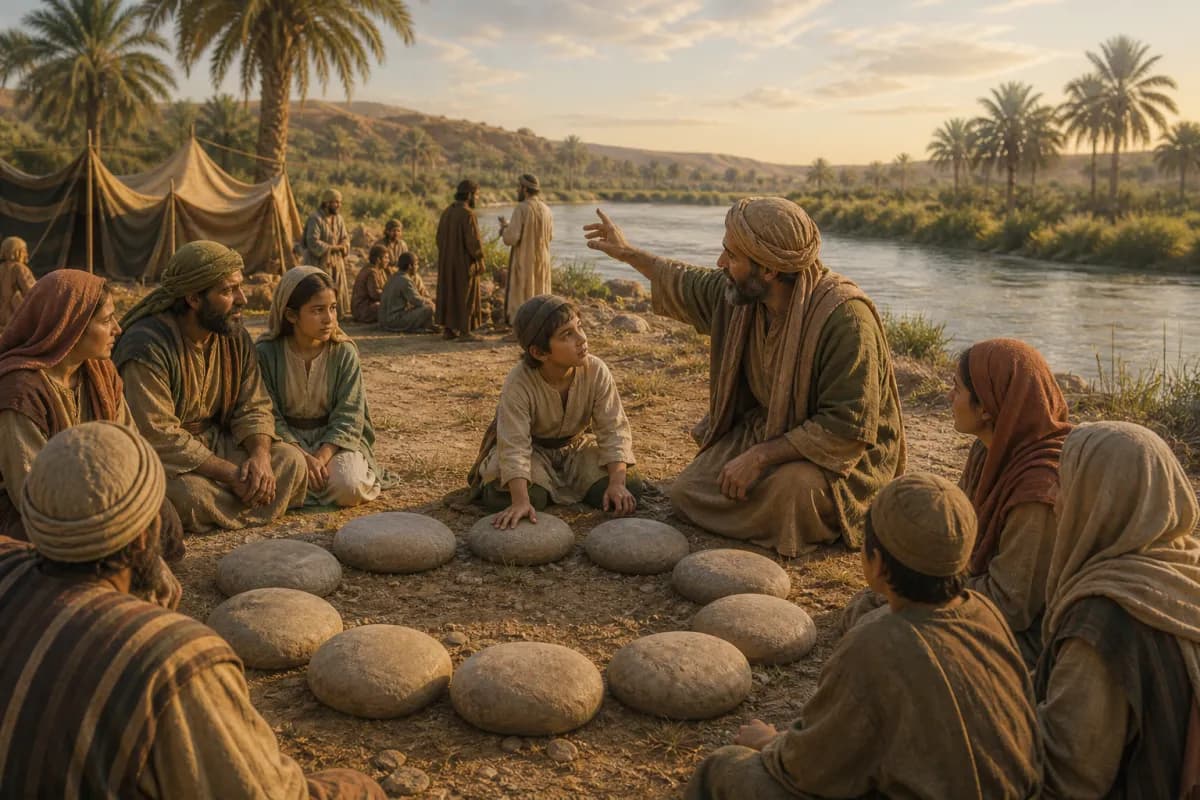
Joshua 4 turns Israel’s Jordan crossing into a lasting testimony. Twelve men lift stones from the riverbed where the priests stand with the ark, and Joshua sets them at Gilgal so children will ask what they mean. The memorial does not glorify Israel’s courage; it teaches that the Lord dried the Jordan before His people. It forms grateful memory that prepares the church to proclaim Christ’s saving acts.
- In this study
- 24 verses · 5 movements
Joshua 4
4:1When all the nation had completely crossed over the Jordan, the LORD spoke to Joshua, saying,
4:2“Take twelve men out of the people, a man out of every tribe,
4:3and command them, saying, ‘Take from out of the middle of the Jordan, out of the place where the priests’ feet stood firm, twelve stones, carry them over with you, and lay them down in the place where you’ll camp tonight.’”
4:4Then Joshua called the twelve men whom he had prepared of the children of Israel, a man out of every tribe.
4:5Joshua said to them, “Cross before the ark of the LORD your God into the middle of the Jordan, and each of you pick up a stone and put it on your shoulder, according to the number of the tribes of the children of Israel;
4:6that this may be a sign among you, that when your children ask in the future, saying, ‘What do you mean by these stones?’
4:7then you shall tell them, ‘Because the waters of the Jordan were cut off before the ark of the LORD’s covenant. When it crossed over the Jordan, the waters of the Jordan were cut off. These stones shall be for a memorial to the children of Israel forever.’”
4:8The children of Israel did as Joshua commanded, and took up twelve stones out of the middle of the Jordan, as the LORD spoke to Joshua, according to the number of the tribes of the children of Israel. They carried them over with them to the place where they camped, and laid them down there.
4:9Joshua set up twelve stones in the middle of the Jordan, in the place where the feet of the priests who bore the ark of the covenant stood; and they are there to this day.
4:10For the priests who bore the ark stood in the middle of the Jordan until everything was finished that the LORD commanded Joshua to speak to the people, according to all that Moses commanded Joshua; and the people hurried and passed over.
4:11When all the people had completely crossed over, the LORD’s ark crossed over with the priests in the presence of the people.
4:12The children of Reuben, and the children of Gad, and the half-tribe of Manasseh crossed over armed before the children of Israel, as Moses spoke to them.
4:13About forty thousand men, ready and armed for war, passed over before the LORD to battle, to the plains of Jericho.
4:14On that day, the LORD magnified Joshua in the sight of all Israel; and they feared him, as they feared Moses, all the days of his life.
4:15The LORD spoke to Joshua, saying,
4:16“Command the priests who bear the ark of the covenant, that they come up out of the Jordan.”
4:17Joshua therefore commanded the priests, saying, “Come up out of the Jordan!”
4:18When the priests who bore the ark of the LORD’s covenant had come up out of the middle of the Jordan, and the soles of the priests’ feet had been lifted up to the dry ground, the waters of the Jordan returned to their place, and went over all its banks, as before.
4:19The people came up out of the Jordan on the tenth day of the first month, and encamped in Gilgal, on the east border of Jericho.
4:20Joshua set up those twelve stones, which they took out of the Jordan, in Gilgal.
4:21He spoke to the children of Israel, saying, “When your children ask their fathers in time to come, saying, ‘What do these stones mean?’
4:22Then you shall let your children know, saying, ‘Israel came over this Jordan on dry land.
4:23For the LORD your God dried up the waters of the Jordan from before you until you had crossed over, as the LORD your God did to the Red Sea, which he dried up from before us, until we had crossed over,
4:24that all the peoples of the earth may know that the LORD’s hand is mighty, and that you may fear the LORD your God forever.’”
CONTEXTUAL OVERVIEW
Joshua 4 slows the narrative after the miracle of chapter 3. The Lord has brought every Israelite across, yet He will not allow the event to become a private memory held only by those who saw it. Twelve stones, one associated with each tribe, carry the riverbed into the camp at Gilgal.
The chapter repeatedly imagines children asking a question: “What do these stones mean to you?” Israel’s answer must name the Lord’s act at the Jordan and connect it to the sea crossing before their fathers. Faithful memory is not nostalgia; it is testimony that teaches a new generation who their God is.
HISTORICAL AND LITERARY CONTEXT
Memorials in the Old Testament often preserve covenant memory at significant places, but Joshua’s stones receive their meaning from the spoken explanation attached to them. The stones are not objects of devotion. They are visible prompts for telling a story of divine faithfulness.
Joshua 4 also confirms Joshua’s leadership before Israel, just as the Lord promised in 3:7. The chapter is carefully framed around the priests carrying the ark: they remain in the river until the command is complete, and the waters return only after they come up. Israel’s safe passage depends on the Lord’s presence and command.
SECTION-BY-SECTION ANALYSIS
- Twelve stones · Joshua 4:8The memorial includes all Israel, preserving a shared story rather than a tribal achievement.
- When your children ask · Joshua 4:21God commands an answer that tells the event as His rescue, not as Israel’s adventure.
- All peoples may know · Joshua 4:24The crossing has a witness-bearing purpose beyond Israel’s immediate safety.
CHRIST IN THIS PASSAGE
The stones at Gilgal do not predict a material Christian monument, but they establish a biblical pattern of remembering God’s saving work through public testimony. Jesus gives His church a decisive saving event to proclaim: His death for sinners and His resurrection. The Lord’s Supper remembers Him in a way the New Testament explicitly commands, while the church’s spoken witness tells what His grace has done.
Joshua’s memorial also looks outward: all peoples are to know the Lord’s mighty hand. That mission finds its fullest expression in the risen Christ sending witnesses to the nations. Christian remembrance therefore includes grateful proclamation, so that children and neighbors hear the gospel rather than merely inherit religious objects.
REFLECTION
A household can preserve Christian vocabulary while losing the story it is meant to tell. Joshua 4 calls parents, churches, and older believers to answer honest questions with the concrete works of God: He made covenant, judged sin, kept promise, sent His Son, and raised Him from the dead.
Consider what practices in your life help another person ask about Jesus. Let Scripture reading, prayer, baptism, communion, and candid testimony become occasions to name His mercy rather than signals of private spiritual achievement.
Original Hebrew Word Study
Joshua 4:7
זִכָּרוֹן
zikkaron · H2146
Usually translated: memorial or remembrance
Zikkaron is a memorial. The stones turn the crossing into a teaching tool so future children will hear that the Lord stopped the Jordan before His people.
Follow the Scripture trail
Stones That Teach the Next Generation in the larger story
The connection: The stones preserve the story of God bringing Israel through the Jordan, and their explanation directs future generations to His saving power. The church remembers and proclaims the greater deliverance accomplished in Jesus’ death and resurrection.
Respond to the passage
Tell one younger believer, child, or friend a concrete story of God’s mercy in Christ. Ask whether the habits of your household make His saving work easier to see and explain.
- Why are the stones meaningless apart from the explanation Joshua gives?
- What does the chapter teach about including all Israel in the memory of deliverance?
- How does Christian remembrance of Christ differ from mere sentimentality?
Prayer
Lord Jesus, keep Your saving work fresh in our memory. Give us words to tell children and neighbors what You have done, and make our worship a truthful witness to Your death and resurrection. Amen.