Passage Study
A Consecrated People before a Holy Commander
Joshua 5:1–5:15
Joshua 5 pauses Israel’s advance at Gilgal for circumcision, Passover, and worship before the commander of the Lord’s army. The reproach of Egypt is removed, the wilderness generation receives the covenant sign, the manna ceases as the land’s produce begins, and Joshua falls before holy presence. The chapter insists that Israel’s future depends on belonging to the Lord; it prepares readers for Jesus, who gives the true covenant cleansing and Passover deliverance.
- In this study
- 15 verses · 5 movements
Joshua 5
5:1When all the kings of the Amorites, who were beyond the Jordan westward, and all the kings of the Canaanites, who were by the sea, heard how the LORD had dried up the waters of the Jordan from before the children of Israel until we had crossed over, their heart melted, and there was no more spirit in them, because of the children of Israel.
5:2At that time, the LORD said to Joshua, “Make flint knives, and circumcise again the sons of Israel the second time.”
5:3Joshua made himself flint knives, and circumcised the sons of Israel at the hill of the foreskins.
5:4This is the reason Joshua circumcised them: all the people who came out of Egypt, who were males, even all the men of war, died in the wilderness along the way, after they came out of Egypt.
5:5For all the people who came out were circumcised; but all the people who were born in the wilderness along the way as they came out of Egypt had not been circumcised.
5:6For the children of Israel walked forty years in the wilderness until all the nation, even the men of war who came out of Egypt, were consumed, because they didn’t listen to the LORD’s voice. The LORD swore to them that he wouldn’t let them see the land which the LORD swore to their fathers that he would give us, a land flowing with milk and honey.
5:7Their children, whom he raised up in their place, were circumcised by Joshua, for they were uncircumcised, because they had not circumcised them on the way.
5:8When they were done circumcising the whole nation, they stayed in their places in the camp until they were healed.
5:9The LORD said to Joshua, “Today I have rolled away the reproach of Egypt from you.” Therefore the name of that place was called Gilgal to this day.
5:10The children of Israel encamped in Gilgal. They kept the Passover on the fourteenth day of the month at evening in the plains of Jericho.
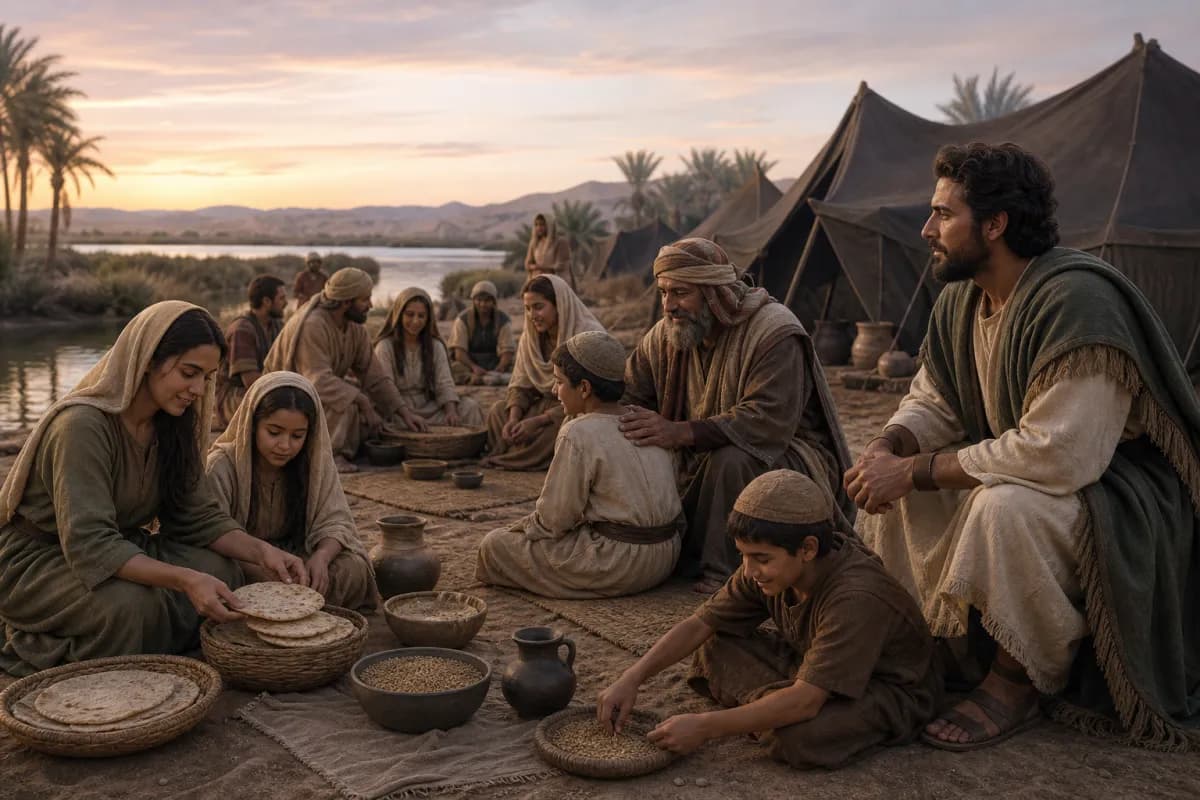
5:11They ate unleavened cakes and parched grain of the produce of the land on the next day after the Passover, in the same day.
5:12The manna ceased on the next day, after they had eaten of the produce of the land. The children of Israel didn’t have manna any more, but they ate of the fruit of the land of Canaan that year.
5:13When Joshua was by Jericho, he lifted up his eyes and looked, and behold, a man stood in front of him with his sword drawn in his hand. Joshua went to him and said to him, “Are you for us, or for our enemies?”
5:14He said, “No; but I have come now as commander of the LORD’s army.” Joshua fell on his face to the earth, and worshiped, and asked him, “What does my lord say to his servant?”
5:15The prince of the LORD’s army said to Joshua, “Take off your sandals, for the place on which you stand is holy.” Joshua did so.
CONTEXTUAL OVERVIEW
Joshua 5 sits between the Jordan crossing and the first battle at Jericho. Rather than rushing into military action, Israel stops at Gilgal for covenant renewal. The vulnerable act of circumcision and the Passover meal declare that the people entering the land are defined by the Lord’s covenant and redemption, not by tactical momentum.
The chapter ends with Joshua alone near Jericho, confronted by a drawn sword. His question—whether the commander is for Israel or its adversaries—receives an answer that corrects the question: “Neither,” because the commander comes as commander of the Lord’s army. Joshua must worship and listen; the Lord is not a weapon to enlist for Israel’s agenda.
HISTORICAL AND LITERARY CONTEXT
Circumcision had been given to Abraham as the covenant sign, and Passover recalled the Lord’s rescue from Egypt. Joshua explains that the males born in the wilderness had not received circumcision, while the previous generation had died after its rebellion. Gilgal therefore marks a new generation’s entrance into covenant responsibility.
The narrative does not identify the commander’s personal name, so Christians should avoid claiming more than the text allows about a visible pre-incarnate appearance of Christ. The ground is holy, however, and Joshua’s response recalls Moses at the burning bush. The clear point is that Israel’s commander must submit to the holy Lord before entering battle.
SECTION-BY-SECTION ANALYSIS
- Circumcision at Gilgal · Joshua 5:9The new generation receives the covenant sign before it receives the first city.
- Passover in Canaan · Joshua 5:10Israel remembers its redemption from Egypt at the threshold of its new inheritance.
- Remove your sandals · Joshua 5:15Joshua encounters holy authority and must first hear what the Lord commands.
CHRIST IN THIS PASSAGE
Passover is an explicit biblical pattern fulfilled in Christ. Paul calls Christ our Passover lamb, because His sacrificial death delivers His people from sin’s judgment. Joshua 5 does not say that its meal itself predicts every detail of the cross, but its setting makes clear that God’s people enter their inheritance as a redeemed people, not as a self-made nation.
The New Testament also speaks of a circumcision made without hands in union with Christ: the cleansing and new identity that outward ritual could not accomplish by itself. Jesus brings people from every nation into God’s covenant family, and His lordship corrects the desire to recruit Him for our battles instead of bowing before His holy command.
REFLECTION
Joshua’s encounter asks an unsettling question before any hard assignment: are we seeking the Lord’s endorsement of our plan, or are we ready to receive His command? The answer begins with worship. God’s mission does not need to be bent toward our fears, rivalries, or hunger for control.
Come to Jesus as the Passover Lamb who removes shame and gives a new covenant identity. Then ask Him to expose any cause you have made ultimate, and submit your next decision to His word with the humility Joshua shows on holy ground.
Original Hebrew Word Study
Joshua 5:15
קֹדֶשׁ
qodesh · H6944
Usually translated: holy ground
Qodesh marks the ground as holy because the Lord’s commander is present. Joshua’s conquest begins with worshipful submission, not military control.
Follow the Scripture trail
A Consecrated People before a Holy Commander in the larger story
The connection: At Gilgal, Israel receives covenant renewal and remembers Passover before entering battle. Jesus fulfills the deeper redemption and cleansing these institutions signify, forming a holy people who belong to Him and obey His mission.
Respond to the passage
Ask Jesus where you have treated Him as an ally for your agenda rather than as Lord. Receive His cleansing by faith and bring one contested decision under His clear command.
- Why does Israel stop for circumcision and Passover before Jericho?
- What does the commander’s answer teach Joshua about whose cause is ultimate?
- How does Christ’s Passover sacrifice transform the way believers speak about cleansing and belonging?
Prayer
Lord Jesus, our true Passover Lamb, cleanse us from sin and make us Your covenant people. Keep us from using Your name for our own agendas, and teach us to worship, listen, and obey. Amen.