Passage Study
Hidden Treachery and the Cost of Covenant Sin
Joshua 7:1–7:26
Joshua 7 explains Israel’s shocking defeat at Ai through Achan’s hidden taking of devoted goods from Jericho. Israel presumes on a small force, the Lord exposes the breach through the tribes, and Achan confesses that he saw, coveted, took, and hid the treasure. The chapter reveals sin’s communal damage and the seriousness of God’s holiness, while leading readers to Christ, who bears sin’s curse and creates a truthful, repentant people.
- In this study
- 26 verses · 5 movements
Joshua 7
7:1But the children of Israel committed a trespass in the devoted things; for Achan, the son of Carmi, the son of Zabdi, the son of Zerah, of the tribe of Judah, took some of the devoted things. Therefore the LORD’s anger burned against the children of Israel.
7:2Joshua sent men from Jericho to Ai, which is beside Beth Aven, on the east side of Bethel, and spoke to them, saying, “Go up and spy out the land.” The men went up and spied out Ai.
7:3They returned to Joshua, and said to him, “Don’t let all the people go up, but let about two or three thousand men go up and strike Ai. Don’t make all the people to toil there, for there are only a few of them.”
7:4So about three thousand men of the people went up there, and they fled before the men of Ai.
7:5The men of Ai struck about thirty-six men of them. They chased them from before the gate even to Shebarim, and struck them at the descent. The hearts of the people melted, and became like water.
7:6Joshua tore his clothes, and fell to the earth on his face before the LORD’s ark until the evening, he and the elders of Israel; and they put dust on their heads.
7:7Joshua said, “Alas, Lord GOD, why have you brought this people over the Jordan at all, to deliver us into the hand of the Amorites, to cause us to perish? I wish that we had been content and lived beyond the Jordan!
7:8Oh, Lord, what shall I say, after Israel has turned their backs before their enemies?
7:9For the Canaanites and all the inhabitants of the land will hear of it, and will surround us, and cut off our name from the earth. What will you do for your great name?”
7:10The LORD said to Joshua, “Get up! Why have you fallen on your face like that?
7:11Israel has sinned. Yes, they have even transgressed my covenant which I commanded them. Yes, they have even taken some of the devoted things, and have also stolen, and also deceived. They have even put it among their own stuff.
7:12Therefore the children of Israel can’t stand before their enemies. They turn their backs before their enemies, because they have become devoted for destruction. I will not be with you any more, unless you destroy the devoted things from among you.
7:13Get up! Sanctify the people, and say, ‘Sanctify yourselves for tomorrow, for the LORD, the God of Israel, says, “There is a devoted thing among you, Israel. You cannot stand before your enemies until you take away the devoted thing from among you.”
7:14In the morning therefore you shall be brought near by your tribes. It shall be that the tribe which the LORD selects shall come near by families. The family which the LORD selects shall come near by households. The household which the LORD selects shall come near man by man.
7:15It shall be, that he who is taken with the devoted thing shall be burned with fire, he and all that he has, because he has transgressed the LORD’s covenant, and because he has done a disgraceful thing in Israel.’”
7:16So Joshua rose up early in the morning and brought Israel near by their tribes. The tribe of Judah was selected.
7:17He brought near the family of Judah, and he selected the family of the Zerahites. He brought near the family of the Zerahites man by man, and Zabdi was selected.
7:18He brought near his household man by man, and Achan, the son of Carmi, the son of Zabdi, the son of Zerah, of the tribe of Judah, was selected.
7:19Joshua said to Achan, “My son, please give glory to the LORD, the God of Israel, and make confession to him. Tell me now what you have done! Don’t hide it from me!”
7:20Achan answered Joshua, and said, “I have truly sinned against the LORD, the God of Israel, and this is what I have done.
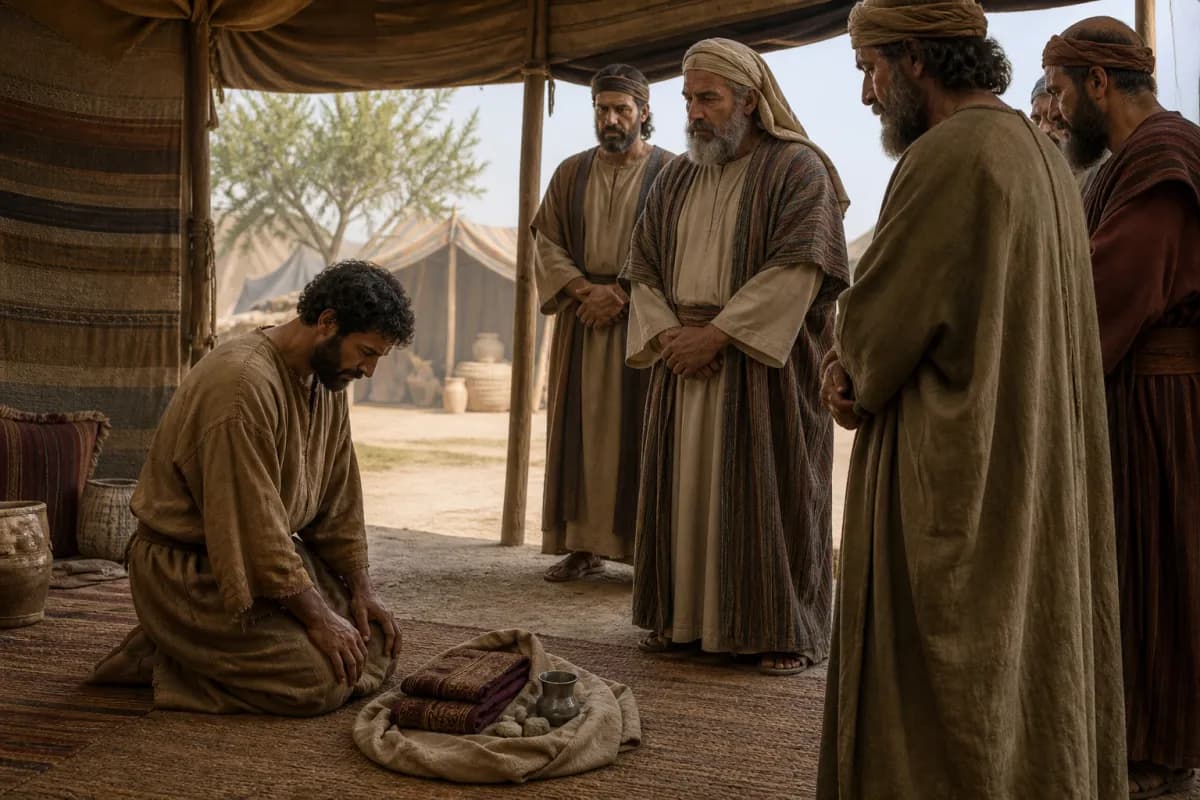
7:21When I saw among the plunder a beautiful Babylonian robe, two hundred shekels of silver, and a wedge of gold weighing fifty shekels, then I coveted them and took them. Behold, they are hidden in the ground in the middle of my tent, with the silver under it.”
7:22So Joshua sent messengers, and they ran to the tent. Behold, it was hidden in his tent, with the silver under it.
7:23They took them from the middle of the tent, and brought them to Joshua and to all the children of Israel. They laid them down before the LORD.
7:24Joshua, and all Israel with him, took Achan the son of Zerah, the silver, the robe, the wedge of gold, his sons, his daughters, his cattle, his donkeys, his sheep, his tent, and all that he had; and they brought them up to the valley of Achor.
7:25Joshua said, “Why have you troubled us? The LORD will trouble you today.” All Israel stoned him with stones, and they burned them with fire and stoned them with stones.
7:26They raised over him a great heap of stones that remains to this day. The LORD turned from the fierceness of his anger. Therefore the name of that place was called “The valley of Achor” to this day.
CONTEXTUAL OVERVIEW
The victory at Jericho is immediately followed by failure at the smaller city of Ai. Joshua’s scouts recommend a limited force because Ai appears weak, but the narrative opens with the hidden fact they cannot see: Achan has taken what was devoted to the Lord. Israel’s problem is not lack of intelligence or troop numbers; it is broken covenant loyalty.
Achan’s confession traces a deliberate sequence: he saw a beautiful cloak, silver, and gold; he coveted them; he took them; and he hid them in his tent. The story names the inner movement of sin instead of blaming an irresistible impulse. What is concealed from the camp remains exposed before the Lord.
HISTORICAL AND LITERARY CONTEXT
Joshua 7 directly follows the ban on Jericho’s goods in 6:17–19. Achan’s act is called a breach of faith because it appropriates what belongs to the Lord and makes the whole people vulnerable under the covenant. The chapter’s corporate language reflects Israel’s covenant identity; it should not be used to excuse punishing uninvolved people for another person’s private wrongdoing in ordinary civil life.
The Valley of Achor, “trouble,” receives its name from the judgment. Later prophets use Achor as a place where God can restore hope, showing that the Bible does not leave the place-name as a final word of despair. The judgment is severe precisely because the story insists that holy God cannot be made safe by victory or religious performance.
SECTION-BY-SECTION ANALYSIS
- Israel has sinned · Joshua 7:11The Lord treats Achan’s breach as a covenant wound in the people He has formed together.
- Saw, coveted, took, hid · Joshua 7:21Achan names the progression by which desire becomes concealed betrayal.
- Valley of Achor · Joshua 7:24The place of trouble memorializes the cost of taking for oneself what God had claimed.
CHRIST IN THIS PASSAGE
Joshua 7 does not make Achan a simple substitute for every sinner, nor does it allow Christians to transfer its covenant penalties directly into church discipline. Its enduring witness is that sin is real, destructive, and exposed before the holy God. Jesus takes that seriousness upon Himself at the cross, bearing the curse sin deserves so that guilty people may be forgiven rather than conceal themselves forever.
The gospel also creates a people who walk in the light. Christ’s grace is not permission to hide greed, sexual sin, or deception under religious success. He calls His church to confession, restoration, and truthful accountability because He has already secured mercy for those who come to Him.
REFLECTION
Achan’s tent warns against the fantasy of a contained sin. What seems private can drain courage, distort judgment, damage families, and weaken a community’s witness. The appropriate response is neither panic nor concealment but bringing the truth into the light before it hardens.
Name before Jesus what you have seen, coveted, taken, or hidden. Seek wise, trustworthy help where confession is needed. His cross is sufficient for forgiveness, and His Spirit forms the honest obedience that hidden sin resists.
Original Hebrew Word Study
Joshua 7:1
מָעַל
maal · H4604
Usually translated: breach of faith
Maal is a breach of faith. Achan’s hidden taking violates the devoted things and brings covenant consequences upon the whole community.
Follow the Scripture trail
Hidden Treachery and the Cost of Covenant Sin in the larger story
The connection: Achan’s hidden breach shows why a holy people cannot be sustained by outward victory. Jesus bears the curse of sin and forms a redeemed community that can confess wrongdoing and live in the light of His grace.
Respond to the passage
Stop protecting the sin you most want hidden. Bring it to Christ in confession and, where another person has been harmed or help is needed, take a truthful step toward repair and accountable discipleship.
- Why does the chapter connect Achan’s private theft to Israel’s public defeat?
- What does Achan’s confession reveal about the progress of sin?
- How does the cross give hope without weakening the chapter’s warning about hidden sin?
Prayer
Lord Jesus, You know what I hide and You bore sin’s curse to bring me near. Give me courage to confess, protect Your people from deceit, and form in us the truthfulness of Your grace. Amen.