Passage Study
The Burnt Offering: Drawing Near Through God’s Provision
Leviticus 1:1–1:17
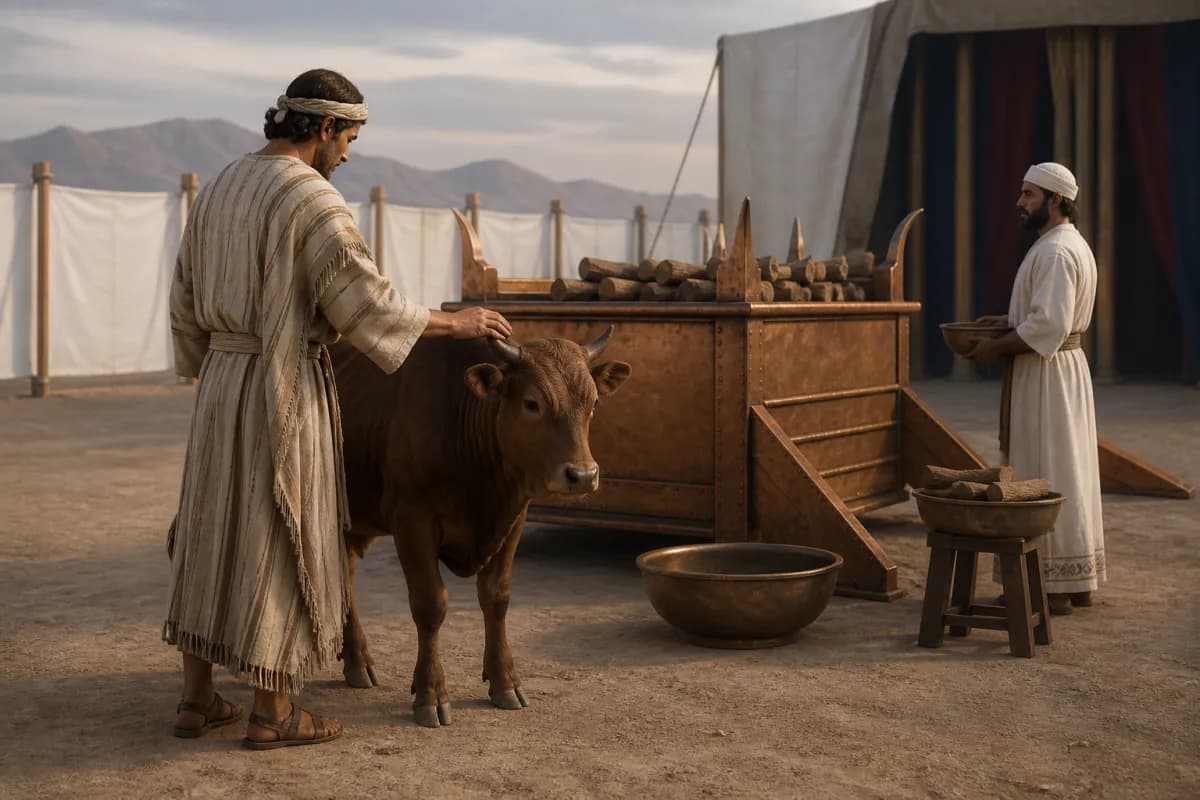
Leviticus 1:1–17 opens Israel’s sacrificial worship with an offering wholly consumed on the altar. The worshiper brings an unblemished animal, lays a hand on it, and sees its life given before the Lord. The rite teaches that approach to the holy God is received through the sacrifice He appoints, preparing the way for Jesus, who gives Himself once for sinners and brings them near to God.
- In this study
- 17 verses · 5 movements
Leviticus 1
1:1The LORD called to Moses, and spoke to him from the Tent of Meeting, saying,
1:2“Speak to the children of Israel, and tell them, ‘When anyone of you offers an offering to the LORD, you shall offer your offering of the livestock, from the herd and from the flock.
1:3“‘If his offering is a burnt offering from the herd, he shall offer a male without defect. He shall offer it at the door of the Tent of Meeting, that he may be accepted before the LORD.
1:4He shall lay his hand on the head of the burnt offering, and it shall be accepted for him to make atonement for him.
1:5He shall kill the bull before the LORD. Aaron’s sons, the priests, shall present the blood and sprinkle the blood around on the altar that is at the door of the Tent of Meeting.
1:6He shall skin the burnt offering and cut it into pieces.
1:7The sons of Aaron the priest shall put fire on the altar, and lay wood in order on the fire;
1:8and Aaron’s sons, the priests, shall lay the pieces, the head, and the fat in order on the wood that is on the fire which is on the altar;
1:9but he shall wash its innards and its legs with water. The priest shall burn all of it on the altar, for a burnt offering, an offering made by fire, of a pleasant aroma to the LORD.
1:10“‘If his offering is from the flock, from the sheep or from the goats, for a burnt offering, he shall offer a male without defect.
1:11He shall kill it on the north side of the altar before the LORD. Aaron’s sons, the priests, shall sprinkle its blood around on the altar.
1:12He shall cut it into its pieces, with its head and its fat. The priest shall lay them in order on the wood that is on the fire which is on the altar,
1:13but the innards and the legs he shall wash with water. The priest shall offer the whole, and burn it on the altar. It is a burnt offering, an offering made by fire, of a pleasant aroma to the LORD.
1:14“‘If his offering to the LORD is a burnt offering of birds, then he shall offer his offering from turtledoves or of young pigeons.
1:15The priest shall bring it to the altar, and wring off its head, and burn it on the altar; and its blood shall be drained out on the side of the altar;
1:16and he shall take away its crop and its feathers, and cast it beside the altar on the east part, in the place of the ashes.
1:17He shall tear it by its wings, but shall not divide it apart. The priest shall burn it on the altar, on the wood that is on the fire. It is a burnt offering, an offering made by fire, of a pleasant aroma to the LORD.
CONTEXTUAL OVERVIEW
Leviticus begins after the tabernacle has been erected and filled with God’s glory. Exodus ends with Moses unable to enter because the cloud covers the tent; Leviticus answers the urgent question that follows: how can a sinful people live near the God who has chosen to dwell among them?
The first word of the book is an invitation to bring an offering. Yet the invitation is governed by God’s instruction. The worshiper does not invent a way into God’s presence. A costly, unblemished life is presented at the entrance of the tent of meeting, where God provides a means of acceptance.
HISTORICAL AND LITERARY CONTEXT
The burnt offering stands first among the offerings because its entire animal is placed on the altar, apart from the skin given to the priest elsewhere in the law. Unlike a shared meal offering, nothing remains for the worshiper. Its total ascent expresses wholehearted presentation to the Lord through the sacrifice He has prescribed.
The three forms—herd, flock, and birds—make the same basic approach available across different levels of household resources. The text does not say that wealth purchases better access to God. Each offering must meet God’s requirement, and the provision of birds ensures that poverty does not bar an Israelite from worship.
SECTION-BY-SECTION ANALYSIS
- Without blemish · Leviticus 1:3The animal represents a costly and fitting gift; worship cannot treat the holy God as worthy of leftovers.
- Hand on the head · Leviticus 1:4The worshiper is personally identified with the offering brought on his behalf before the Lord.
- Blood at the altar · Leviticus 1:5Life is given in the place God appoints for approach, making reconciliation a gift rather than human achievement.
CHRIST IN THIS PASSAGE
Leviticus 1 is not a hidden code in which every piece of the animal predicts one detail of Jesus’ passion. Its stronger canonical witness is the pattern it establishes: access to God requires the sacrifice God provides, and the sacrifice must be whole and acceptable. The New Testament presents Jesus as the sinless one who offers Himself to God for us, fulfilling what repeated animal offerings could only enact provisionally.
Christ’s saving mission includes both atonement and consecration. By His death He bears sin and brings believers to God; by His grace He forms them into people who offer their whole selves in thankful obedience. The sacrifice does not teach self-salvation. It directs the worshiper first to God’s merciful provision and then to a life given back to Him.
REFLECTION
Leviticus challenges casual ideas of worship. God welcomes His people, but His welcome is holy, costly, and gracious. The question is not whether we can create enough sincerity to approach Him. The question is whether we receive the way He has opened.
Jesus makes that way secure. Those who trust Him do not bring a sacrifice to earn acceptance; they come because His sacrifice has opened access to the Father. That assurance gives ordinary obedience its proper shape: work, possessions, bodies, and desires become offerings of gratitude rather than attempts to purchase God’s love.
Original Hebrew Word Study
Leviticus 1:3
עֹלָה
olah · H5930
Usually translated: burnt offering
Olah is the offering that goes up in smoke. Its whole ascent pictures a life wholly yielded to God through the sacrifice He provides.
Follow the Scripture trail
The Burnt Offering: Drawing Near Through God’s Provision in the larger story
The connection: The first offering of Leviticus teaches that God Himself provides the way for His people to draw near. Jesus fulfills that saving purpose as the unblemished and final sacrifice whose death brings sinners into the Father’s presence and whose grace reshapes their whole lives.
Respond to the passage
Come to God through Jesus rather than through your performance. Then ask where gratitude can make your daily life a willing offering to the One who has already received you in Christ.
- Why does Leviticus begin with God’s invitation and instructions for sacrifice after the tabernacle is filled with His glory?
- What do the unblemished animal, the laying on of hands, and the blood at the altar communicate about approach to God?
- How does Jesus’ final sacrifice change the difference between offering yourself to God in gratitude and trying to earn His acceptance?
Prayer
Holy Father, thank You for opening a way for sinners to draw near through Jesus. Forgive my attempts to approach You on my own terms. Receive my life as a grateful response to Christ’s perfect sacrifice, and make my worship wholehearted. Amen.