Passage Study
Life, Cleansing, and Return: Purification After Childbirth
Leviticus 12:1–12:8
Leviticus 12:1–8 gives a mother a defined period of ritual uncleanness after childbirth and then provides offerings for her restoration to worship. The chapter does not call birth sinful or a child impure; it places the powerful realities of blood, birth, and mortality before the holy God who makes a way back. Jesus fulfills that saving purpose by bearing human uncleanness and bringing the excluded near.
- In this study
- 8 verses · 5 movements
Leviticus 12
12:1The LORD spoke to Moses, saying,
12:2“Speak to the children of Israel, saying, ‘If a woman conceives, and bears a male child, then she shall be unclean seven days; as in the days of her monthly period she shall be unclean.
12:3In the eighth day the flesh of his foreskin shall be circumcised.
12:4She shall continue in the blood of purification thirty-three days. She shall not touch any holy thing, nor come into the sanctuary, until the days of her purifying are completed.
12:5But if she bears a female child, then she shall be unclean two weeks, as in her period; and she shall continue in the blood of purification sixty-six days.
12:6“‘When the days of her purification are completed for a son or for a daughter, she shall bring to the priest at the door of the Tent of Meeting, a year old lamb for a burnt offering, and a young pigeon or a turtledove, for a sin offering.
12:7He shall offer it before the LORD, and make atonement for her; then she shall be cleansed from the fountain of her blood. “‘This is the law for her who bears, whether a male or a female.
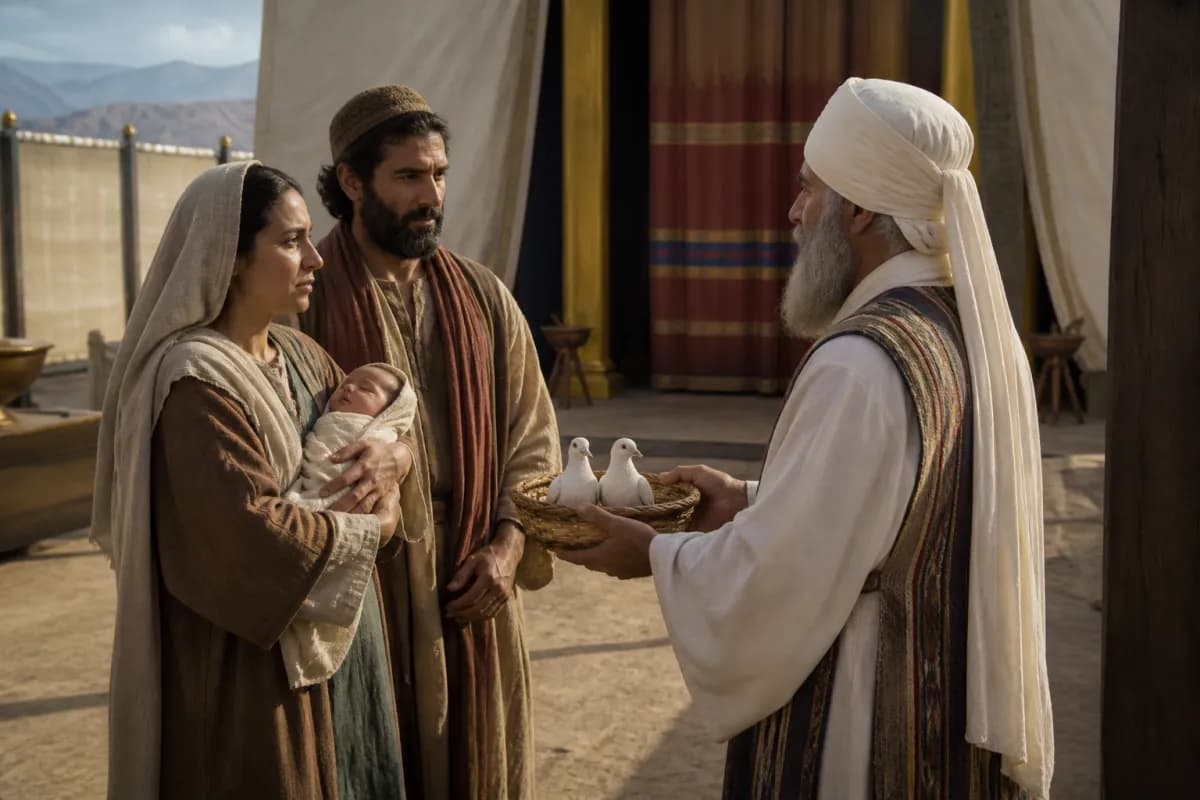
12:8If she cannot afford a lamb, then she shall take two turtledoves or two young pigeons: the one for a burnt offering, and the other for a sin offering. The priest shall make atonement for her, and she shall be clean.’”
CONTEXTUAL OVERVIEW
Leviticus 12 stands between the food laws of chapter 11 and the examinations for skin disease in chapters 13–14. Its concern is ritual status, not moral blame. The woman has given life, yet the blood associated with childbirth places her temporarily outside the sanctuary’s normal participation until God’s prescribed process of purification is complete.
The law gives careful limits rather than leaving a new mother in vague exclusion. It distinguishes the initial days of uncleanness from the longer period in which she remains at home before touching holy things or entering the sanctuary. At the end, she comes through sacrifice into restored fellowship.
HISTORICAL AND LITERARY CONTEXT
Israel’s worship was organized around the holy presence of the Lord in the camp. Conditions connected with blood, bodily discharge, and death required ritual boundaries because God is the source of life and Israel could not treat His presence casually. Those boundaries did not assign guilt to every bodily condition they named.
The final provision is especially revealing: a family unable to bring a lamb may bring two birds. God does not reserve restoration for those with greater means. Luke later notes that Mary and Joseph brought the offering of two birds after Jesus’ birth, locating the holy family within this merciful provision.
SECTION-BY-SECTION ANALYSIS
- Birth and blood · Leviticus 12:7The chapter treats childbirth with gravity because bodily life and its fragility are lived before the God of life.
- A defined return · Leviticus 12:4The days are limited; this is a God-given path to restoration, not an indefinite stigma.
- The poor offering · Leviticus 12:8Two birds make full restoration available to a household that cannot bring a lamb.
CHRIST IN THIS PASSAGE
Leviticus 12 does not predict a particular event in Jesus’ ministry, but its concern for holiness, cleansing, and restored approach prepares readers to see why the incarnation matters. Jesus enters the ordinary vulnerability of human birth and, in Luke 2, is presented in the temple by parents who keep this law. He stands with the people He came to save.
Jesus also crosses the boundary this chapter guards without becoming unclean Himself. When He touches those marked by sickness, death, or exclusion, His holiness brings cleansing and life. By His death He opens enduring access to God for sinners who could never make themselves clean enough to draw near.
REFLECTION
This passage forbids shame where God has not assigned shame. Childbirth is not presented as a moral failure; it is a profound human event that belongs under the care of the holy God. The law’s measured provisions protect both worship and the mother’s eventual return to the gathered people.
Jesus sees people whom others reduce to a condition, a limitation, or a cost. Receive His welcome when weakness makes you feel distant, and extend that welcome to a parent, a family under financial strain, or anyone whose participation in church life has become difficult.
Original Hebrew Word Study
Leviticus 12:8
טָהֵר
taher · H2891
Usually translated: to be clean or purified
Taher means to be cleansed. The offerings address ritual purification after childbirth, not moral blame for birth, and restore the mother to full participation in worship.
Follow the Scripture trail
Life, Cleansing, and Return: Purification After Childbirth in the larger story
The connection: The law gives a mother a merciful way back into Israel’s worship after childbirth. Jesus enters our embodied, vulnerable world and fulfills God’s saving purpose by cleansing people who cannot repair their own distance from Him.
Respond to the passage
Bring to Jesus one place where weakness or a season of care has made you feel sidelined. Ask Him to restore you to fellowship, then make one practical act of welcome toward someone carrying a hidden burden.
- Why is it important to distinguish ritual uncleanness from moral guilt in this chapter?
- What does the poor family’s bird offering reveal about God’s provision for restoration?
- How does Jesus’ welcome of the excluded change the way a church should care for new parents and vulnerable people?
Prayer
Lord Jesus, You entered our frail human life and welcome those who feel distant or overlooked. Remove false shame, restore weary people to fellowship, and make Your church a place where Your cleansing mercy is made visible. Amen.