Passage Study
A Holy Home: Defiling Marks in Houses
Leviticus 14:33–14:57
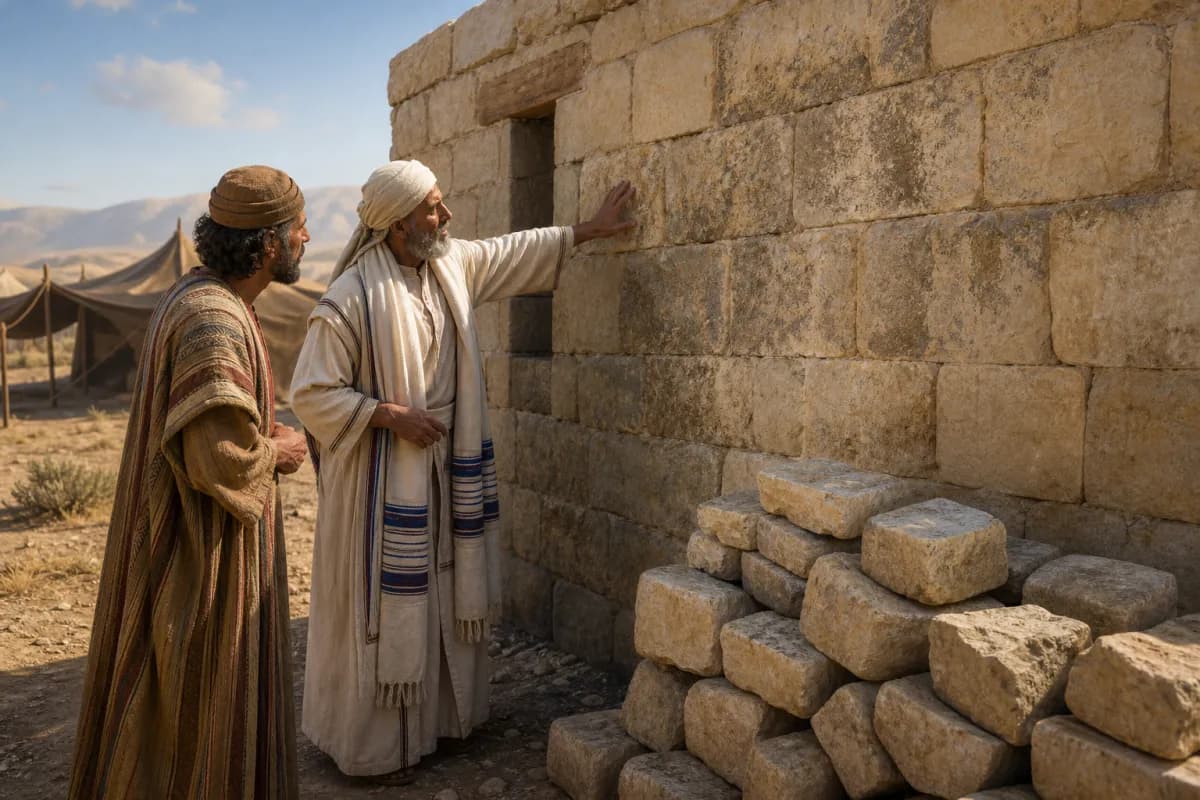
Leviticus 14:33–57 extends the concern for defiling marks from bodies and garments to an Israelite house in the promised land. The owner reports a suspicious greenish or reddish mark, the priest inspects it, and the house may be emptied, quarantined, repaired, or demolished. God’s holiness reaches shared spaces, and Jesus calls His people to honest cleansing that makes their homes and communities places of life.
- In this study
- 25 verses · 5 movements
Leviticus 14
14:33The LORD spoke to Moses and to Aaron, saying,
14:34“When you have come into the land of Canaan, which I give to you for a possession, and I put a spreading mildew in a house in the land of your possession,
14:35then he who owns the house shall come and tell the priest, saying, ‘There seems to me to be some sort of plague in the house.’
14:36The priest shall command that they empty the house, before the priest goes in to examine the plague, that all that is in the house not be made unclean. Afterward the priest shall go in to inspect the house.
14:37He shall examine the plague; and behold, if the plague is in the walls of the house with hollow streaks, greenish or reddish, and it appears to be deeper than the wall,
14:38then the priest shall go out of the house to the door of the house, and shut up the house seven days.
14:39The priest shall come again on the seventh day, and look. If the plague has spread in the walls of the house,
14:40then the priest shall command that they take out the stones in which is the plague, and cast them into an unclean place outside of the city.
14:41He shall cause the inside of the house to be scraped all over. They shall pour out the mortar that they scraped off outside of the city into an unclean place.
14:42They shall take other stones, and put them in the place of those stones; and he shall take other mortar, and shall plaster the house.
14:43“If the plague comes again, and breaks out in the house after he has taken out the stones, and after he has scraped the house, and after it was plastered,
14:44then the priest shall come in and look; and behold, if the plague has spread in the house, it is a destructive mildew in the house. It is unclean.
14:45He shall break down the house, its stones, and its timber, and all the house’s mortar. He shall carry them out of the city into an unclean place.
14:46“Moreover he who goes into the house while it is shut up shall be unclean until the evening.
14:47He who lies down in the house shall wash his clothes; and he who eats in the house shall wash his clothes.
14:48“If the priest shall come in, and examine it, and behold, the plague hasn’t spread in the house, after the house was plastered, then the priest shall pronounce the house clean, because the plague is healed.
14:49To cleanse the house he shall take two birds, cedar wood, scarlet, and hyssop.
14:50He shall kill one of the birds in an earthen vessel over running water.
14:51He shall take the cedar wood, the hyssop, the scarlet, and the living bird, and dip them in the blood of the slain bird, and in the running water, and sprinkle the house seven times.
14:52He shall cleanse the house with the blood of the bird, and with the running water, with the living bird, with the cedar wood, with the hyssop, and with the scarlet;
14:53but he shall let the living bird go out of the city into the open field. So shall he make atonement for the house; and it shall be clean.”
14:54This is the law for any plague of leprosy, and for an itch,
14:55and for the destructive mildew of a garment, and for a house,
14:56and for a swelling, and for a scab, and for a bright spot;
14:57to teach when it is unclean, and when it is clean. This is the law of leprosy.
CONTEXTUAL OVERVIEW
Leviticus has moved from the body to garments and now to a house. The chapter anticipates Israel living in the land rather than tents in the wilderness, yet the same question remains: how can a people live near the holy God? Shared spaces, not only private bodies, are brought under His care.
The homeowner does not hide the mark. He tells the priest, “There seems to me to be some sort of disease in my house.” That modest wording models truthful disclosure before certainty. A suspected danger is named early so that it can be examined rather than concealed until it spreads.
HISTORICAL AND LITERARY CONTEXT
The condition is described with the same broad language used in the surrounding purity laws. It should not be flattened into a modern diagnosis of mildew, mold, or a single building disease. The priest’s concern is ritual defilement and the preservation of a habitable covenant home, not an ancient substitute for a modern inspection code.
The procedure is graduated. First the house is emptied, so possessions are not declared unclean before the priest has inspected. The house is shut for seven days; if the mark spreads, affected stones and plaster are removed and taken outside the city. Only a recurring, spreading affliction leads to demolition.
SECTION-BY-SECTION ANALYSIS
- Report it early · Leviticus 14:36The owner brings a concern forward before he knows exactly what it is.
- Graduated response · Leviticus 14:35Emptying, waiting, repair, and only then demolition prevent both neglect and panic.
- A cleansed dwelling · Leviticus 14:51The bird rite joins the wellbeing of a household to God’s holiness and mercy.
CHRIST IN THIS PASSAGE
This law does not make a house a symbol that can be mechanically decoded, yet it presses a lasting truth: God’s holiness reaches the places where His people live together. Jesus calls His disciples to bring hidden works into the light, and His saving mission creates a household of faith where sin is confessed rather than protected.
Jesus also describes His own body as the true temple raised after destruction. In Him, access to God is no longer secured by managing a sacred building; He makes believers a dwelling place for God by the Spirit. That fulfillment does not make our homes morally irrelevant—it gives them a new calling as places that display His truth, hospitality, and mercy.
REFLECTION
A healthy household is not one that pretends no spreading mark exists. The homeowner in Leviticus 14 names what he sees and invites examination. Families, churches, and leaders can learn from that honesty: secret harm, addiction, exploitation, bitterness, and unsafe conditions grow worse when they are hidden.
Christ’s cleansing mercy gives courage to act early. Ask what needs truthful attention in your home, your habits, or a shared ministry space. Seek appropriate help, protect those at risk, and pursue repair that serves real peace rather than merely preserving appearances.
Original Hebrew Word Study
Leviticus 14:34
צָרַעַת
tsaraat · H6883
Usually translated: diseased affliction or defiling mark
Tsaraat is a defiling affliction. Its appearance in a house extends the concern for cleansing beyond an individual body to the shared spaces of covenant life.
Follow the Scripture trail
A Holy Home: Defiling Marks in Houses in the larger story
The connection: The house law teaches Israel that God cares about the places where covenant life is lived and that hidden defilement must be brought to light. Jesus makes His people God’s dwelling and sends them to build truthful, hospitable communities that point to His cleansing mercy.
Respond to the passage
Identify one “spreading mark” you have been tempted to minimize in your home, relationships, or ministry setting. Bring it into the light before Jesus and take the next wise step toward protection, help, and repair.
- Why does the owner report a suspected mark before knowing exactly what it is?
- What wisdom do you see in the law’s gradual response rather than immediate demolition?
- How does being God’s dwelling in Christ shape the way believers care for their homes and shared spaces?
Prayer
Lord Jesus, You are the true dwelling place of God with us. Give me courage to name what is harmful, wisdom to seek help, and grace to make my home and community a place of truth, safety, and welcome. Amen.