Passage Study
Near the God of Life: Bodily Discharges and Cleansing
Leviticus 15:1–15:33
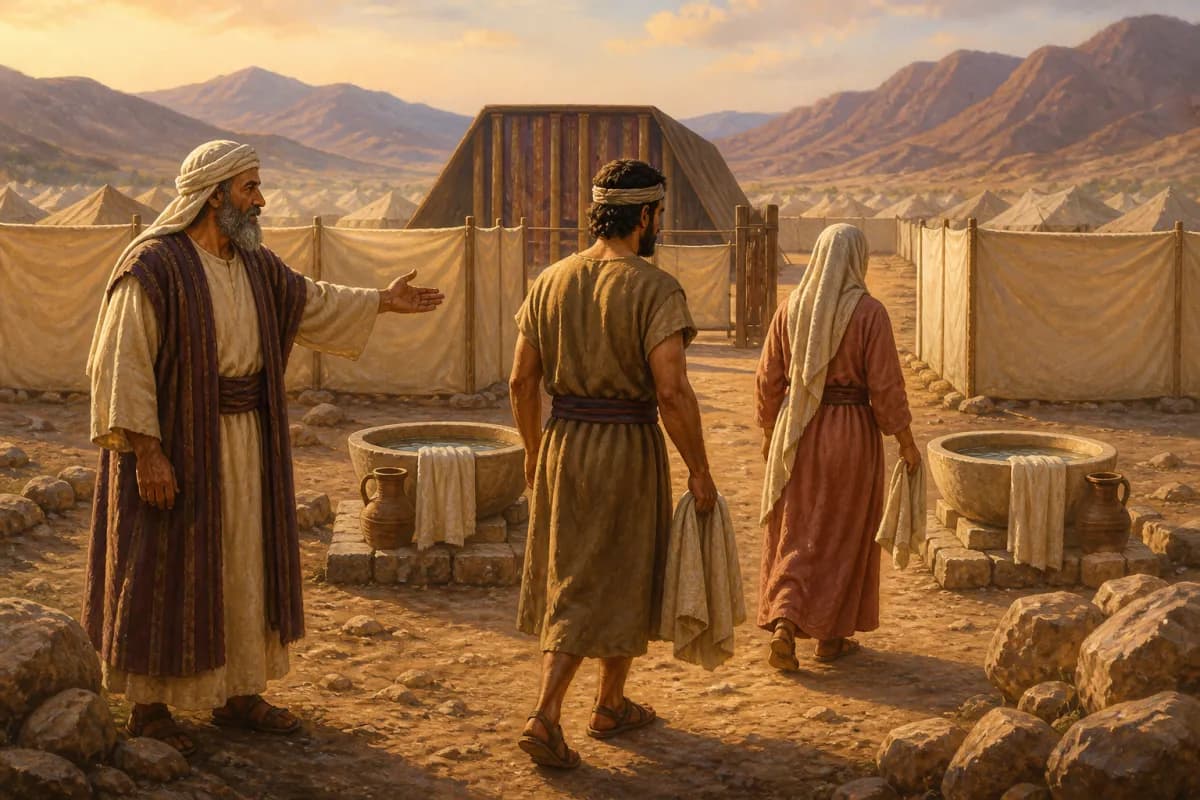
Leviticus 15:1–33 addresses male and female bodily discharges, distinguishing ordinary conditions from abnormal ones and prescribing washing, waiting, and offerings where required. The chapter does not treat embodiment as shameful; it teaches Israel to honor the God of life by recognizing that bodily frailty affects approach to His sanctuary. Jesus brings its saving hope to fulfillment by cleansing the unclean and granting lasting access to God.
- In this study
- 33 verses · 5 movements
Leviticus 15
15:1The LORD spoke to Moses and to Aaron, saying,
15:2“Speak to the children of Israel, and tell them, ‘When any man has a discharge from his body, because of his discharge he is unclean.
15:3This shall be his uncleanness in his discharge: whether his body runs with his discharge, or his body has stopped from his discharge, it is his uncleanness.
15:4“‘Every bed on which he who has the discharge lies shall be unclean; and everything he sits on shall be unclean.
15:5Whoever touches his bed shall wash his clothes, and bathe himself in water, and be unclean until the evening.
15:6He who sits on anything on which the man who has the discharge sat shall wash his clothes, and bathe himself in water, and be unclean until the evening.
15:7“‘He who touches the body of him who has the discharge shall wash his clothes, and bathe himself in water, and be unclean until the evening.
15:8“‘If he who has the discharge spits on him who is clean, then he shall wash his clothes, and bathe himself in water, and be unclean until the evening.
15:9“‘Whatever saddle he who has the discharge rides on shall be unclean.
15:10Whoever touches anything that was under him shall be unclean until the evening. He who carries those things shall wash his clothes, and bathe himself in water, and be unclean until the evening.
15:11“‘Whomever he who has the discharge touches, without having rinsed his hands in water, he shall wash his clothes, and bathe himself in water, and be unclean until the evening.
15:12“‘The earthen vessel, which he who has the discharge touches, shall be broken; and every vessel of wood shall be rinsed in water.
15:13“‘When he who has a discharge is cleansed of his discharge, then he shall count to himself seven days for his cleansing, and wash his clothes; and he shall bathe his flesh in running water, and shall be clean.
15:14“‘On the eighth day he shall take two turtledoves, or two young pigeons, and come before the LORD to the door of the Tent of Meeting, and give them to the priest.
15:15The priest shall offer them, the one for a sin offering, and the other for a burnt offering. The priest shall make atonement for him before the LORD for his discharge.
15:16“‘If any man has an emission of semen, then he shall bathe all his flesh in water, and be unclean until the evening.
15:17Every garment and every skin which the semen is on shall be washed with water, and be unclean until the evening.
15:18If a man lies with a woman and there is an emission of semen, they shall both bathe themselves in water, and be unclean until the evening.
15:19“‘If a woman has a discharge, and her discharge in her flesh is blood, she shall be in her impurity seven days. Whoever touches her shall be unclean until the evening.
15:20“‘Everything that she lies on in her impurity shall be unclean. Everything also that she sits on shall be unclean.
15:21Whoever touches her bed shall wash his clothes, and bathe himself in water, and be unclean until the evening.
15:22Whoever touches anything that she sits on shall wash his clothes, and bathe himself in water, and be unclean until the evening.
15:23If it is on the bed, or on anything she sits on, when he touches it, he shall be unclean until the evening.
15:24“‘If any man lies with her, and her monthly flow is on him, he shall be unclean seven days; and every bed he lies on shall be unclean.
15:25“‘If a woman has a discharge of her blood many days not in the time of her period, or if she has a discharge beyond the time of her period, all the days of the discharge of her uncleanness shall be as in the days of her period. She is unclean.
15:26Every bed she lies on all the days of her discharge shall be to her as the bed of her period. Everything she sits on shall be unclean, as the uncleanness of her period.
15:27Whoever touches these things shall be unclean, and shall wash his clothes and bathe himself in water, and be unclean until the evening.
15:28“‘But if she is cleansed of her discharge, then she shall count to herself seven days, and after that she shall be clean.
15:29On the eighth day she shall take two turtledoves, or two young pigeons, and bring them to the priest, to the door of the Tent of Meeting.
15:30The priest shall offer the one for a sin offering, and the other for a burnt offering; and the priest shall make atonement for her before the LORD for the uncleanness of her discharge.
15:31“‘Thus you shall separate the children of Israel from their uncleanness, so they will not die in their uncleanness when they defile my tabernacle that is among them.’”
15:32This is the law of him who has a discharge, and of him who has an emission of semen, so that he is unclean by it;
15:33and of her who has her period, and of a man or woman who has a discharge, and of him who lies with her who is unclean.
CONTEXTUAL OVERVIEW
Leviticus 15 speaks frankly about bodies. It names conditions Israel could not avoid and gives concrete instructions for washing, laundering, waiting, and, in longer cases, bringing an offering. The chapter’s conclusion explains its purpose: Israel must be kept from uncleanness so they do not defile the Lord’s tabernacle in their midst.
Ritual uncleanness is not identical to sin. Normal seminal emission and menstruation receive instructions without confession language or moral accusation. The chapter does teach that life’s bodily realities, especially those involving fluid and potential loss of life, require reverent boundaries near the dwelling of the holy God.
HISTORICAL AND LITERARY CONTEXT
The chapter completes a sequence of purity laws in Leviticus 11–15. It distinguishes conditions by duration and effect, and it carefully includes men and women. Modern medical categories should not be read backward into the text, but neither should its ritual categories be used to stigmatize illness, fertility, menstruation, or sexuality.
The instructions protect communal worship in a camp where God’s sanctuary is central. Washing and evening boundaries govern ordinary cases. For persistent discharges, seven clean days and two birds on the eighth day mark a fuller return to sanctuary life. God provides order and a route back rather than abandonment.
SECTION-BY-SECTION ANALYSIS
- No moral accusation · Leviticus 15:25Normal bodily processes are regulated as ritual realities, not presented as personal wrongdoing.
- Care for contact · Leviticus 15:15The laws make people attentive to how one person’s condition affects another person and shared objects.
- A way back · Leviticus 15:14Washing, waiting, and offerings give a defined route to renewed participation before God.
CHRIST IN THIS PASSAGE
The woman in Mark 5 had suffered bleeding for twelve years, a condition that would have made Leviticus 15 painfully personal. She touches Jesus’ garment in faith. Rather than becoming unclean, Jesus heals her and calls her “daughter,” restoring both her body and her public dignity.
That scene points beyond ritual restoration to Jesus’ saving mission. He takes the full weight of sin and death upon Himself without being conquered by them, and by His blood He grants a cleansing that reaches the conscience. Those who trust Him are welcomed into the Father’s presence with confidence, not dread.
REFLECTION
Churches can mishandle passages like this by attaching shame to conditions God does not call sin. Leviticus should produce reverence and care, not cruelty. People dealing with chronic illness, menstrual pain, infertility, sexual brokenness, or private bodily distress need truthful teaching and dignified support.
Jesus receives the woman who reaches for help in fear. Bring Him the condition or vulnerability you would rather hide. Then let His welcome shape how you speak about bodies and how you make room for people whose suffering is inconvenient, misunderstood, or invisible.
Original Hebrew Word Study
Leviticus 15:2
זָב
zav · H2100
Usually translated: a flow or discharge
Zav describes a bodily flow. These laws treat the realities of bodily life with seriousness and provide a path back to ritual cleanness without attaching personal shame to ordinary embodiment.
Follow the Scripture trail
Near the God of Life: Bodily Discharges and Cleansing in the larger story
The connection: Leviticus 15 teaches Israel to honor God’s holy presence amid the ordinary frailty of bodily life and to receive His path of restoration. Jesus meets people in that frailty, cleanses what separates them, and brings them into enduring fellowship with God.
Respond to the passage
Bring to Jesus a bodily weakness, fear, or shame you have carried alone. Ask Him for His restoring mercy, and consider how you can offer practical dignity and care to someone whose suffering is usually hidden.
- How does the chapter itself distinguish ritual uncleanness from moral guilt?
- Why does the conclusion connect these laws to the Lord’s tabernacle among Israel?
- What does Jesus’ response to the woman in Mark 5 teach about His heart toward people who feel unclean or exposed?
Prayer
Lord Jesus, You know the weakness and hidden pain of human bodies. Free me from false shame, draw me near by Your cleansing grace, and make me compassionate toward those who suffer in silence. Amen.