Passage Study
One Day Before the Holy God: The Day of Atonement
Leviticus 16:1–16:34
Leviticus 16:1–34 appoints Israel’s annual Day of Atonement after the death of Nadab and Abihu. The high priest enters the most holy place only through God’s commanded sacrifices; one goat is sacrificed and another carries Israel’s confessed sins away. The chapter establishes the need for a God-provided mediator and cleansing, which Jesus fulfills by offering Himself once for all and bringing His people to God.
- In this study
- 34 verses · 5 movements
Leviticus 16
16:1The LORD spoke to Moses after the death of the two sons of Aaron, when they came near before the LORD, and died;
16:2and the LORD said to Moses, “Tell Aaron your brother not to come at just any time into the Most Holy Place within the veil, before the mercy seat which is on the ark; lest he die; for I will appear in the cloud on the mercy seat.
16:3“Aaron shall come into the sanctuary with a young bull for a sin offering, and a ram for a burnt offering.
16:4He shall put on the holy linen tunic. He shall have the linen trousers on his body, and shall put on the linen sash, and he shall be clothed with the linen turban. They are the holy garments. He shall bathe his body in water, and put them on.
16:5He shall take from the congregation of the children of Israel two male goats for a sin offering, and one ram for a burnt offering.
16:6“Aaron shall offer the bull of the sin offering, which is for himself, and make atonement for himself and for his house.
16:7He shall take the two goats, and set them before the LORD at the door of the Tent of Meeting.
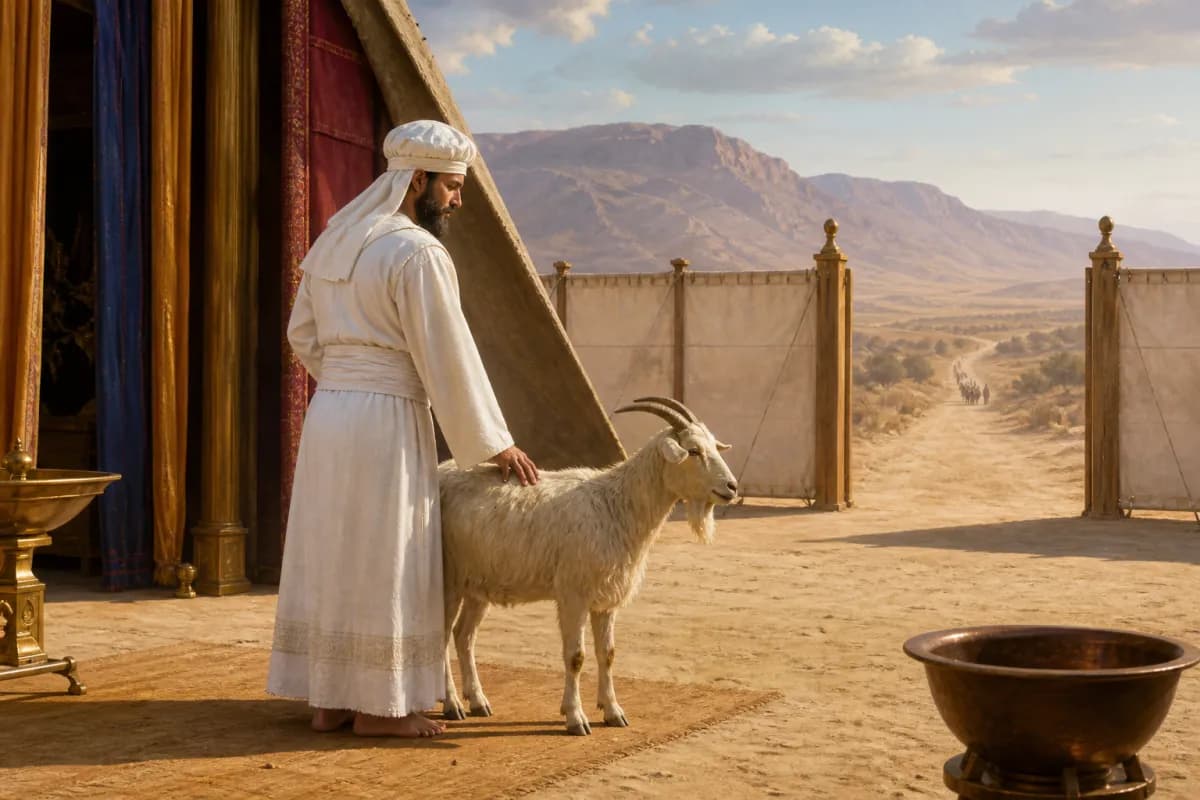
16:8Aaron shall cast lots for the two goats: one lot for the LORD, and the other lot for the scapegoat.
16:9Aaron shall present the goat on which the lot fell for the LORD, and offer him for a sin offering.
16:10But the goat on which the lot fell for the scapegoat shall be presented alive before the LORD, to make atonement for him, to send him away as the scapegoat into the wilderness.
16:11“Aaron shall present the bull of the sin offering, which is for himself, and shall make atonement for himself and for his house, and shall kill the bull of the sin offering which is for himself.
16:12He shall take a censer full of coals of fire from off the altar before the LORD, and two handfuls of sweet incense beaten small, and bring it within the veil.
16:13He shall put the incense on the fire before the LORD, that the cloud of the incense may cover the mercy seat that is on the covenant, so that he will not die.
16:14He shall take some of the blood of the bull, and sprinkle it with his finger on the mercy seat on the east; and before the mercy seat he shall sprinkle some of the blood with his finger seven times.
16:15“Then he shall kill the goat of the sin offering that is for the people, and bring his blood within the veil, and do with his blood as he did with the blood of the bull, and sprinkle it on the mercy seat and before the mercy seat.
16:16He shall make atonement for the Holy Place, because of the uncleanness of the children of Israel, and because of their transgressions, even all their sins; and so he shall do for the Tent of Meeting that dwells with them in the middle of their uncleanness.
16:17No one shall be in the Tent of Meeting when he enters to make atonement in the Holy Place, until he comes out, and has made atonement for himself and for his household, and for all the assembly of Israel.
16:18“He shall go out to the altar that is before the LORD and make atonement for it, and shall take some of the bull’s blood, and some of the goat’s blood, and put it around on the horns of the altar.
16:19He shall sprinkle some of the blood on it with his finger seven times, and cleanse it, and make it holy from the uncleanness of the children of Israel.
16:20“When he has finished atoning for the Holy Place, the Tent of Meeting, and the altar, he shall present the live goat.
16:21Aaron shall lay both his hands on the head of the live goat, and confess over him all the iniquities of the children of Israel, and all their transgressions, even all their sins; and he shall put them on the head of the goat, and shall send him away into the wilderness by the hand of a man who is ready.
16:22The goat shall carry all their iniquities on himself to a solitary land, and he shall release the goat in the wilderness.
16:23“Aaron shall come into the Tent of Meeting, and shall take off the linen garments which he put on when he went into the Holy Place, and shall leave them there.
16:24Then he shall bathe himself in water in a holy place, put on his garments, and come out and offer his burnt offering and the burnt offering of the people, and make atonement for himself and for the people.
16:25The fat of the sin offering he shall burn on the altar.
16:26“He who lets the goat go as the scapegoat shall wash his clothes, and bathe his flesh in water, and afterward he shall come into the camp.
16:27The bull for the sin offering, and the goat for the sin offering, whose blood was brought in to make atonement in the Holy Place, shall be carried outside the camp; and they shall burn their skins, their flesh, and their dung with fire.
16:28He who burns them shall wash his clothes, and bathe his flesh in water, and afterward he shall come into the camp.
16:29“It shall be a statute to you forever: in the seventh month, on the tenth day of the month, you shall afflict your souls, and shall do no kind of work, whether native-born or a stranger who lives as a foreigner among you;
16:30for on this day shall atonement be made for you, to cleanse you. You shall be clean from all your sins before the LORD.
16:31It is a Sabbath of solemn rest to you, and you shall afflict your souls. It is a statute forever.
16:32The priest, who is anointed and who is consecrated to be priest in his father’s place, shall make the atonement, and shall put on the linen garments, even the holy garments.
16:33Then he shall make atonement for the Holy Sanctuary; and he shall make atonement for the Tent of Meeting and for the altar; and he shall make atonement for the priests and for all the people of the assembly.
16:34“This shall be an everlasting statute for you, to make atonement for the children of Israel once in the year because of all their sins.” It was done as the LORD commanded Moses.
CONTEXTUAL OVERVIEW
Leviticus 16 begins with a warning shaped by grief: Nadab and Abihu died when they came near the Lord contrary to His command. The question is not whether Israel needs God near, but how sinful people can survive before His holy presence. God answers with one carefully ordered day of cleansing rather than casual access.
The rite reaches farther than an individual worshiper. It addresses Aaron, his house, the sanctuary, the altar, and the people. Israel’s sin has consequences in the very place where God dwells among them, so God provides atonement that cleanses both people and sacred space.
HISTORICAL AND LITERARY CONTEXT
The chapter stands at the center of Leviticus, after the laws of sacrifice, priesthood, and purity and before the call to holy living. Its annual rhythm teaches that Israel cannot manage sin merely by ordinary routines; the nation needs God’s repeated mercy and a priest who acts according to His word.
The live goat is sent “for Azazel,” a phrase whose precise meaning is debated. The passage’s clear point does not depend on solving that question: after Aaron confesses Israel’s iniquities over it, the goat bears them away into an uninhabited region. Sin is dealt with by God’s provision, not denied or left in the camp.
SECTION-BY-SECTION ANALYSIS
- Behind the curtain · Leviticus 16:1The restricted entry shows that God’s presence is a gift to be approached only by His appointed way.
- Blood and confession · Leviticus 16:15The rite joins sacrificial life given before God with the honest naming and removal of the people’s sins.
- A humbled people · Leviticus 16:24Israel rests and humbles itself because atonement is received from God, not achieved by its effort.
CHRIST IN THIS PASSAGE
The New Testament directly uses this day to explain Jesus’ priestly work. Hebrews says Christ entered the greater heavenly sanctuary by His own blood, not by repeated animal blood, securing eternal redemption. Leviticus does not reduce Jesus to one detail of either goat; together its sacrifices establish the pattern of sin’s cost, cleansing, and removal that His once-for-all offering fulfills.
Jesus is also the sinless mediator Aaron could never be. He does not first offer for His own sins, and His saving mission reaches the conscience as well as the sanctuary. Those who trust Him can confess sin honestly because He has borne its judgment and opened the way to the Father.
REFLECTION
We often try to carry sin by hiding it, excusing it, or punishing ourselves indefinitely. The live goat teaches a different posture: sin must be named before God and removed by His mercy. The day’s solemnity keeps forgiveness from becoming shallow, while its provision keeps guilt from becoming hopeless.
Come to Jesus with a concrete sin rather than a vague sense of failure. Receive His finished work, make restitution where love requires it, and let His mercy free you to invite another burdened person toward the same Savior.
Original Hebrew Word Study
Leviticus 16:30
כָּפַר
kaphar · H3722
Usually translated: to make atonement or cover
Kaphar is the root of atonement. On this day God provides cleansing for priest, sanctuary, and people, so their continued life near Him rests on His mercy rather than their own adequacy.
Follow the Scripture trail
One Day Before the Holy God: The Day of Atonement in the larger story
The connection: Israel’s holiest day declares that only God can cleanse sin and sustain life near His presence. Jesus fulfills that saving purpose as the sinless High Priest and final sacrifice who brings forgiven people to God.
Respond to the passage
Name one actual sin before Jesus without minimizing it. Thank Him that His sacrifice is sufficient, then take one truthful step toward repentance, reconciliation, or accountability.
- Why does Aaron need atonement for himself before he serves the people?
- How do the sacrificed goat and the goat sent away together portray what sin requires and what God provides?
- How does Hebrews change the way Christians receive the Day of Atonement without treating it as obsolete or trivial?
Prayer
Lord Jesus, You are the sinless High Priest who has opened the way to God. Teach me to confess without hiding, receive Your mercy without self-salvation, and walk in the freedom Your sacrifice has won. Amen.