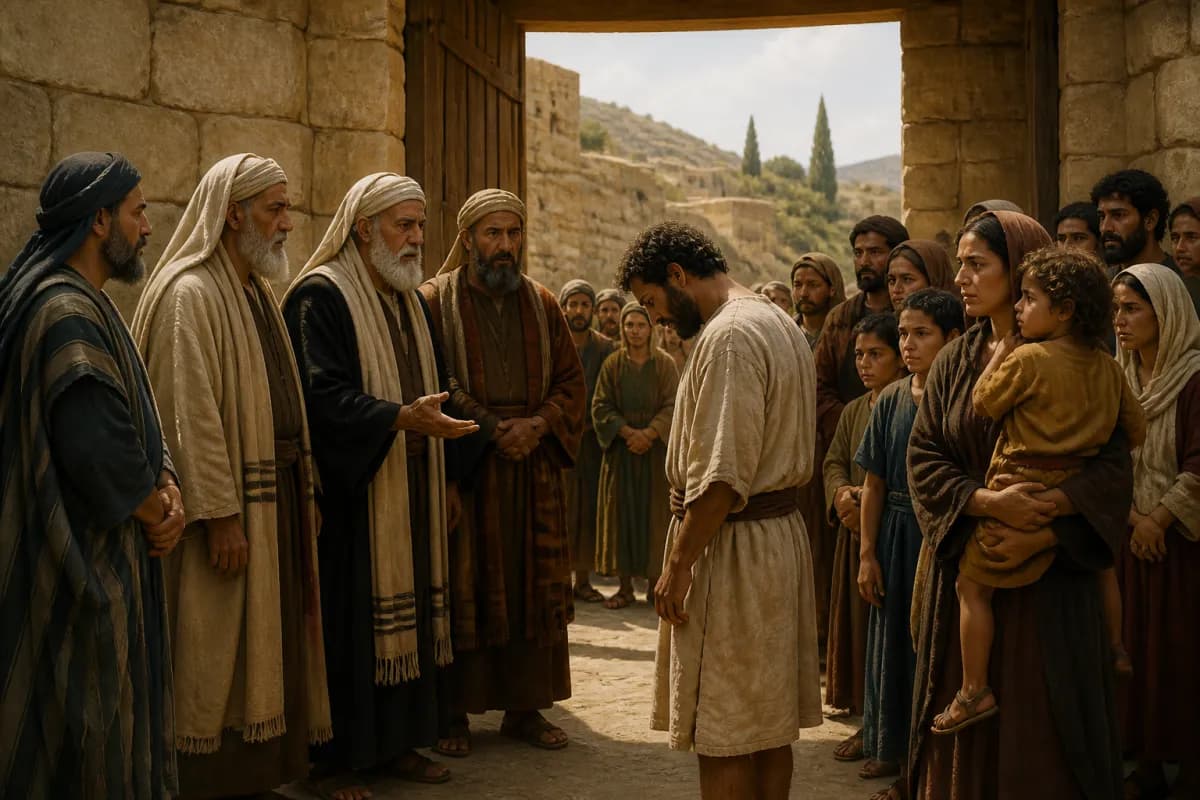
Passage Study
A Holy People Under God’s Judgment: Covenant Unfaithfulness
Leviticus 20:1–20:27
Leviticus 20:1–27 attaches severe covenant penalties to child sacrifice, occult practices, and the sexual sins named in the preceding chapter. The passage reveals that idolatry and exploitation destroy the people God has set apart. Its judgments cannot be casually transferred into Christian civil enforcement; they press every reader toward the holy Judge and toward Jesus, who bears sin’s judgment and creates a people set apart for God.
- In this study
- 27 verses · 5 movements
Leviticus 20
20:1The LORD spoke to Moses, saying,
20:2“Moreover, you shall tell the children of Israel, ‘Anyone of the children of Israel, or of the strangers who live as foreigners in Israel, who gives any of his offspring to Molech shall surely be put to death. The people of the land shall stone that person with stones.
20:3I also will set my face against that person, and will cut him off from among his people, because he has given of his offspring to Molech, to defile my sanctuary, and to profane my holy name.
20:4If the people of the land all hide their eyes from that person when he gives of his offspring to Molech, and don’t put him to death,
20:5then I will set my face against that man and against his family, and will cut him off, and all who play the prostitute after him to play the prostitute with Molech, from among their people.
20:6“‘The person that turns to those who are mediums and wizards, to play the prostitute after them, I will even set my face against that person, and will cut him off from among his people.
20:7“‘Sanctify yourselves therefore, and be holy; for I am the LORD your God.
20:8You shall keep my statutes, and do them. I am the LORD who sanctifies you.
20:9“‘For everyone who curses his father or his mother shall surely be put to death. He has cursed his father or his mother. His blood shall be upon himself.
20:10“‘The man who commits adultery with another man’s wife, even he who commits adultery with his neighbor’s wife, the adulterer and the adulteress shall surely be put to death.
20:11“‘The man who lies with his father’s wife has uncovered his father’s nakedness. Both of them shall surely be put to death. Their blood shall be upon themselves.
20:12“‘If a man lies with his daughter-in-law, both of them shall surely be put to death. They have committed a perversion. Their blood shall be upon themselves.
20:13“‘If a man lies with a male, as with a woman, both of them have committed an abomination. They shall surely be put to death. Their blood shall be upon themselves.
20:14“‘If a man takes a wife and her mother, it is wickedness. They shall be burned with fire, both he and they, that there may be no wickedness among you.
20:15“‘If a man lies with an animal, he shall surely be put to death; and you shall kill the animal.
20:16“‘If a woman approaches any animal and lies with it, you shall kill the woman and the animal. They shall surely be put to death. Their blood shall be upon them.
20:17“‘If a man takes his sister—his father’s daughter, or his mother’s daughter—and sees her nakedness, and she sees his nakedness, it is a shameful thing. They shall be cut off in the sight of the children of their people. He has uncovered his sister’s nakedness. He shall bear his iniquity.
20:18“‘If a man lies with a woman having her monthly period, and uncovers her nakedness, he has made her fountain naked, and she has uncovered the fountain of her blood. Both of them shall be cut off from among their people.
20:19“‘You shall not uncover the nakedness of your mother’s sister, nor of your father’s sister, for he has made his close relative naked. They shall bear their iniquity.
20:20If a man lies with his uncle’s wife, he has uncovered his uncle’s nakedness. They shall bear their sin. They shall die childless.
20:21“‘If a man takes his brother’s wife, it is an impurity. He has uncovered his brother’s nakedness. They shall be childless.
20:22“‘You shall therefore keep all my statutes and all my ordinances, and do them, that the land where I am bringing you to dwell may not vomit you out.
20:23You shall not walk in the customs of the nation which I am casting out before you; for they did all these things, and therefore I abhorred them.
20:24But I have said to you, “You shall inherit their land, and I will give it to you to possess it, a land flowing with milk and honey.” I am the LORD your God, who has separated you from the peoples.
20:25“‘You shall therefore make a distinction between the clean animal and the unclean, and between the unclean fowl and the clean. You shall not make yourselves abominable by animal, or by bird, or by anything with which the ground teems, which I have separated from you as unclean for you.
20:26You shall be holy to me, for I, the LORD, am holy, and have set you apart from the peoples, that you should be mine.
20:27“‘A man or a woman that is a medium or is a wizard shall surely be put to death. They shall be stoned with stones. Their blood shall be upon themselves.’”
CONTEXTUAL OVERVIEW
Leviticus 20 returns to the sins listed in chapter 18 and states their covenant seriousness. The chapter begins with Molech, where children are given over in an act of idolatry, and repeatedly names practices that profane God’s name and corrupt the people. Holiness has consequences because Israel belongs to the Lord who lives among it.
The penalties are difficult and must not be handled carelessly. They belong to Israel’s covenant life as a holy nation under God’s direct law. The chapter does not authorize Christians to take vengeance or to bypass the justice, mercy, and church discipline taught in the New Testament. It does reveal that evil is more destructive than modern moral indifference admits.
HISTORICAL AND LITERARY CONTEXT
Chapter 20 follows the moral prohibitions of chapter 18 and echoes the call to holiness in chapter 19. Its judicial language protects Israel’s worship and social life from practices that involve idolatry, family violation, exploitation, and occult allegiance. The repeated formula “I will set my face against” emphasizes that these are offenses against the Lord Himself.
The closing distinction between clean and unclean animals recalls the earlier purity laws. It widens the chapter’s point: Israel’s separateness is not sustained only by spectacular court cases but by a whole pattern of life. God’s choosing grace—“I have separated you from the peoples”—is the foundation for the call to be holy.
SECTION-BY-SECTION ANALYSIS
- Do not look away · Leviticus 20:19The Molech command holds the community accountable when it tolerates violence against the vulnerable.
- God sets His face · Leviticus 20:7Idolatry and occult allegiance are personal betrayal of the covenant Lord, not spiritually neutral alternatives.
- Separated for holiness · Leviticus 20:24God’s prior claim on Israel provides the reason and power for a distinct way of life.
CHRIST IN THIS PASSAGE
Leviticus 20 exposes the judgment sin deserves and the inability of a people to make itself holy by warning alone. Jesus does not soften God’s opposition to evil; He calls for radical repentance and announces final judgment. Yet at the cross He bears the curse of sin for those who trust Him, so that condemned sinners may be forgiven and made holy.
Christ’s saving mission creates a people whose separation is no longer maintained by Israel’s civil penalties but by belonging to Him. The church is called to protect the vulnerable, reject idolatry, practice discipline with restoration in view, and bear witness to the holy mercy of the One who rescues people from darkness.
REFLECTION
This chapter forbids sentimental views of evil. To ignore exploitation, abuse, occult bondage, or destructive sexual sin is not compassion. It is also not faithfulness to use Scripture as a weapon against selected people while excusing our own hidden loyalties. God calls His people to truthful protection of the vulnerable and humble repentance.
Bring your fear of judgment and your actual sin to Jesus. His mercy is not denial; it is costly rescue. Ask Him to make you alert where someone needs protection, clear where spiritual compromise has been normalized, and patient in helping a repentant person walk toward restoration.
Original Hebrew Word Study
Leviticus 20:3
חָלַל
chalal · H2490
Usually translated: to profane or treat as common
Chalal means to profane. Covenant rebellion treats the Lord’s holy name as common, so the penalties show the destructive seriousness of giving worship and loyalty to other gods.
Follow the Scripture trail
A Holy People Under God’s Judgment: Covenant Unfaithfulness in the larger story
The connection: Leviticus 20 reveals the holy Judge’s opposition to idolatry and destructive rebellion while calling a redeemed people to protect life and live differently. Jesus bears sin’s judgment and forms a holy people who show His rescuing mercy in the world.
Respond to the passage
Ask Jesus to show you where silence, compromise, or selective judgment has weakened your love of holiness. Turn from it, seek help if sin has become entrenched, and take one concrete step to protect or serve someone vulnerable.
- Why does the chapter make the whole community responsible when violence against children is tolerated?
- How do the closing clean-and-unclean commands connect everyday life with covenant holiness?
- Why must Christians receive this chapter’s moral seriousness without treating Israel’s civil penalties as a direct church or state program?
Prayer
Holy God, You see the evil people hide and the vulnerable people others overlook. Through Jesus forgive my sin, deliver me from compromise, and make me courageous in truth, protection, repentance, and mercy. Amen.