Passage Study
The Land’s Sabbath: Trusting the God Who Provides
Leviticus 25:1–25:7
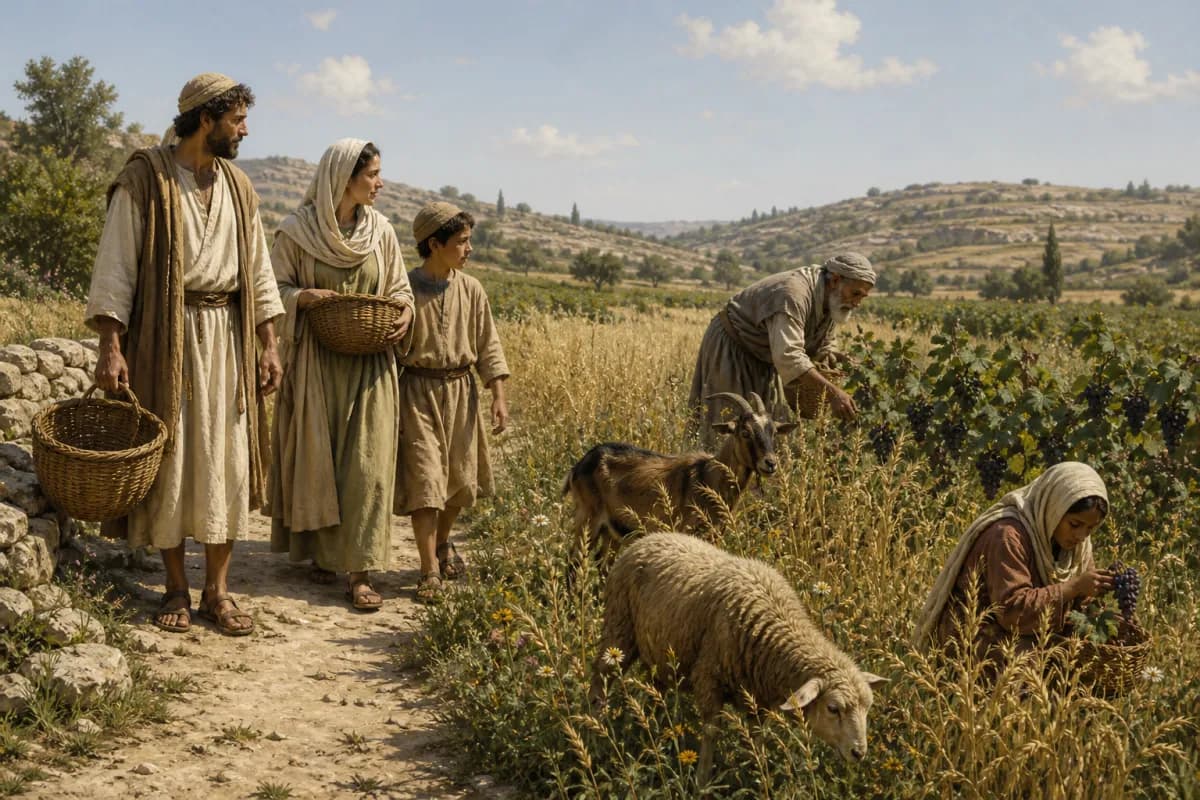
Leviticus 25:1–7 commands Israel to let the land rest every seventh year. Fields and vineyards are not driven without limit; their spontaneous growth is shared with household, worker, resident alien, livestock, and wild animals. The Sabbath year teaches that the land belongs to God and that His people live by received provision, a truth fulfilled in Jesus, who frees His people from anxious self-sufficiency and teaches generous trust.
- In this study
- 7 verses · 5 movements
Leviticus 25
25:1The LORD said to Moses on Mount Sinai,
25:2“Speak to the children of Israel, and tell them, ‘When you come into the land which I give you, then the land shall keep a Sabbath to the LORD.
25:3You shall sow your field six years, and you shall prune your vineyard six years, and gather in its fruits;
25:4but in the seventh year there shall be a Sabbath of solemn rest for the land, a Sabbath to the LORD. You shall not sow your field or prune your vineyard.
25:5What grows of itself in your harvest you shall not reap, and you shall not gather the grapes of your undressed vine. It shall be a year of solemn rest for the land.
25:6The Sabbath of the land shall be for food for you; for yourself, for your servant, for your maid, for your hired servant, and for your stranger, who lives as a foreigner with you.
25:7For your livestock also, and for the animals that are in your land, shall all its increase be for food.
CONTEXTUAL OVERVIEW
Leviticus 25 begins on Sinai but looks ahead to life in the land. Israel will farm real fields and vineyards, yet it must never imagine that settled agriculture makes it independent. Every seventh year, the normal rhythm of sowing, pruning, reaping, and gathering stops because the land is to keep a Sabbath for the Lord.
The command is strikingly material. Sabbath trust is not only a private feeling or a sanctuary service. It reaches soil, seed, food stores, employment, and the people who rely on a household’s fields. The land’s rest declares that Israel’s future rests with its covenant God rather than with ceaseless extraction.
HISTORICAL AND LITERARY CONTEXT
The chapter follows the festival calendar and extends Sabbath from a weekly day to a seven-year agricultural pattern. In an agrarian society, leaving a field unsown carried an obvious economic risk. The command therefore trains Israel to remember that its food comes ultimately from the Lord who gives the land, rain, fertility, and strength to work.
The Sabbath year also widens access to what grows on its own. The household, male and female servants, hired workers, resident aliens, cattle, and wild animals may eat. The passage does not give modern farming policy in detail, but its covenant principle is clear: God’s provision is not to be hoarded as though land and harvest existed solely for the owner’s gain.
SECTION-BY-SECTION ANALYSIS
- Six years and one · Leviticus 25:3Ordinary labor is affirmed, but the seventh year interrupts the illusion that human effort is ultimate.
- A Sabbath for the land · Leviticus 25:6The land belongs to the Lord and is included in Israel’s covenant life rather than treated as an unlimited possession.
- Food for all · Leviticus 25:7Spontaneous growth is shared across household, worker, resident alien, livestock, and wildlife.
CHRIST IN THIS PASSAGE
The Sabbath year is not a hidden agricultural prediction of Jesus, and the New Testament does not impose its civil rule on the church. Its God-given pattern exposes a deeper bondage: sinners try to secure life through possession and relentless control. Jesus meets that bondage by reconciling people to the Father and teaching them to seek God’s kingdom before anxious accumulation.
Christ’s saving mission also gives generosity a new center. He supplies His people with grace and sends them to care for the vulnerable rather than treating money, land, or productivity as ultimate. Christian stewardship cannot be reduced to a sabbatical calendar, but it should visibly confess that creation and provision belong to the Lord who gave Himself for us.
REFLECTION
The Sabbath year asks what our work is for. Productivity can be faithful service, but it becomes cruel when it demands every season, consumes every margin, and treats dependents or creation as fuel. God’s command gives His people permission to trust Him enough to stop.
Receive your work and possessions from Jesus rather than using them to prove your worth. Consider a concrete practice of rest, fair provision, open-handed sharing, or care for the limits of people and resources under your responsibility. Let that practice point beyond you to the God who provides.
Original Hebrew Word Study
Leviticus 25:4
שַׁבָּתוֹן
shabbaton · H7677
Usually translated: solemn rest
Shabbaton is a solemn rest. The land itself is given a Sabbath, teaching Israel that even their fields remain the Lord’s gift and cannot be driven without limit.
Follow the Scripture trail
The Land’s Sabbath: Trusting the God Who Provides in the larger story
The connection: The land’s Sabbath teaches Israel that soil, food, and future come from the Lord and are meant to sustain a whole community. Jesus reconciles anxious sinners to the Father and sends them into His mission as generous witnesses to God’s care.
Respond to the passage
Name one area where scarcity or ambition has made you grasp for control. Bring it to Jesus, then choose a concrete practice of rest, generosity, or fair care for someone affected by your work.
- Why is the Sabbath year given to the land as well as to Israel’s workers?
- Who benefits from the spontaneous growth in the seventh year, and what does that reveal about ownership?
- How can Christians practice faithful work and genuine trust without simply recreating Israel’s agricultural law?
Prayer
Provider of every good gift, forgive my anxious grasping and my tendency to treat Your gifts as mine alone. Thank You for Jesus, who brings me to You by grace. Teach me to work faithfully, rest trustingly, and share generously with those You place near me. Amen.