Passage Study
Jubilee: Liberty, Return, and the Lord’s Ownership
Leviticus 25:8–25:55
Leviticus 25:8–55 proclaims a fiftieth-year Jubilee in which liberty is announced, ancestral property returns, and Israelites enslaved by poverty may be redeemed. The law interrupts permanent loss because land and people belong to the Lord. Jesus announces the good news of God’s liberating kingdom and redeems people from slavery to sin, forming a family marked by mercy, truthful economics, and hope.
- In this study
- 48 verses · 5 movements
Leviticus 25
25:8“‘You shall count off seven Sabbaths of years, seven times seven years; and there shall be to you the days of seven Sabbaths of years, even forty-nine years.
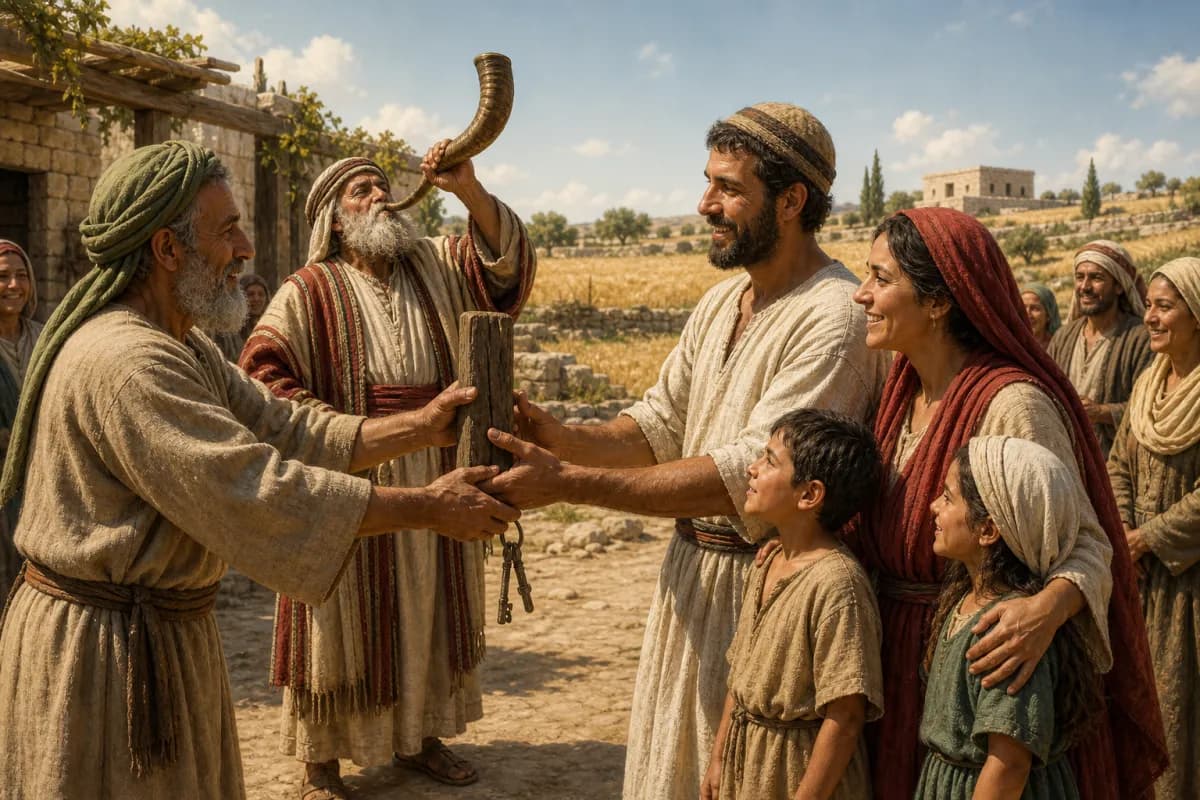
25:9Then you shall sound the loud trumpet on the tenth day of the seventh month. On the Day of Atonement you shall sound the trumpet throughout all your land.
25:10You shall make the fiftieth year holy, and proclaim liberty throughout the land to all its inhabitants. It shall be a jubilee to you; and each of you shall return to his own property, and each of you shall return to his family.
25:11That fiftieth year shall be a jubilee to you. In it you shall not sow, neither reap that which grows of itself, nor gather from the undressed vines.
25:12For it is a jubilee; it shall be holy to you. You shall eat of its increase out of the field.
25:13“‘In this Year of Jubilee each of you shall return to his property.
25:14“‘If you sell anything to your neighbor, or buy from your neighbor, you shall not wrong one another.
25:15According to the number of years after the Jubilee you shall buy from your neighbor. According to the number of years of the crops he shall sell to you.
25:16According to the length of the years you shall increase its price, and according to the shortness of the years you shall diminish its price; for he is selling the number of the crops to you.
25:17You shall not wrong one another, but you shall fear your God; for I am the LORD your God.
25:18“‘Therefore you shall do my statutes, and keep my ordinances and do them; and you shall dwell in the land in safety.
25:19The land shall yield its fruit, and you shall eat your fill, and dwell therein in safety.
25:20If you said, “What shall we eat the seventh year? Behold, we shall not sow, nor gather in our increase;”
25:21then I will command my blessing on you in the sixth year, and it shall bear fruit for the three years.
25:22You shall sow the eighth year, and eat of the fruits from the old store until the ninth year. Until its fruits come in, you shall eat the old store.
25:23“‘The land shall not be sold in perpetuity, for the land is mine; for you are strangers and live as foreigners with me.
25:24In all the land of your possession you shall grant a redemption for the land.
25:25“‘If your brother becomes poor, and sells some of his possessions, then his kinsman who is next to him shall come, and redeem that which his brother has sold.
25:26If a man has no one to redeem it, and he becomes prosperous and finds sufficient means to redeem it,
25:27then let him reckon the years since its sale, and restore the surplus to the man to whom he sold it; and he shall return to his property.
25:28But if he isn’t able to get it back for himself, then what he has sold shall remain in the hand of him who has bought it until the Year of Jubilee. In the Jubilee it shall be released, and he shall return to his property.
25:29“‘If a man sells a dwelling house in a walled city, then he may redeem it within a whole year after it has been sold. For a full year he shall have the right of redemption.
25:30If it isn’t redeemed within the space of a full year, then the house that is in the walled city shall be made sure in perpetuity to him who bought it, throughout his generations. It shall not be released in the Jubilee.
25:31But the houses of the villages which have no wall around them shall be accounted for with the fields of the country: they may be redeemed, and they shall be released in the Jubilee.
25:32“‘Nevertheless, in the cities of the Levites, the Levites may redeem the houses in the cities of their possession at any time.
25:33The Levites may redeem the house that was sold, and the city of his possession, and it shall be released in the Jubilee; for the houses of the cities of the Levites are their possession among the children of Israel.
25:34But the field of the pasture lands of their cities may not be sold, for it is their perpetual possession.
25:35“‘If your brother has become poor, and his hand can’t support himself among you, then you shall uphold him. He shall live with you like an alien and a temporary resident.
25:36Take no interest from him or profit; but fear your God, that your brother may live among you.
25:37You shall not lend him your money at interest, nor give him your food for profit.
25:38I am the LORD your God, who brought you out of the land of Egypt, to give you the land of Canaan, and to be your God.
25:39“‘If your brother has grown poor among you, and sells himself to you, you shall not make him to serve as a slave.
25:40As a hired servant, and as a temporary resident, he shall be with you; he shall serve with you until the Year of Jubilee.
25:41Then he shall go out from you, he and his children with him, and shall return to his own family, and to the possession of his fathers.
25:42For they are my servants, whom I brought out of the land of Egypt. They shall not be sold as slaves.
25:43You shall not rule over him with harshness, but shall fear your God.
25:44“‘As for your male and your female slaves, whom you may have from the nations that are around you, from them you may buy male and female slaves.
25:45Moreover, of the children of the aliens who live among you, of them you may buy, and of their families who are with you, which they have conceived in your land; and they will be your property.
25:46You may make them an inheritance for your children after you, to hold for a possession. Of them you may take your slaves forever, but over your brothers the children of Israel you shall not rule, one over another, with harshness.
25:47“‘If an alien or temporary resident with you becomes rich, and your brother beside him has grown poor, and sells himself to the stranger or foreigner living among you, or to a member of the stranger’s family,
25:48after he is sold he may be redeemed. One of his brothers may redeem him;
25:49or his uncle, or his uncle’s son, may redeem him, or any who is a close relative to him of his family may redeem him; or if he has grown rich, he may redeem himself.
25:50He shall reckon with him who bought him from the year that he sold himself to him to the Year of Jubilee. The price of his sale shall be according to the number of years; he shall be with him according to the time of a hired servant.
25:51If there are yet many years, according to them he shall give back the price of his redemption out of the money that he was bought for.
25:52If there remain but a few years to the year of jubilee, then he shall reckon with him; according to his years of service he shall give back the price of his redemption.
25:53As a servant hired year by year shall he be with him. He shall not rule with harshness over him in your sight.
25:54If he isn’t redeemed by these means, then he shall be released in the Year of Jubilee: he and his children with him.
25:55For to me the children of Israel are servants; they are my servants whom I brought out of the land of Egypt. I am the LORD your God.
CONTEXTUAL OVERVIEW
Jubilee begins with counted time: seven sets of seven years, then a trumpet blast on the Day of Atonement. The timing matters. Liberty is proclaimed in the context of God’s cleansing mercy. Israel is reminded that its future cannot be secured finally by a family’s success, a buyer’s leverage, or a debtor’s desperation.
The chapter faces the ordinary tragedies of agrarian life: a household becomes poor, sells land, borrows, or enters service to survive. God does not deny these realities. He sets limits around them, so hardship cannot become an excuse for permanent domination among a people He has redeemed as His own servants.
HISTORICAL AND LITERARY CONTEXT
Israel’s land is distributed by tribes and families, and the law treats it as an inheritance held under God’s ownership. A land sale is therefore priced by the number of crops until Jubilee, not as an absolute transfer. Houses in walled cities and Levite towns receive distinct provisions, showing that the chapter governs several real kinds of property rather than offering a slogan about possessions.
The chapter includes both debt relief and laws regarding Israelites sold to resident aliens. It does not celebrate slavery. It limits exploitation, requires humane treatment of Israelite kin, and provides avenues of redemption. The repeated reason is theological: “they are my servants,” whom the Lord brought out of Egypt.
SECTION-BY-SECTION ANALYSIS
- Liberty proclaimed · Leviticus 25:10Jubilee declares release publicly; restoration is not left to the goodwill of the powerful.
- Land returned · Leviticus 25:23Ancestral inheritance is protected because the land belongs first to the Lord, not to a market without limits.
- Kin redeemed · Leviticus 25:30Poverty does not erase a person’s covenant dignity; relatives and the community have duties of costly help.
CHRIST IN THIS PASSAGE
Jubilee establishes a strong biblical pattern of release and restoration, but Jesus does not simply reenact Israel’s land law for every nation. In Nazareth He reads Isaiah’s promise of good news to the poor and liberty to captives, then declares that Scripture fulfilled in His ministry. His mission reaches the deeper slavery Jubilee exposes: sin, death, alienation, and powers people cannot buy their way out of.
Jesus is the Redeemer who pays a cost His people could not pay. Through His death and resurrection, He brings forgiven sinners into God’s household and promises the final restoration of creation. That hope does not make present economic harm unimportant; it sends Christians to resist exploitation, practice costly mercy, and announce the freedom found in Christ.
REFLECTION
Jubilee confronts the fear that a loss must define a person forever. It also confronts the ambition that sees another person’s crisis as a chance to gain control. God’s people remember that they are servants rescued from Egypt, not masters licensed to turn need into permanent advantage.
Trust Jesus with the places where debt, shame, or past failure feel final. Look for a concrete way to help someone regain stable footing rather than merely offering a temporary appearance of concern. Speak of Christ’s freedom with humility, because every believer lives by a redemption he or she could never purchase.
Original Hebrew Word Study
Leviticus 25:10
דְּרוֹר
deror · H1865
Usually translated: liberty or release
Deror means liberty or release. Jubilee proclaims a return that interrupts permanent loss, because the land and the people ultimately belong to the Lord.
Follow the Scripture trail
Jubilee: Liberty, Return, and the Lord’s Ownership in the larger story
The connection: Jubilee announces that land, families, and future belong to the Lord who rescues His servants from bondage. Jesus accomplishes the deeper redemption Jubilee anticipates and sends His restored people to embody mercy while proclaiming His kingdom to the captive and poor.
Respond to the passage
Bring to Jesus one loss or shame that feels permanent, and receive His promise of redemption. Then consider whether your use of money, property, or influence makes another person more trapped or more able to stand again.
- Why is Jubilee proclaimed on the Day of Atonement rather than as a merely economic reform?
- How does the declaration that land and people belong to the Lord limit exploitation?
- In what way does Jesus fulfill Jubilee without reducing His mission to a simple repetition of Israel’s civil laws?
Prayer
Redeeming Lord, thank You that my past, possessions, and failures do not own me. Through Jesus, bring freedom where sin and fear have held me captive. Make me truthful with resources, quick to show mercy, and ready to point others to the lasting restoration You promise. Amen.