Passage Study
The Peace Offering: Fellowship at God’s Table
Leviticus 3:1–3:17
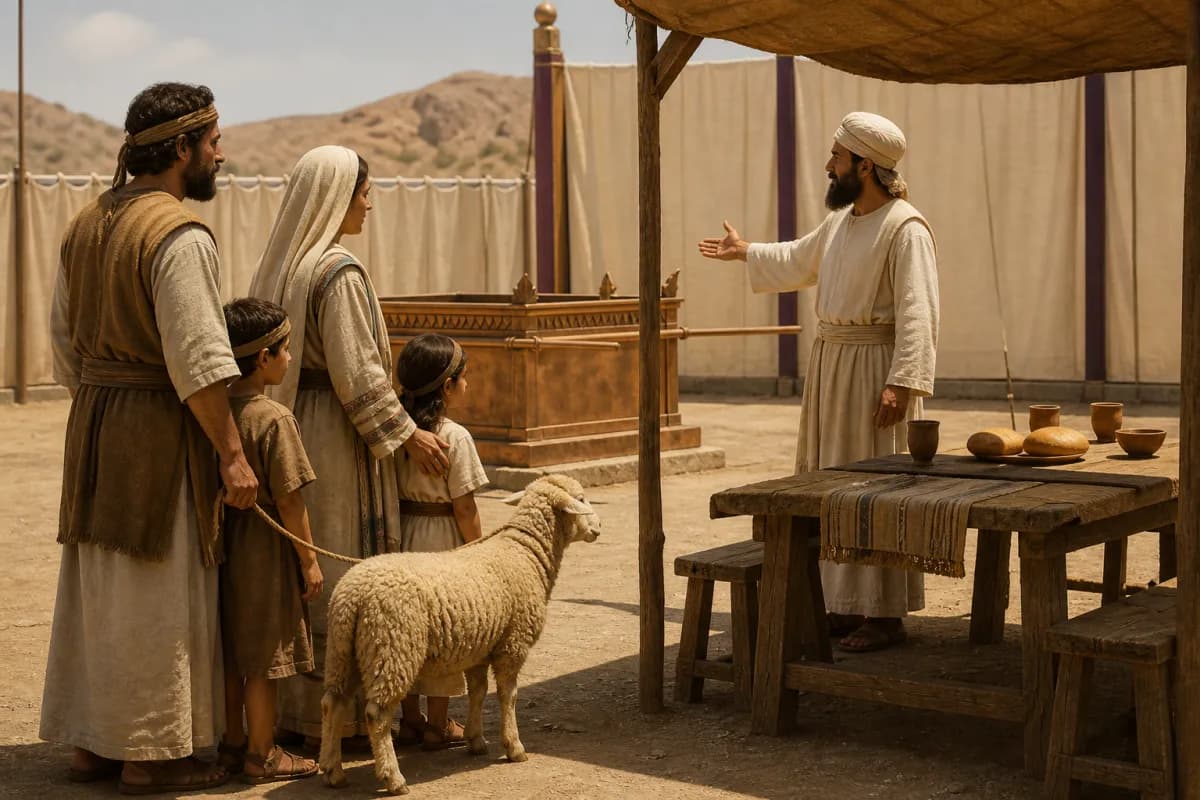
Leviticus 3:1–17 describes the well-being offering, in which a worshiper brings an unblemished animal from the herd, flock, or goats and shares its sacrificial meal within God’s covenant order. The fat belongs to the Lord, the blood is not eaten, and the offering declares that restored fellowship is His gift. This table-shaped sacrifice points forward to the peace Jesus makes through His blood and the reconciled people He gathers around Himself.
- In this study
- 17 verses · 5 movements
Leviticus 3
3:1“‘If his offering is a sacrifice of peace offerings, if he offers it from the herd, whether male or female, he shall offer it without defect before the LORD.
3:2He shall lay his hand on the head of his offering, and kill it at the door of the Tent of Meeting. Aaron’s sons, the priests, shall sprinkle the blood around on the altar.
3:3He shall offer of the sacrifice of peace offerings an offering made by fire to the LORD. The fat that covers the innards, and all the fat that is on the innards,
3:4and the two kidneys, and the fat that is on them, which is by the loins, and the cover on the liver, with the kidneys, he shall take away.
3:5Aaron’s sons shall burn it on the altar on the burnt offering, which is on the wood that is on the fire: it is an offering made by fire, of a pleasant aroma to the LORD.
3:6“‘If his offering for a sacrifice of peace offerings to the LORD is from the flock, either male or female, he shall offer it without defect.
3:7If he offers a lamb for his offering, then he shall offer it before the LORD;
3:8and he shall lay his hand on the head of his offering, and kill it before the Tent of Meeting. Aaron’s sons shall sprinkle its blood around on the altar.
3:9He shall offer from the sacrifice of peace offerings an offering made by fire to the LORD; its fat, the entire tail fat, he shall take away close to the backbone; and the fat that covers the entrails, and all the fat that is on the entrails,
3:10and the two kidneys, and the fat that is on them, which is by the loins, and the cover on the liver, with the kidneys, he shall take away.
3:11The priest shall burn it on the altar: it is the food of the offering made by fire to the LORD.
3:12“‘If his offering is a goat, then he shall offer it before the LORD.
3:13He shall lay his hand on its head, and kill it before the Tent of Meeting; and the sons of Aaron shall sprinkle its blood around on the altar.
3:14He shall offer from it as his offering, an offering made by fire to the LORD; the fat that covers the innards, and all the fat that is on the innards,
3:15and the two kidneys, and the fat that is on them, which is by the loins, and the cover on the liver, with the kidneys, he shall take away.
3:16The priest shall burn them on the altar: it is the food of the offering made by fire, for a pleasant aroma; all the fat is the LORD’s.
3:17“‘It shall be a perpetual statute throughout your generations in all your dwellings, that you shall eat neither fat nor blood.’”
CONTEXTUAL OVERVIEW
Leviticus moves from whole consecration in the burnt offering and grateful tribute in the grain offering to fellowship. The name often translated peace offering is connected to wholeness and well-being. It is not merely the absence of conflict; it is life set right under God’s favor.
The passage’s action is sacrificial, but its horizon is communion. The choicest inner portions are placed on the altar for the Lord, while Leviticus 7 explains that the priests and worshipers receive appointed portions. God’s altar stands at the center of the meal, declaring that shared joy among His people rests on fellowship with Him.
HISTORICAL AND LITERARY CONTEXT
The instructions for cattle, sheep, and goats closely follow one another. Each animal must be without blemish; each worshiper identifies with the offering; each priest handles the blood; and each set of fat portions is burned. The repeated form protects the central truth from becoming a matter of social rank or personal creativity.
The final prohibition of fat and blood is a lasting instruction for Israel. Fat represents the rich portions claimed for the Lord in this offering, and blood represents life given by God. The rule prevents the covenant meal from collapsing into a casual feast where worshipers consume what God has marked as His.
SECTION-BY-SECTION ANALYSIS
- Whole or well-being · Leviticus 3:1The offering’s peace is covenant wholeness: life received in right relation to God and shared rightly with His people.
- Fat for the Lord · Leviticus 3:16The richest portions are reserved for God, teaching that fellowship begins by honoring Him as the true giver and host.
- Blood not eaten · Leviticus 3:2Life belongs to God and is given at the altar; the covenant meal cannot treat atoning life as ordinary food.
CHRIST IN THIS PASSAGE
This offering supplies a real pattern for the gospel without making every prescribed animal detail an allegory. Peace with God is not achieved by human conviviality; it rests on sacrifice and God’s welcome. The New Testament announces that Jesus makes peace through the blood of His cross, bringing alienated people into fellowship with the Father.
Jesus also gathers a reconciled people around a table. The Lord’s Supper does not repeat Levitical sacrifice, for Christ’s offering is once for all. It remembers and proclaims His finished death while forming a community that receives one another as people who have been welcomed by God through the same Savior.
REFLECTION
Many people desire peace mainly as relief from tension. Leviticus asks a deeper question: are we at peace with the God whose gifts we enjoy? The offering begins at the altar, where God’s holiness and mercy establish the terms of communion.
Because Jesus has made peace, Christians can pursue reconciliation with unusual honesty. We need not hide sin to preserve appearances, and we need not make another person carry the cost of our self-protection. Around Christ, meals, hospitality, forgiveness, and shared worship can become signs of the peace He has secured.
Original Hebrew Word Study
Leviticus 3:1
שֶׁלֶם
shelem · H8002
Usually translated: peace, well-being, or fellowship offering
Shelem is tied to wholeness and well-being. This sacrifice celebrates restored fellowship with God, expressed in a shared covenant meal.
Follow the Scripture trail
The Peace Offering: Fellowship at God’s Table in the larger story
The connection: The peace offering portrays fellowship with God as His sacrificial gift, not a human achievement. Jesus fulfills that hope by making peace through His cross and gathering forgiven people into a table-shaped community of worship, reconciliation, and mission.
Respond to the passage
Receive the peace Jesus has made with God, then consider one relationship where His welcome should shape your next step: confession, forgiveness, hospitality, or patient truth-telling.
- Why does the peace offering place sacrifice at the center of fellowship rather than treating peace as a feeling?
- What does reserving fat and blood for the Lord teach Israel about the source and boundaries of shared joy?
- How does Christ’s finished sacrifice shape the way a church practices reconciliation and table fellowship?
Prayer
God of peace, thank You for reconciling me to Yourself through the blood of Jesus. Make me grateful for Your welcome and truthful in my relationships. Form our church into a community where Christ’s peace is seen in worship, hospitality, and forgiveness. Amen.