Passage Study
The Congregation’s Sin Offering: Shared Guilt, Shared Mercy
Leviticus 4:13–4:21
Leviticus 4:13–21 addresses a wrong committed by the whole assembly without awareness. When the sin becomes known, the elders lay hands on a bull, the priest handles its blood as in his own offering, and atonement is made for the people. The passage names corporate responsibility without erasing individual accountability and directs hope to Jesus, whose saving death creates a cleansed people from every nation.
- In this study
- 9 verses · 5 movements
Leviticus 4
4:13“‘If the whole congregation of Israel sins, and the thing is hidden from the eyes of the assembly, and they have done any of the things which the LORD has commanded not to be done, and are guilty;
4:14when the sin in which they have sinned is known, then the assembly shall offer a young bull for a sin offering, and bring it before the Tent of Meeting.
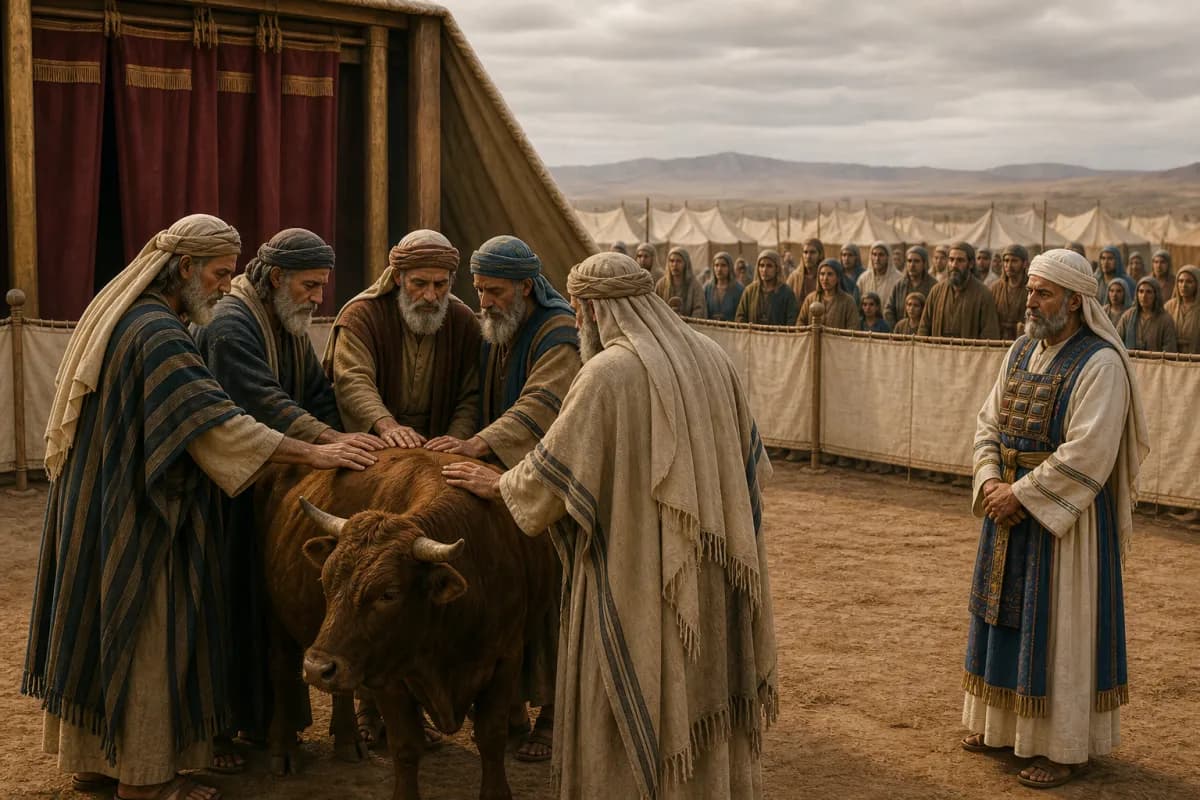
4:15The elders of the congregation shall lay their hands on the head of the bull before the LORD; and the bull shall be killed before the LORD.
4:16The anointed priest shall bring some of the blood of the bull to the Tent of Meeting.
4:17The priest shall dip his finger in the blood and sprinkle it seven times before the LORD, before the veil.
4:18He shall put some of the blood on the horns of the altar which is before the LORD, that is in the Tent of Meeting; and the rest of the blood he shall pour out at the base of the altar of burnt offering, which is at the door of the Tent of Meeting.
4:19All its fat he shall take from it, and burn it on the altar.
4:20He shall do this with the bull; as he did with the bull of the sin offering, so he shall do with this; and the priest shall make atonement for them, and they shall be forgiven.
4:21He shall carry the bull outside the camp, and burn it as he burned the first bull. It is the sin offering for the assembly.
CONTEXTUAL OVERVIEW
After addressing the anointed priest, Leviticus considers the entire assembly. The scenario is striking: the people do not know at first that they have violated one of the Lord’s commands. Discovery does not make the fault disappear. God’s covenant people must reckon honestly with wrong that has become embedded in their common life.
The remedy is also communal. The congregation brings one bull, and its elders lay hands on the animal before the Lord. The representatives do not make the people spectators; they enact the assembly’s identification with the offering and lead the community in receiving the mercy God provides.
HISTORICAL AND LITERARY CONTEXT
Israel is repeatedly described in the Torah as an assembly before the Lord. The term here denotes the gathered covenant community rather than a loose collection of private religious individuals. That setting explains why shared wrongdoing can require a shared response: worship, leadership, teaching, and public practice shape people together.
The ritual closely parallels the offering for the anointed priest. Blood enters the tent, is sprinkled before the veil, and is placed on the incense altar, while the bull is burned outside the camp. The parallel makes a theological claim: the sin of the whole congregation carries sanctuary-wide seriousness, yet God has provided a real way for forgiveness to be declared.
SECTION-BY-SECTION ANALYSIS
- Hidden sin uncovered · Leviticus 4:13Ignorance delays recognition, but it does not turn covenant violation into faithfulness once the truth is known.
- Elders before the Lord · Leviticus 4:15Representative leaders publicly identify the community with the offering, modeling responsibility rather than evasion.
- Atonement and forgiveness · Leviticus 4:20The closing assurance rests on God’s provision: He makes cleansing and pardon available to a guilty people.
CHRIST IN THIS PASSAGE
Leviticus 4 gives categories for corporate sin without allowing us to map ancient ritual directly onto every modern institution. Its firm message is that communities can share real responsibility for patterns they failed to see or confront, and God’s mercy calls them into truth. Jesus bears sin to create a holy people, not merely isolated forgiven individuals.
Christ’s cross is sufficient for the cleansing Levitical sacrifices repeatedly sought. Through His death, He reconciles people to God and to one another, forming one body from former enemies. His saving mission therefore calls churches to confess communal failures, repair what they can, and bear witness to a reconciliation that is deeper than public image management.
REFLECTION
A congregation can be tempted to protect its name by treating only obvious personal sins as serious. Leviticus 4:13–21 makes room for a harder form of repentance: asking whether shared habits, teaching, silence, or leadership have wounded people or resisted God’s commands without being recognized at the time.
That work requires care and truth, not vague collective shame. Jesus gives the church confidence to face what is real because His mercy is not fragile. His people can listen to those harmed, confess clearly, pursue repair where possible, and continue their mission as a community whose hope rests in the Savior rather than its record.
Original Hebrew Word Study
Leviticus 4:13
עֵדָה
edah · H5712
Usually translated: congregation or assembly
Edah is the gathered community. The whole congregation can share responsibility for an unrecognized wrong, showing that covenant faithfulness has a corporate as well as personal dimension.
Follow the Scripture trail
The Congregation’s Sin Offering: Shared Guilt, Shared Mercy in the larger story
The connection: The congregation’s offering shows that God deals mercifully with the sin of a people as well as individuals. Jesus fulfills that saving aim by cleansing a people for God, reconciling former enemies, and sending His church to live in truthful repentance and public witness.
Respond to the passage
Ask Jesus to show you where your church, family, or community may need honest repentance rather than defensiveness. Begin with your own responsibility, listen carefully, and take a concrete step toward truth, repair, and Christ-shaped reconciliation.
- Why does the passage require a response after the congregation learns of a sin it did not initially recognize?
- What role do the elders play, and how does their action differ from simply blaming a few individuals?
- How can confidence in Christ’s cleansing help a church face shared failures with both truth and hope?
Prayer
Lord Jesus, search Your people and expose the sins we have overlooked or defended. Thank You that Your blood cleanses and reconciles. Give us humility to confess, courage to repair what we can, and love that makes Your saving mission visible in our life together. Amen.