Passage Study
The Priests’ Holy Portion: Receiving God’s Gift with Reverence
Leviticus 6:14–6:23
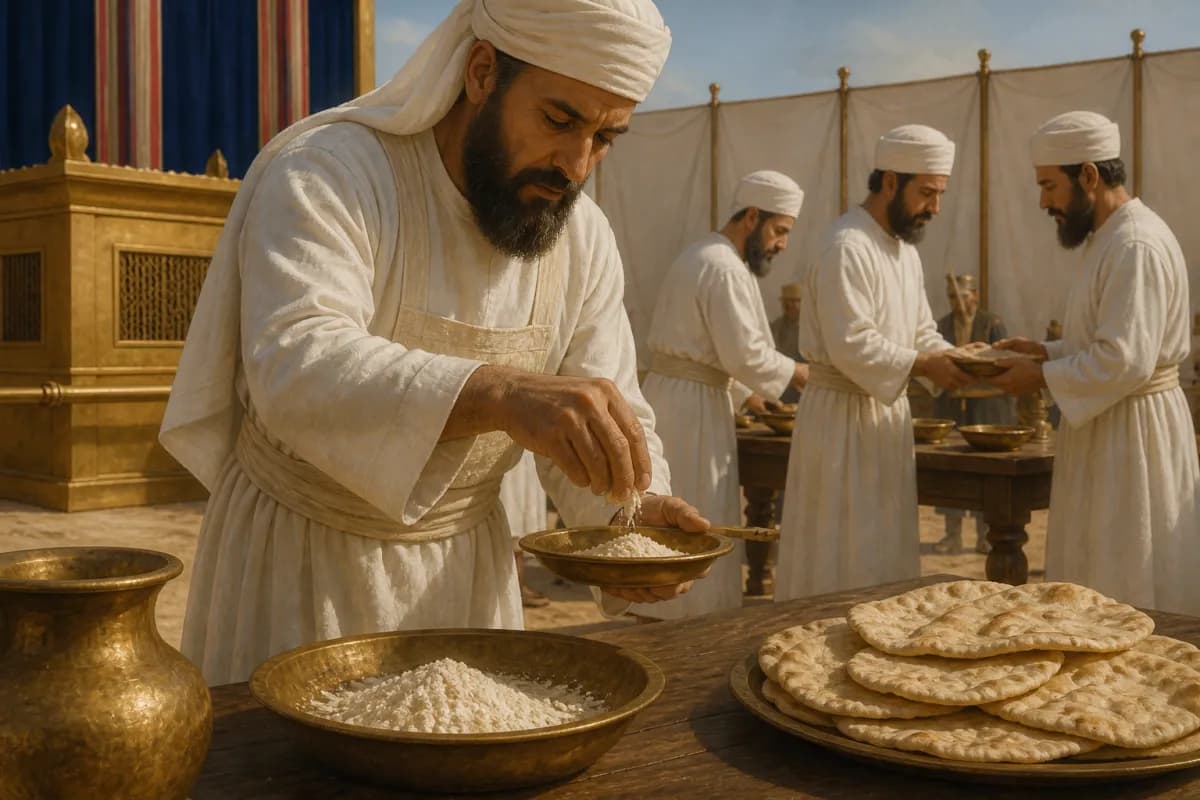
Leviticus 6:14–23 gives priests instructions for the grain offering. They take a memorial portion to the altar, eat the remainder unleavened in a holy place, and offer the high priest’s own grain offering entirely to the Lord. The passage teaches that provision connected to worship is holy rather than private entitlement. Jesus, the faithful Priest, consecrates His people to receive God’s gifts with gratitude and to offer themselves in service to His saving mission.
- In this study
- 10 verses · 5 movements
Leviticus 6
6:14“‘This is the law of the meal offering: the sons of Aaron shall offer it before the LORD, before the altar.
6:15He shall take from there his handful of the fine flour of the meal offering, and of its oil, and all the frankincense which is on the meal offering, and shall burn it on the altar for a pleasant aroma, as its memorial portion, to the LORD.
6:16That which is left of it Aaron and his sons shall eat. It shall be eaten without yeast in a holy place. They shall eat it in the court of the Tent of Meeting.
6:17It shall not be baked with yeast. I have given it as their portion of my offerings made by fire. It is most holy, as are the sin offering and the trespass offering.
6:18Every male among the children of Aaron shall eat of it, as their portion forever throughout your generations, from the offerings of the LORD made by fire. Whoever touches them shall be holy.’”
6:19The LORD spoke to Moses, saying,
6:20“This is the offering of Aaron and of his sons, which they shall offer to the LORD in the day when he is anointed: one tenth of an ephah of fine flour for a meal offering perpetually, half of it in the morning, and half of it in the evening.
6:21It shall be made with oil in a griddle. When it is soaked, you shall bring it in. You shall offer the meal offering in baked pieces for a pleasant aroma to the LORD.
6:22The anointed priest that will be in his place from among his sons shall offer it. By a statute forever, it shall be wholly burned to the LORD.
6:23Every meal offering of a priest shall be wholly burned. It shall not be eaten.”
CONTEXTUAL OVERVIEW
Leviticus 2 introduced the grain offering as a gift from field and kitchen. Leviticus 6 turns toward the priests who receive part of it. Their share is real provision, but the passage carefully prevents it from becoming a claim of ownership. It is eaten in a holy place, without leaven, because it comes from offerings made by fire to the Lord.
The final verses shift to Aaron and his successors. On the day of anointing, the high priest brings a regular grain offering that is entirely burned; he receives no portion from his own offering. The contrast is deliberate: priests are sustained by God’s provision, yet their representative service remains wholly accountable to Him.
HISTORICAL AND LITERARY CONTEXT
These instructions belong to the priestly manual following the worshiper-facing laws of Leviticus 1–5. A memorial portion of fine flour, oil, and frankincense is burned at the altar; the remainder feeds Aaron and his sons. In an agrarian society, that provision matters materially, but the text regulates it as participation in holy service rather than compensation detached from worship.
Leaven is excluded from this priestly portion as it was from the altar portion in Leviticus 2. The passage does not treat leaven as evil in every biblical setting. Here it marks the distinctive character of an offering handled within the sanctuary’s consecrated boundaries. The high priest’s offering is wholly burned, making it unlike the ordinary priestly share.
SECTION-BY-SECTION ANALYSIS
- Memorial portion · Leviticus 6:15The flour, oil, and frankincense burned at the altar keep God at the center of a gift drawn from ordinary labor.
- Holy place · Leviticus 6:16The priests’ meal is bounded by the sanctuary because its source and purpose are inseparable from God’s worship.
- Wholly burned offering · Leviticus 6:23Aaron’s own regular offering is not a benefit package for the priesthood; it is an act of consecration before God.
CHRIST IN THIS PASSAGE
Leviticus does not identify the grain offering with a particular event in Jesus’ life, but it establishes a lasting truth: those who serve before God are sustained by His gift and must not treat holy service as a private possession. Jesus is the faithful High Priest who does not exploit His office. He gives Himself fully to the Father and for the people He comes to save.
Through Jesus, believers are brought near as a holy people and taught to receive every provision as grace. His mission frees ministers and congregations alike from using sacred things for self-advancement. The church bears witness to Him when resources, service, and leadership are handled as gifts entrusted by God for the good of others.
REFLECTION
It is easy to treat a ministry role, a paycheck, a platform, or even spiritual knowledge as personal property. Leviticus corrects that instinct. Gifts that sustain service are good gifts, but they remain holy: they are received before God and directed toward His people’s life with Him.
Jesus welcomes His servants with provision and also purifies their motives. Ask Him to expose any way you have used a responsibility for self-protection or status. Then receive what He gives with thanks and use it with the open-handed generosity of the Priest who gave Himself for us.
Original Hebrew Word Study
Leviticus 6:17
קֹדֶשׁ
qodesh · H6944
Usually translated: holy; belonging to God
Qodesh marks the offering as holy. The priests’ portion is received within God’s boundaries, teaching that even provision for ministry is governed by reverence.
Follow the Scripture trail
The Priests’ Holy Portion: Receiving God’s Gift with Reverence in the larger story
The connection: The grain offering teaches Israel that provision connected to God’s worship is holy and received in stewardship. Jesus fulfills this saving pattern as the faithful High Priest who gives Himself wholly to the Father, sustains His people by grace, and sends them to serve without exploiting what God entrusts.
Respond to the passage
Name one gift, role, or resource you have begun to treat as personal entitlement. Thank Jesus for it, ask how it can serve others, and choose one concrete act of open-handed stewardship this week.
- Why must the priests eat their share in a holy place rather than treating it as ordinary food?
- What does the wholly burned high-priestly offering communicate about representative service?
- How does Jesus’ self-giving priesthood reshape the way you receive and use the gifts that sustain you?
Prayer
Lord Jesus, faithful High Priest, forgive me for treating Your gifts as possessions to guard or use for myself. Teach me to receive Your provision with reverence, to serve without grasping, and to use every entrusted gift for Your people and Your saving mission. Amen.